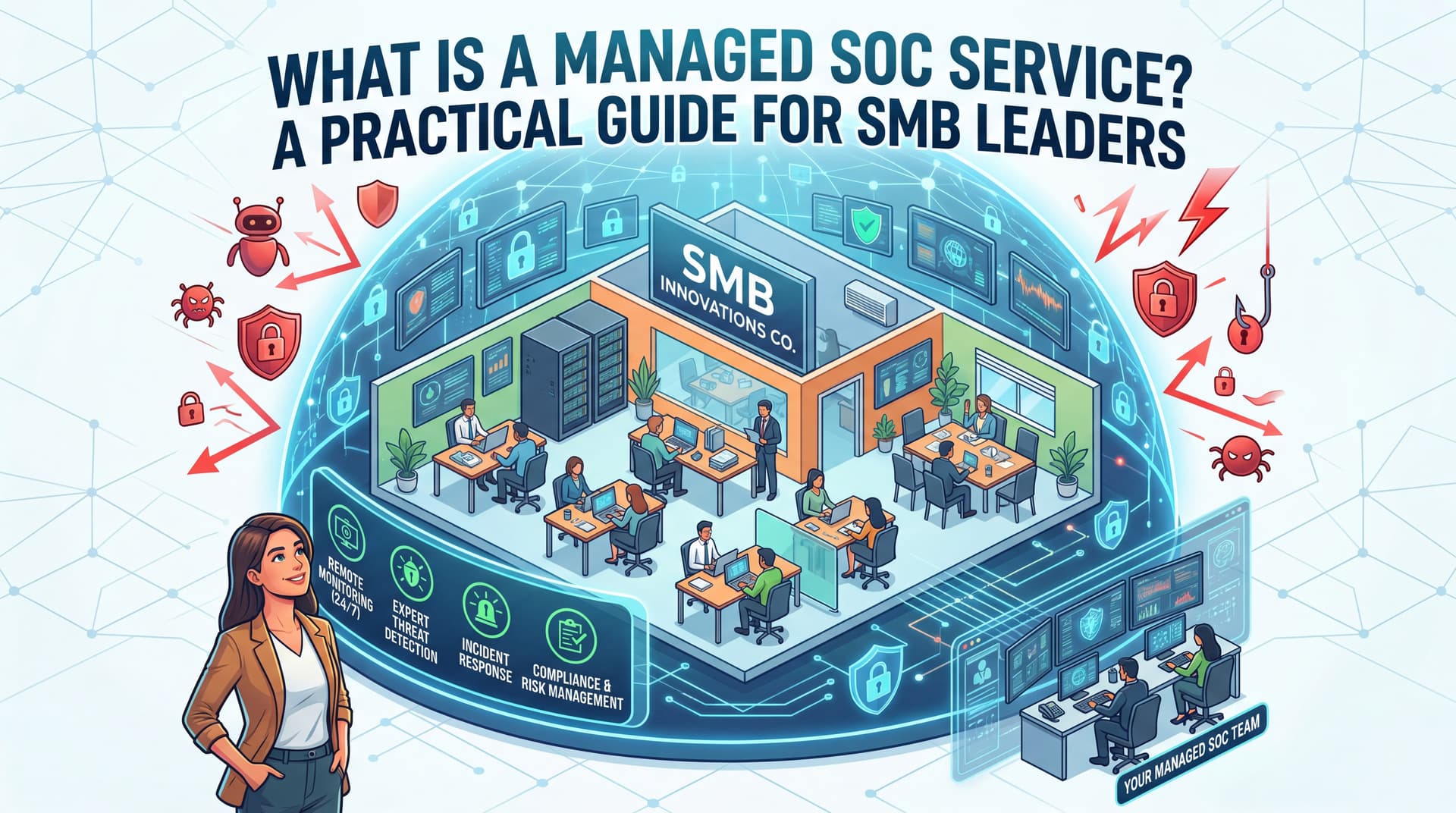
What Is a Managed SOC Service and Why Your SMB Needs One in 2025
TL;DR
A Managed Security Operations Center (SOC) is a team of security professionals monitoring your network 24/7, watching for attacks, and stopping them before they cause damage. For SMBs that cannot afford a full-time in-house security team, a managed SOC provides the same eyes and expertise at a fraction of the cost—typically $1,000–$5,000 per month for small businesses. It is the difference between hoping employees spot an attack and knowing an expert caught it at 2 AM.
The Problem: Why "Set It and Forget It" Security Doesn't Work
Most SMBs have deployed the basics: firewalls, antivirus, backups, maybe MFA. Then they assume they are protected.
But security tools are inert without someone watching them.
Here's a real scenario from a Tampa Bay dental practice in 2024:
- 8 PM: An employee clicks a phishing email and enters her password. Antivirus does not care—she used her real credentials.
- 8:15 PM: The attacker logs in, scans the network, finds the backup server, and disables it.
- 8:45 PM: Ransomware is deployed across 12 workstations.
- Next morning, 8 AM: The practice owner arrives and finds every computer encrypted. The attacker is demanding $80K.
The brutal truth: All of this happened after hours. There was no one watching. The tools existed, but they were generating alerts to an inbox that no one was reading at night.
This is where a Managed SOC comes in.
A SOC is a 24/7 security command center—a team of certified analysts, threat hunters, and incident responders who are constantly watching your network, interpreting alerts, and pulling the trigger on incident response before an attacker gets a foothold.
What Does a Managed SOC Actually Do?
A Managed SOC is not a single tool—it is a combination of technology, people, and processes working in concert:
1. Continuous Monitoring
Your network generates millions of log entries every day: login attempts, file access, network traffic, email delivery, cloud API calls, you name it.
A SOC collects all of those logs into a Security Information and Event Management (SIEM) platform, applies machine learning and rules-based detection, and identifies anomalies:
- Impossible travel: An employee logged in from Tampa at 9 AM and London at 10:15 AM (impossible without a private jet).
- Privilege escalation: Someone just promoted themselves from "user" to "administrator."
- Mass data exfiltration: Gigabytes of files were downloaded to an external cloud account.
- Unusual service activity: A database server is suddenly making outbound connections to the internet (normal databases do not do that).
2. Alert Triage and Response
Not all alerts are equal. Your SOC receives thousands per day—many of them false positives from misconfigured systems or over-sensitive rules.
A SOC analyst manually reviews high-priority alerts in real time:
- Is this alert legitimate?
- What is the actual risk?
- Do we need to respond now or investigate further?
- Should we involve the customer's IT team or escalate to incident response?
If an alert looks suspicious, the SOC does not wait for business hours to tell you. They contact your emergency on-call contact, open an incident ticket, and begin investigation.
3. Threat Hunting
Beyond monitoring alerts, SOC analysts actively hunt for threats that might be hiding in your network. For example:
- An attacker steals credentials but has not used them yet (no alert).
- A backdoor was installed weeks ago but is staying dormant (no suspicious activity).
- An insider is slowly exfiltrating data in small increments (under the radar).
SOC analysts run queries like: "Show me all accounts that have never logged in but were created in the last 30 days" or "List all scheduled tasks that were created outside normal IT change windows." These hunts are proactive—they are looking for evidence of a breach that has not triggered an alert yet.
4. Incident Response
If the SOC detects an active attack or breach:
- Immediately isolate the compromised device or user account to prevent lateral movement.
- Preserve forensic evidence for your incident report and any regulatory requirements.
- Notify you and any relevant authorities (if required by law, e.g., HIPAA, PCI-DSS, or state breach notification laws).
- Initiate recovery: restore from clean backups, reset credentials, patch vulnerabilities.
- Post-incident analysis: provide a written report explaining what happened, how long the attacker was in your network, what was accessed, and recommendations to prevent it again.
For ransomware specifically, a SOC can often kill the process and recover files before the entire network is encrypted—saving you hundreds of thousands of dollars.
5. Compliance and Reporting
If your industry requires security audits or compliance certifications (HIPAA, PCI-DSS, NIST, etc.), a SOC provides:
- Continuous compliance monitoring to ensure you are meeting regulatory requirements.
- Audit logs and reports documenting all security events and responses.
- Evidence of incident preparedness (e.g., "We detected and responded to threats within X minutes").
This documentation is gold in a regulatory exam or after a breach.
How a Managed SOC Differs from Your IT Team or MSP
Your internal IT team is generalist—they manage servers, users, backups, and a hundred other things. Security monitoring is not their full-time job, and they often lack the specialized training and tools.
An IT MSP handles day-to-day managed services—patch management, helpdesk, backups. Many MSPs also offer security tools, but not all of them operate a true SOC.
A Managed SOC is a specialist in threat detection and response. The entire team is trained on cybersecurity, threat hunting, and incident response. They use industry-standard SIEM platforms (like Splunk, Azure Sentinel, or QRadar) and follow frameworks like NIST and CIS. Their job is only security—24/7, no distractions.
Real-World Example: How a SOC Stops an Attack
The Scenario:
A law firm employee receives a phishing email pretending to be from their bar association. She clicks it, enters her password (or falls for credential theft), and does not realize anything is wrong.
Without a SOC:
- The attacker logs in at 2 AM on a Saturday.
- They explore the network, looking for client files (law firms are gold mines for data theft).
- They begin downloading confidential case files.
- By Monday morning, the attacker has exfiltrated gigabytes of data and threatened to release it unless the firm pays a ransom.
- No one knew anything was wrong until the extortion demand arrived.
With a Managed SOC:
- 2:05 AM: The SOC platform detects a login from a new device in a new location, outside normal business hours. Red flag.
- 2:06 AM: The SOC analyst on duty sees the alert, investigates the login, and confirms it is suspicious (not a VPN, not a scheduled job, just a random credential attempt).
- 2:07 AM: The analyst immediately disables the user account, isolating the attacker.
- 2:15 AM: The SOC escalates the incident to the on-call incident response team, who preserves forensic evidence.
- Monday morning: The law firm is notified that an attack was detected and stopped before any files were accessed.
Result: No ransom, no data loss, minimal disruption.
The difference: a real human watching at 2 AM instead of waiting until Monday.
What Does a Managed SOC Cost?
Pricing varies based on company size, network complexity, and service level:
| Organization Size | SOC Service Cost | What's Included |
|---|---|---|
| Small Business (10–50 employees) | $1,000–$5,000/month | 24/7 monitoring, alert triage, incident response, basic threat hunting, monthly reporting |
| Mid-Market (50–250 employees) | $5,000–$15,000/month | Enhanced threat hunting, dedicated analyst hours, custom detection rules, compliance support |
| Enterprise (250+ employees) | $15,000–$50,000+/month | Advanced threat hunting, tabletop exercises, custom integration, senior analyst time |
What you are really comparing:
- Cost of a full-time security analyst in-house: $80K–$150K/year salary + benefits + tools + training = ~$100K–$200K/year (or $8K–$17K/month).
- Managed SOC: $2K–$5K/month for SMBs, which includes analyst time across multiple customers, so you are sharing expertise.
For an SMB with a $50K IT budget, an in-house security team is impossible. A managed SOC is affordable and delivers expert-level monitoring.
How to Choose a Managed SOC Provider
Not all managed SOC services are equal. Here's what to evaluate:
1. Analyst Experience
Ask:
- "What certifications do your analysts have?" (Look for GCIH, GIAC, CISSP, or equivalent.)
- "How much hands-on incident response experience do they have?"
Avoid vendors who are mostly automated; you want people interpreting alerts, not just a tool.
2. Response Time
Ask:
- "What's your average time to detect and alert on a suspicious login?" (Should be under 5 minutes.)
- "If I am breached at 11 PM, when will I hear about it?" (Should be immediate, not Monday morning.)
3. Transparency
Ask:
- "Can I see the alerts my SOC is detecting?"
- "Will you provide monthly reports showing what you have caught?"
- "Who do I contact if I have questions about an incident?"
Avoid vendors who treat their SOC as a black box.
4. Tooling
Ask:
- "What SIEM and detection tools do you use?"
- "Can you integrate with my existing tools?"
- "Do you hunt for threats proactively, or just monitor alerts?"
Better vendors use industry-standard tools and have custom detection rules tuned to your industry (e.g., healthcare, finance, law).
5. Incident Response Capability
Ask:
- "If you detect a ransomware attack at 3 AM, can your team immediately isolate devices and stop the encryption?"
- "Or do I need a separate incident response firm?"
Ideal: the SOC can respond directly, with a separate IR firm on retainer for complex cases.
The SOC + MSP Partnership Model (Most Common for SMBs)
Many Tampa Bay SMBs use a hybrid model:
- MSP handles: Day-to-day IT (patch management, helpdesk, backups, hardware).
- Managed SOC handles: 24/7 security monitoring, threat detection, incident response.
The two teams work together. The MSP's SIEM feeds into the SOC's platform. When the SOC detects an attack, they alert the MSP, who coordinates remediation with the business.
This model is ideal because:
- The MSP knows your environment (hardware, software, business processes).
- The SOC is a specialist in security threats.
- You get comprehensive coverage without redundancy.
Building Your SOC Readiness: A 90-Day Checklist
Even if you do not hire a full SOC today, you can prepare your business to be "SOC-ready":
30 Days:
- Ensure all systems are logging events (servers, firewalls, cloud services, endpoints).
- Verify backups are working and isolated from the network (attackers target backups first).
- Document your critical data: what would we lose if encrypted? Where does it live?
60 Days:
- Conduct a phishing simulation to see how many employees fall for attacks (SOC monitors the aftermath, but prevention starts with you).
- Review your incident response plan (or create one). Does it mention SOC, backup recovery, customer notification?
90 Days:
- Contact 2–3 managed SOC vendors for proposals.
- Request a "trial period" or free assessment where they audit your logs for a week.
- Decision: in-house SOC (unlikely for SMBs), managed SOC, or enhanced MSP with SIEM monitoring.
DIY vs. MSP vs. Managed SOC: Decision Matrix
| Need | DIY | MSP Only | MSP + Managed SOC |
|---|---|---|---|
| Threat detection after hours | ❌ No one monitoring | ⚠️ Basic alerts only | ✅ Expert analyst 24/7 |
| Incident response in 30 minutes | ❌ Wait until morning | ⚠️ Try to help | ✅ Specialized response team |
| Compliance audits & evidence | ❌ Manual, incomplete | ⚠️ Partial logging | ✅ Comprehensive audit trail |
| Cost for small business | $100K+/year | $2K–$3K/month | $3K–$5K/month |
| Scalability | ❌ Limited | ✅ Scales with MSP | ✅ Scales with business |
| Risk if a breach happens | ❌ Catastrophic | ⚠️ High downtime | ✅ Minimal downtime |
FAQs
Q: Will a managed SOC tell me about every alert, or just the serious ones?
A: Good SOCs filter out noise and alert you on meaningful events. You will get monthly reports on all activity, but real-time escalations are reserved for actual threats or suspicious behavior. You should not get paged at midnight for a misconfigured device; you should get paged if your database is being accessed from a new IP.
Q: What if the SOC misses an attack?
A: No SOC is 100% perfect, but most have SLAs (Service Level Agreements) promising uptime, response times, and sometimes liability insurance if they fail to detect a specific class of threats. Always ask about their SLA and what happens if they miss something.
Q: Can a managed SOC work with my existing firewall and antivirus?
A: Yes. In fact, a good SOC integrates with your existing tools. They pull logs from your firewall, antivirus, cloud services, and endpoints into their SIEM. They do not replace your tools; they analyze the data your tools generate.
Q: Do I need a managed SOC if I have a good IT team?
A: Not necessarily—but a good IT team managing security 24/7 is a SOC (just in-house). The tradeoff is cost. If your IT team is stretched thin (which most SMB IT teams are), a managed SOC lets them focus on keeping systems running while specialists handle security.
Q: What happens during an incident? Who's in charge?
A: The SOC discovers and escalates. Your IT team (or MSP) coordinates remediation with business stakeholders (CEO, finance, HR). In a serious breach, a separate incident response firm may be engaged. But the SOC is the "first responder."
Q: How long does it take to get a managed SOC up and running?
A: Usually 2–4 weeks. The SOC provider will need to integrate with your systems, configure detection rules, and conduct a baseline analysis of your logs so they can spot anomalies (things that are unusual for your environment, specifically). A week of setup, a week of tuning, then 24/7 monitoring.
Q: Do I need a SOC if I am in a regulated industry like healthcare or finance?
A: Yes. HIPAA, PCI-DSS, and other frameworks require evidence of continuous security monitoring. A managed SOC provides logs, incident documentation, and compliance reporting that proves you are compliant.
Next Steps
If you do not have continuous security monitoring today, the risk is too high. Start with a free security audit to see what threats are currently hiding in your logs.
Free Security Audit: What's in Your Network Right Now
We will analyze your logs for the past 30 days, identify suspicious activity you might have missed, and show you exactly why 24/7 monitoring matters.