Operationalizing Security Assessments: A Practical Remediation Framework for SMBs
A comprehensive security assessment often leaves mid-market organizations with an overwhelming list of vulnerabilities, configuration gaps, and compliance deficiencies. Without a structured prioritization model, leadership risks falling into two common traps: tackling issues ad-hoc based on ease rather than risk, or engaging in "checklist theater"—superficial compliance that satisfies immediate questions but leaves underlying operational risks unaddressed.
To extract genuine business value from security consulting, managing partners, compliance officers, and IT directors must convert raw assessment findings into a clear, phased execution model.
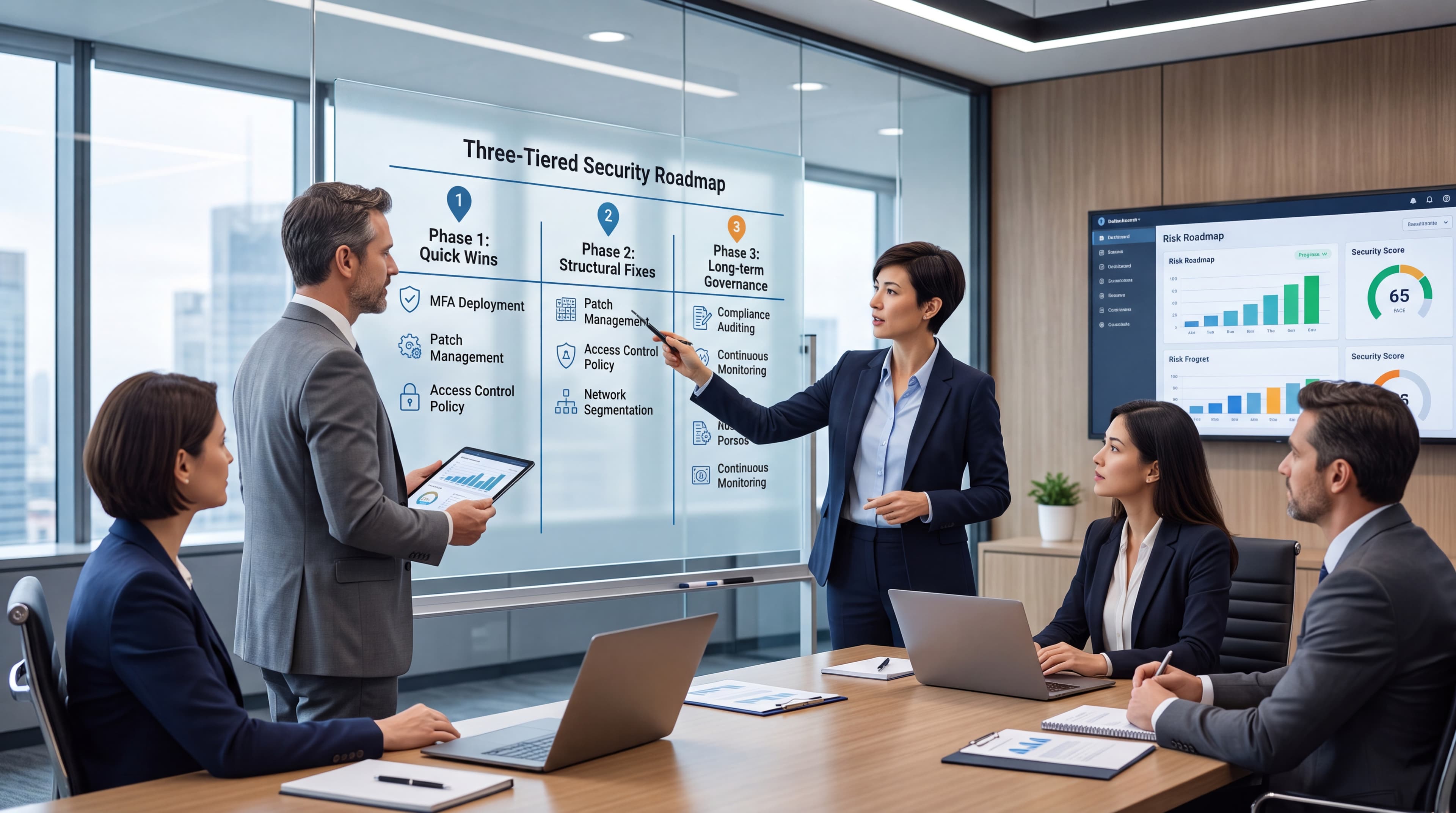
Tier 1: Immediate Quick Wins and Low-Hanging Risk Reduction
Quick wins represent security enhancements that deliver immediate risk reduction with minimal operational friction or capital investment. These items should be addressed within the first 30 days following an assessment.
- Enforcing Universal Multi-Factor Authentication (MFA): Extending MFA across all remote access points, cloud services, and privileged accounts.
- Closing Unnecessary External Exposure: Disabling unused exposed services, legacy protocols, and open ports identified during external scans.
- Credential and Privilege Hygiene: Deprovisioning stale accounts and reducing unnecessary local administrator privileges across endpoints.
By accelerating these low-complexity items, SMBs drastically shrink their threat surface while building momentum for larger structural initiatives.
Tier 2: Structural Fixes and Architectural Modernization
Structural fixes address systemic vulnerabilities that require cross-departmental coordination, budgetary planning, or architecture changes. Typically executed over a 3- to 6-month timeline, these measures prevent whole classes of security incidents.
- Network Segmentation & Zero Trust Controls: Isolating critical asset zones, operational technology, and guest networks to contain potential lateral movement.
- Standardized Patch & Vulnerability Management: Establishing automated, policy-driven patching cycles for operating systems and third-party software.
- Identity and Access Management (IAM) Governance: Implementing centralized role-based access control (RBAC) and just-in-time privilege elevation workflows.
Tier 3: Sustained Governance and vCISO Oversight
Long-term security posture depends on governance mechanisms that ensure controls remain effective over time. Strategic advisory services, such as virtual CISO (vCISO) engagements, bridge the gap between tactical IT execution and board-level risk management.
- Policy Realignment: Updating incident response plans, vendor risk management frameworks, and business continuity strategies to reflect current operational realities.
- Continuous Control Monitoring: Transitioning from annual point-in-time reviews to real-time risk visibility and automated reporting.
- Executive & Board Alignment: Translating technical metrics into meaningful business risk indicators for executive decision-makers.
Moving Beyond Checklist Theater: Gathering Auditor-Ready Evidence
Compliance checks often result in "checklist theater"—creating policies on paper that do not reflect operational reality. True security posture relies on verifiable, automated evidence collection.
To prepare for formal audits and regulatory reviews without duplicating effort:
- Automate Control Evidence Gathering: Utilize centralized log management and compliance automation platforms to continuously collect configuration snapshots and access logs.
- Maintain Traceability: Map every security control directly to recognized frameworks (such as NIST CSF, ISO 27001, or CIS Controls) and internal risk register items.
- Validate Operational Execution: Conduct periodic dry-run audit sampling to verify that documented policies match everyday administrative practices.
Building Your Tailored Security Roadmap
Transforming assessment findings into a resilient security posture requires tailored strategic guidance, expert prioritization, and consistent executive alignment.
Ready to turn security assessment findings into an actionable strategic advantage? Request a scoped security assessment from Bitscaled today to evaluate your current posture and build an auditor-ready remediation roadmap.