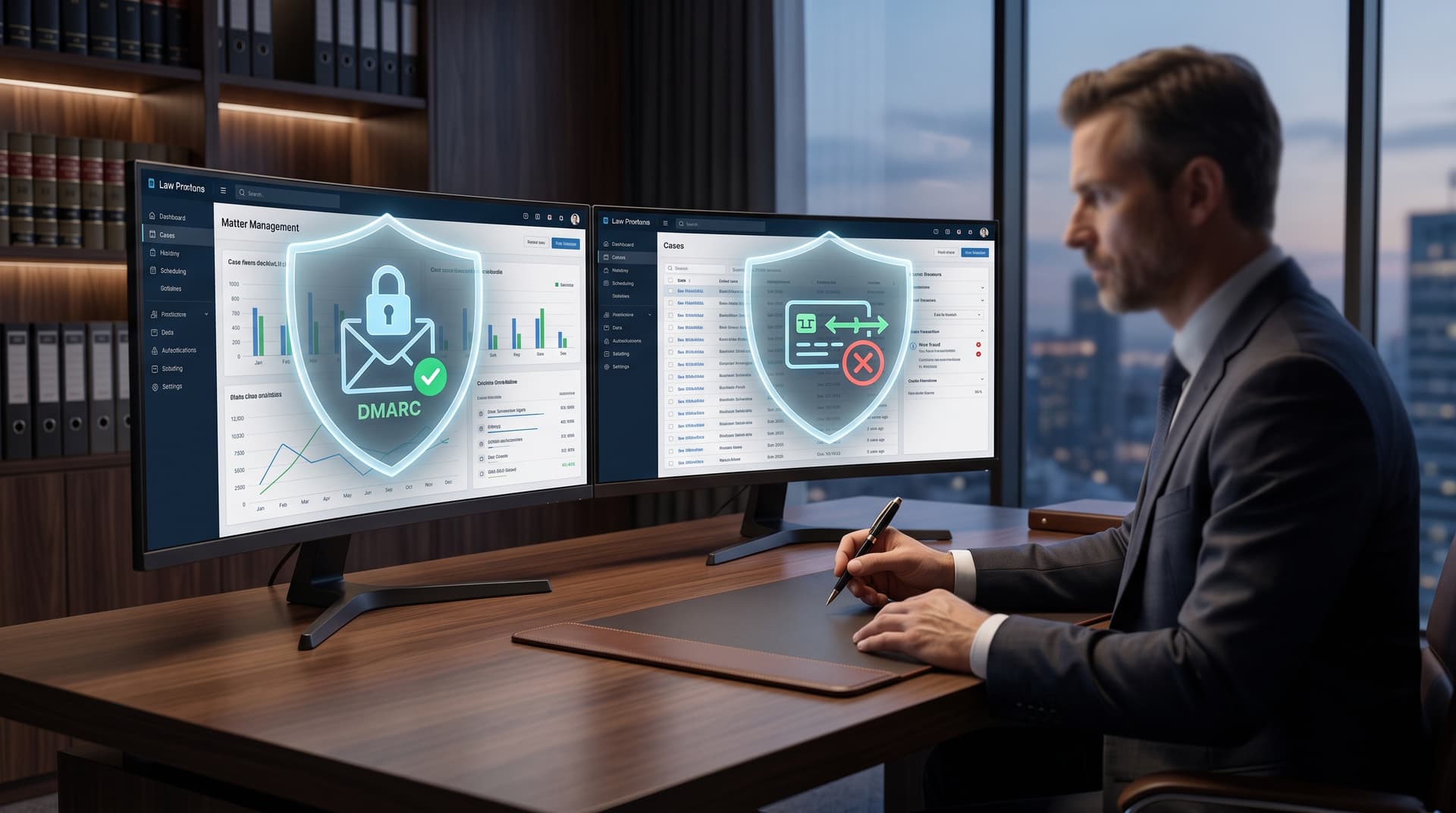
Defending Professional Standing: Operationalizing Matter Isolation and Domain Authentication in Legal Practice
For modern legal practices, confidentiality is not merely an operational preference—it is the foundational currency of client trust and a strict professional duty. Under ethics guidelines such as ABA Model Rule 1.6, law firms are mandated to take reasonable, proactive measures to prevent the unauthorized disclosure of, or unauthorized access to, sensitive client information. Yet, modern law firms operate in an environment where malicious actors actively target their digital perimeter, recognizing that legal organizations handle high-value commercial transactions, confidential intellectual property, escrow funds, and highly sensitive personal data.
When security posture fails in a legal enterprise, the consequences extend far beyond technical downtime. A single compromised account or spoofed domain can trigger malpractice claims, severe regulatory penalties, ethical bar inquiries, and irreversible damage to firm reputation. Managing partners and law firm administrators must move beyond baseline antivirus software and legacy firewalls. Establishing a defense-in-depth posture requires building absolute email trust through strict domain authentication, enforcing granular matter data isolation, eliminating risky file-sharing behaviors, and standardizing verified wire-transfer workflows across every practice group.
1. Neutralizing Domain Impersonation with DMARC, SPF, and DKIM
Email remains the primary vector for cyberattacks directed at law firms. Business Email Compromise (BEC) and domain spoofing exploit a structural vulnerability in historical email protocols: by default, email servers do not verify whether the sender listed in the "From" header matches the actual server delivering the message. Attackers leverage this flaw to send convincing messages that appear to originate directly from a managing partner, senior associate, or escrow officer.
Without robust authentication protocols, an adversary can easily register a lookalike domain or directly spoof your primary firm domain to send fake wire transfer instructions to clients, escrow agents, or opposing counsel. The recipient, trusting the visual identity and domain authority of the firm, executes the wire transfer into an attacker-controlled account.
To prevent domain spoofing and preserve domain authority, law firms must deploy three complementary email security frameworks:
- Sender Policy Framework (SPF): Defines which specific IP addresses and mail servers are authorized to send outbound messages on behalf of your firm's domain.
- DomainKeys Identified Mail (DKIM): Attaches an immutable cryptographic signature to outgoing messages. The receiving mail server uses your public key, published in your DNS records, to verify that the email body and attachments were not altered in transit.
- Domain-based Message Authentication, Reporting, and Conformance (DMARC): Ties SPF and DKIM together by establishing an explicit enforcement policy. DMARC instructs receiving mail servers how to handle messages that fail SPF or DKIM checks.
Simply publishing a DMARC record is insufficient; firm leadership must ensure the policy is transitioned to strict enforcement (p=reject). Under a p=reject policy, receiving mail servers automatically block spoofed messages before they ever reach the recipient's inbox.
Firm administrators can verify their current outbound email risk by utilizing the Bitscaled Email Spoof Test, which evaluates domain authentication records and highlights vulnerabilities that expose your practice to impersonation.
2. Granular Matter Data Isolation: Eliminating Broad Internal Access
Historically, many law firms maintained open internal network shares where all partners, associates, and administrative support staff could access every file, active client matter, and historical archive. While this broad model facilitated internal collaboration, it creates severe malpractice and compliance risks in contemporary legal environments.
When a single attorney or administrative staff member falls victim to a credential harvesting attack, an unsegmented environment allows attackers to move laterally across the entire firm network. This broad access turns a localized account breach into a firm-wide data exposure event involving thousands of unassociated client matters.
Furthermore, broad internal access undermines ethical walls (also known as ethical screens or conflict blocks). When handling matters with strict conflict-of-interest mandates, high-profile corporate litigation, or sensitive M&A transactions, firms are legally obligated to restrict document access strictly to authorized project personnel.
To achieve true matter data isolation, firms must implement structured zero-trust access controls through specialized Law Firm IT Solutions:
- Role-Based and Need-to-Know Access Controls (RBAC): Group permissions must align directly with active matter staffing. Personnel should only be granted permission to view, edit, or search files associated with matters to which they are officially assigned.
- Automated Ethical Walls: Integrated legal practice management tools and document management systems (DMS) should automatically enforce conflict screens, restricting access for flagged personnel across document repositories, email archives, and chat channels.
- Conditional Access and Information Barriers: Enforce dynamic policies that evaluate user context (such as verified device identity, geographic location, and network posture) before granting entry to sensitive matter repositories.
- DLP and Sensitivity Labeling: Implement automated Data Loss Prevention (DLP) rules that tag files based on sensitivity, blocking external forwarding, printing, or USB extraction of client work product.
3. Secure File Sharing and Closing Wire-Fraud Vectors
Email attachments represent another major security vulnerability in traditional legal workflows. Transmitting sensitive contracts, financial disclosures, personally identifiable information (PII), or wire transfer details via standard unencrypted email exposes data to interception, vendor email compromise, and unauthorized forwarding.
Wire fraud in particular represents an acute liability for real estate, corporate, and estate planning practices. In a common attack scenario, malicious actors monitor a compromised email thread between a law firm and a client leading up to a property closing or escrow deposit. Right before the payment is due, the attacker inserts themselves into the thread—using a lookalike domain or compromised account—and issues updated wire instructions directing funds to a fraudulent offshore account.
To prevent wire fraud and eliminate risky attachment practices, legal practices must establish standardized transactional workflows:
- Encrypted Client Portals: Eliminate attachment-based document distribution. Require clients and third parties to access sensitive documents, settlement agreements, and closing binders through secure, authenticated client portals protected by multi-factor authentication (MFA).
- Out-of-Band Wire Verification: Implement a non-negotiable firm policy that wire instructions are never accepted, changed, or confirmed via email alone. Require verbal confirmation over a known, independently verified phone number prior to authorizing any outgoing or incoming financial transfer.
- Immutable Transaction Logs: Utilize document platforms that capture detailed audit trails for every file access, download, and signature attempt, providing clear evidence of chain-of-custody in legal proceedings.
Takeaway: Preventing wire fraud requires a dual strategy: technical domain authentication (DMARC
p=reject) to block email impersonation, paired with mandatory out-of-band verbal verification for all transactional funds movement.
4. Operationalizing Legal Risk Mitigation: Controls Evaluation
The following matrix outlines key technical and procedural controls required to protect firm reputation, minimize malpractice exposure, and ensure compliance with client security mandates:
| Security Domain | Vulnerable Practice | Recommended Enterprise Standard | Risk Reduction Benefit |
|---|---|---|---|
| Email Identity | SPF/DKIM missing or DMARC set to p=none |
DMARC enforced at p=reject with daily aggregate reporting |
Prevents attackers from spoofing firm domain to issue fake instructions |
| Matter Access | Universal staff access to open file shares | Role-based matter isolation with strict ethical wall enforcement | Limits lateral movement in breaches and preserves client confidentiality |
| File Sharing | Sending client documents as unencrypted email attachments | Encrypted portal links with multi-factor authentication and dynamic expiration | Protects privileged communications from interception and unauthorized forwarding |
| Wire Processing | Relying on incoming email requests or PDF wire details | Out-of-band phone confirmation + dual-partner authorization workflows | Eliminates interception-based real estate and settlement wire fraud |
| Device Access | Unmanaged personal devices accessing practice software | Managed endpoint security with device health verification | Ensures compromised home devices cannot expose matter databases |
5. Hardening Legal Operations with Bitscaled
Preserving client trust requires continuous alignment between technical controls and administrative policy. Modern law firms cannot afford to view IT infrastructure as a simple background utility; it is the core mechanism through which firm reputation, client confidentiality, and financial transactions are safeguarded.
By auditing domain health, enforcing granular matter data isolation, deploying advanced threat protection, and training staff on secure transactional workflows, legal leaders significantly reduce their malpractice liability and operational risk profile.
Bitscaled provides specialized managed IT security, cloud governance, and cybersecurity consulting designed tailored for legal practices. To evaluate your firm's current security posture and harden your environment against email impersonation and data exposure:
- Assess your external domain integrity with the Bitscaled Email Spoof Test.
- Explore tailored infrastructure strategies on our Law Firms Industry Page.
- Review comprehensive threat prevention frameworks via Bitscaled Cybersecurity Services.
- Schedule a confidential security review by visiting Bitscaled Contact.
Harden your email authentication and matter access controls with Bitscaled to ensure your practice maintains the highest standards of client trust and operational resilience.