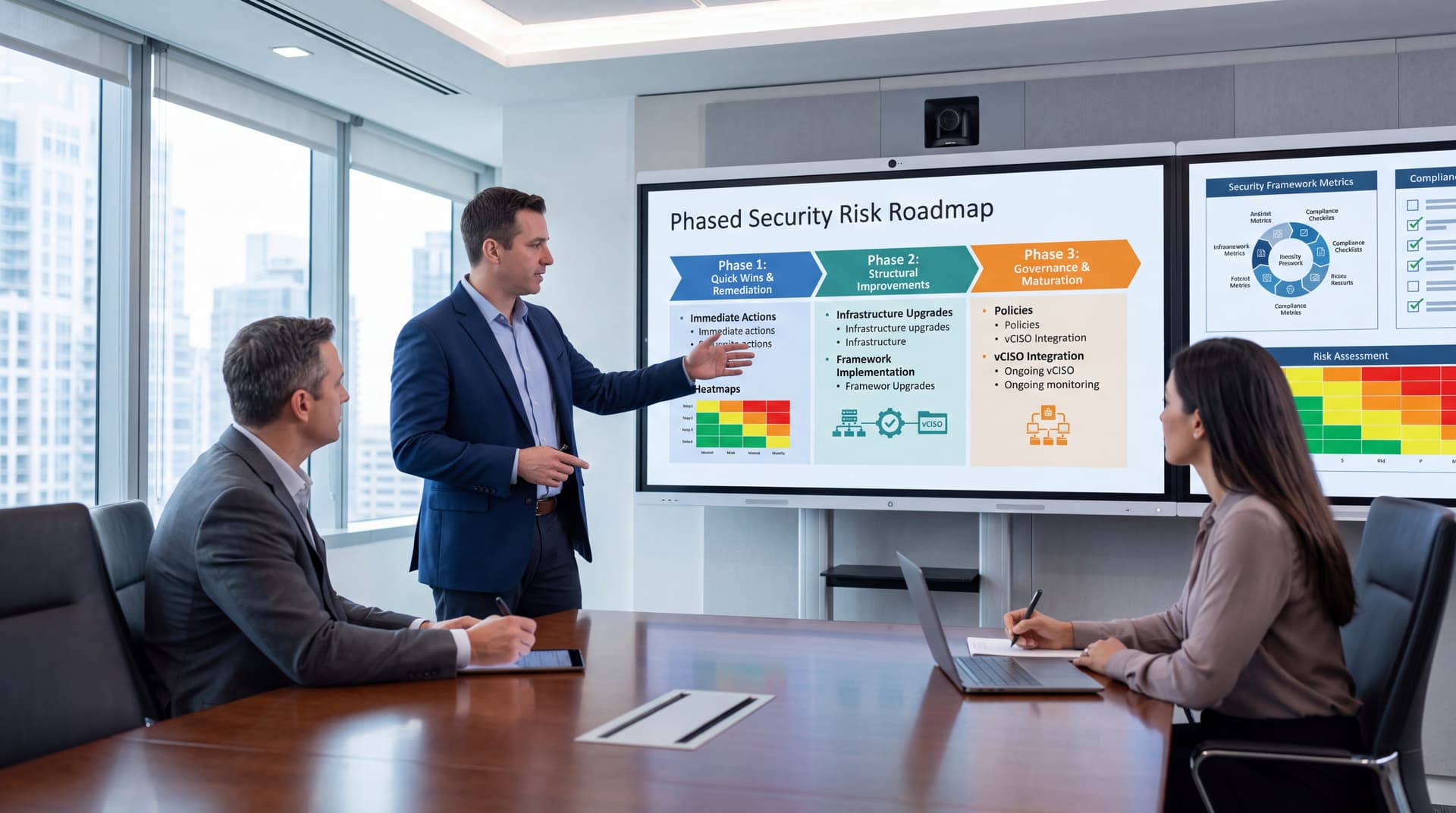
Security assessments often leave growing organizations with an overwhelming list of vulnerabilities, configuration gaps, and policy deficiencies. For SMB leadership—compliance officers, managing partners, and IT directors—the core challenge is not identifying what is broken, but determining what to fix first without stalling daily operations or wasting resources on superficial compliance.
To build a defensible security posture, organizations must move beyond checklist theater and implement a phased risk roadmap supported by expert security consulting.
1. Triage Findings: The Three-Tier Prioritization Model
A comprehensive security assessment categorizes findings by risk impact, operational exposure, and remediation effort. SMBs can translate raw findings into three actionable execution tiers:
Tier 1: Quick Wins (Immediate Impact, Low Complexity)
- Examples: Enforcing multi-factor authentication (MFA) on external portals, closing unneeded open firewall ports, disabling legacy authentication protocols.
- Objective: Instantly reduce exposure to high-volume automated threats while demonstrating swift progress to executive stakeholders.
Tier 2: Structural Fixes (Medium-to-Long Term Engineering)
- Examples: Implementing Zero Trust Network Access (ZTNA), deploying Endpoint Detection and Response (EDR), configuring centralized log aggregation and monitoring.
- Objective: Address systemic vulnerabilities by embedding resilience into architecture and system defaults.
Tier 3: Governance & Policy Alignment (Sustained Program Maturity)
- Examples: Formalizing incident response playbooks, establishing vendor risk management standards, conducting regular risk register updates.
- Objective: Ensure organizational compliance and long-term risk management overseen by internal leadership or a virtual CISO (vCISO).
2. Evidence Collection: Eliminating Checklist Theater
Audit readiness is frequently conflated with compliance theater—collecting static screenshots once a year that fail to prove ongoing control effectiveness. Modern auditors and cyber insurance underwriters demand verifiable, continuous evidence.
- Automated Telemetry: Rely on automated compliance tracking rather than manual point-in-time checks. Continuous telemetry provides real-time proof of encryption, patching levels, and access controls.
- Configuration as Proof: Maintain infrastructure-as-code repository histories and change-management logs to demonstrate controlled deployment practices.
- Process Artifacts: Document actual tabletop exercise outcomes, incident response post-mortems, and quarterly risk reviews rather than relying purely on policy templates.
3. Aligning Remediation with Operational Strategy
A security risk roadmap must reflect business realities. Security investments should align with operational growth, contract obligations, and regulatory frameworks (such as SOC 2, ISO 27001, or CMMC). Engaging a vCISO or strategic security consulting partner ensures that technical remediation projects are prioritized based on actual business risk rather than arbitrary vendor severity scores.
Take the Next Step Toward Defensible Security
Transforming complex assessment data into a clear execution plan requires experience and business context.
Ready to turn assessment findings into an actionable risk roadmap? Request a scoped security assessment from Bitscaled today to build a tailored security posture.