Operationalizing Enterprise AI: A Blueprint for Governed Workflow Adoption
As enterprise leaders and Managed Service Providers (MSPs) rush to harness artificial intelligence, the biggest operational hurdle is rarely the capability of the underlying LLMs—it is governing how those models interact with corporate data and production workflows.
Without explicit guardrails, ad-hoc AI scripts and unvetted third-party plugins quickly turn into shadow IT risks. To capture AI velocity safely, organizations need a structured framework for AI development and custom workflow integration that enforces data boundaries, secure connectivity, immutable auditing, and human oversight.
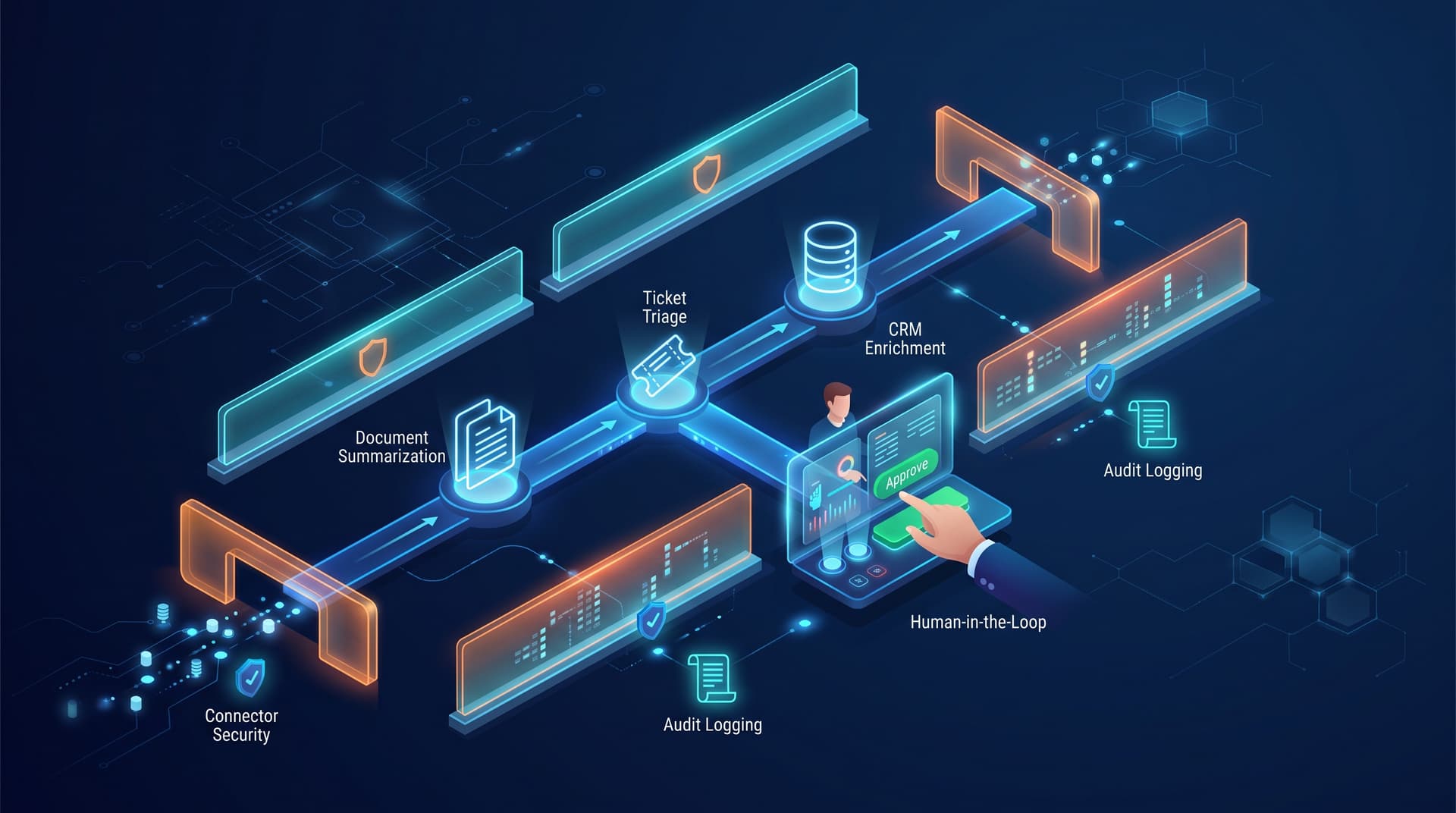
The Four Pillars of Governed AI Integration
Deploying AI workflows into production environments requires moving past basic API calls toward an enterprise-grade architecture.
1. Granular Data Boundaries
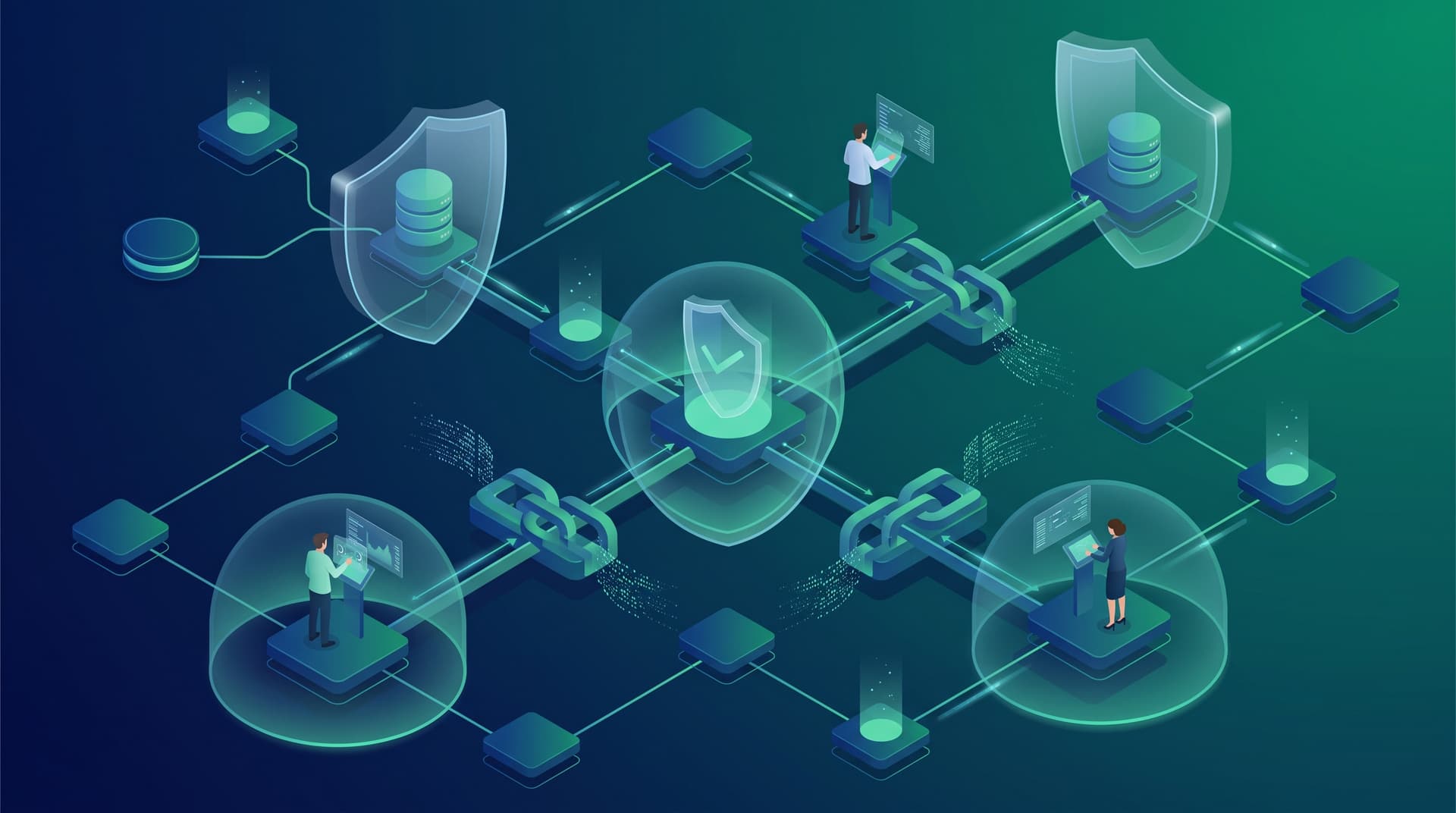
- Tenant Isolation: Ensure client and departmental data streams remain logically separated so model prompts never mix organizational contexts.
- Zero Data Retention Agreements: Route sensitive prompts strictly through enterprise API endpoints that guarantee data is not retained or used for foundation model training.
- PII Redaction: Implement pre-execution sanitization layers that automatically mask personally identifiable information (PII), credentials, and financial metrics before sending context to external APIs.
2. Connector & API Security
- Least-Privilege Scopes: AI agents and integration connectors should operate using service accounts restricted to only the exact tables, queues, or folders required for the task.
- Centralized Key Management: Store credentials in secure vault services rather than hardcoding environment tokens in custom automation scripts.
- Rate-Limiting & Cost Caps: Implement strict execution limits at the API gateway level to prevent run-away recursive loops or unexpected API billing spikes.
3. Comprehensive Audit Logging & Lineage
- Prompt & Response Tracking: Store encrypted logs of prompt inputs, generated outputs, token usage, and model versioning for forensic auditing.
- Compliance Lineage: Maintain traceable records demonstrating how an automated action was derived, aiding compliance evaluations under GDPR, HIPAA, or SOC 2 standards via Bitscaled Governance tools.
4. Human-in-the-Loop (HITL) Approval Workflows
- Confidence Scoring: Set automated execution thresholds. For instance, high-confidence routines (e.g., >95% certainty) execute automatically, while lower-confidence outputs trigger a review queue.
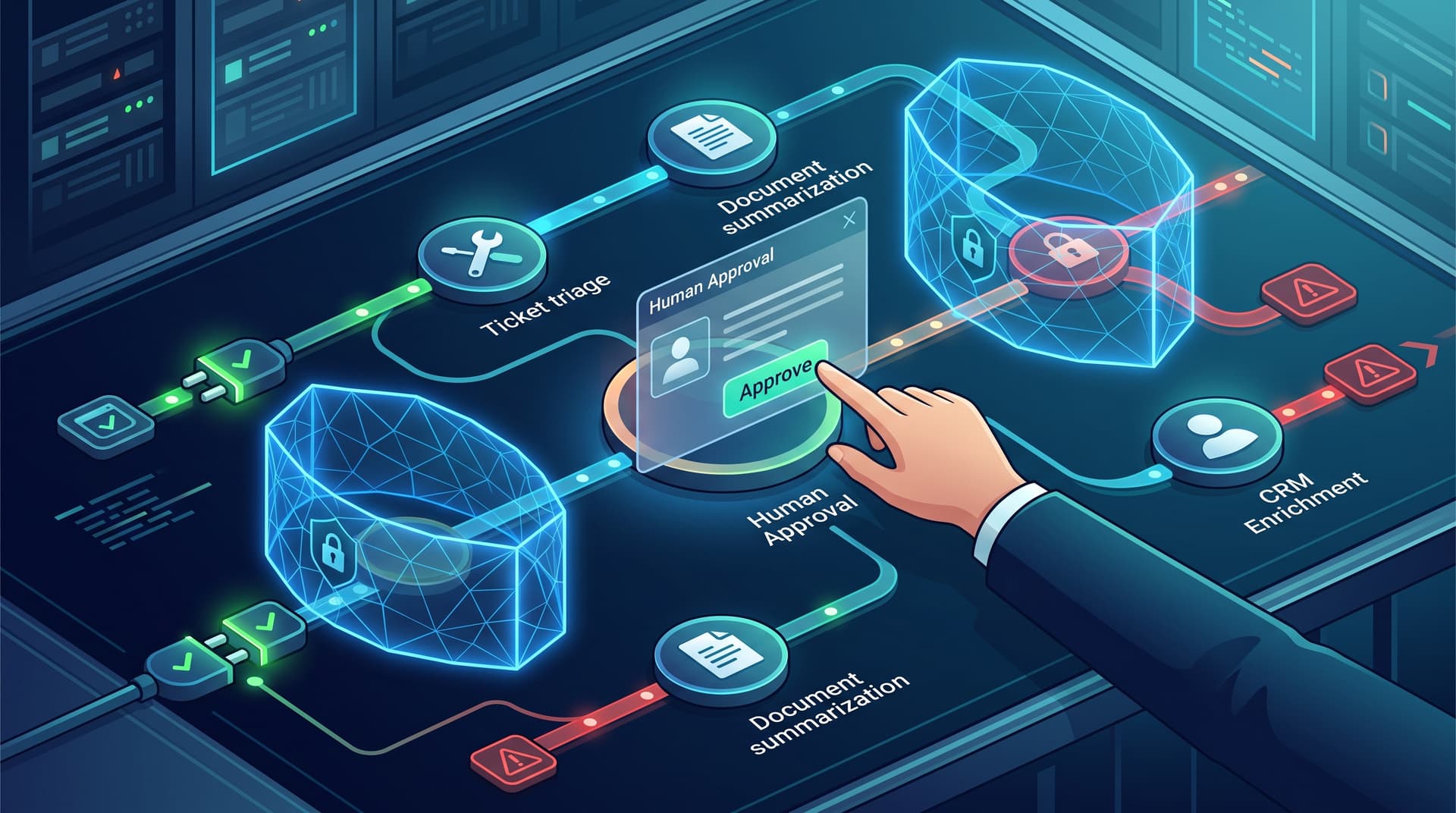
- Structured Gatekeeping: Require manual operational sign-off for actions that write back to production systems, change permissions, or send external customer communications.
3 Key Use Cases and Their Governance Risks
Use Case 1: Automated Ticket Triage and Routing
- The Workflow: Incoming support tickets are analyzed by an LLM agent to classify priority, apply service tags, summarize issue history, and draft initial responses.
- The Benefit: Drastically reduces ticket queue latency and improves first-response resolution metrics for Managed IT Services.
- The Risk: Misclassification & Data Exposure. Unchecked ticket triage can misroute critical severity-1 outages or expose internal system passwords accidentally embedded in client ticket notes.
- The Guardrail: Restrict the agent to tag drafting and triage suggestion; require service desk analysts to approve auto-replies until baseline accuracy targets are sustained over time.
Use Case 2: Document Summarization and Key Term Extraction
- The Workflow: Complex vendor contracts, service level agreements (SLAs), and regulatory filings are ingested to extract standard renewal dates, liability caps, and compliance mandates.
- The Benefit: Accelerates legal and operational review processes by up to 80%.
- The Risk: Hallucination and Fine-Print Omission. Generative models may hallucinate specific indemnification caps or miss subtle conditional clauses hidden in complex legal syntax.
- The Guardrail: Pair automated text extraction with side-by-side human review interfaces, where extracted data points link directly to highlighted source snippets in the source PDF.
Use Case 3: CRM Data Enrichment and Lead Scoring
- The Workflow: Market intelligence APIs and web data are combined with internal client records to enrich accounts with firmographic details and score incoming opportunities.
- The Benefit: Delivers real-time account context to sales and account management teams without manual copy-pasting.
- The Risk: Data Pollution & Unvetted Ingress. Automated overwriting of master CRM fields can clobber clean internal records with inaccurate third-party data.
- The Guardrail: Route enriched data into staging or pending-review fields in the CRM, allowing automated validation scripts or sales operations staff to approve updates prior to primary record updates.
Building Your Governed AI Roadmap
Scaling AI automation across an organization requires starting with high-impact, low-risk pilots backed by robust management tools.
- Audit Existing Workflows: Identify where employees are manually using unmonitored consumer AI interfaces to accomplish work.
- Establish Baseline Guardrails: Define strict policies around data exposure, allowed API endpoints, and mandatory human review gates.
- Deploy Managed Integration Controls: Use centralized orchestration engines that handle credential vaulting, token rate limiting, and structured logging.
- Measure and Iterate: Monitor accuracy, cost per execution, and operational time saved while maintaining absolute administrative visibility.
Ready to implement secure, policy-driven automation across your service stack? Talk to Bitscaled about AI workflow pilots equipped with built-in guardrails and measurable ROI.