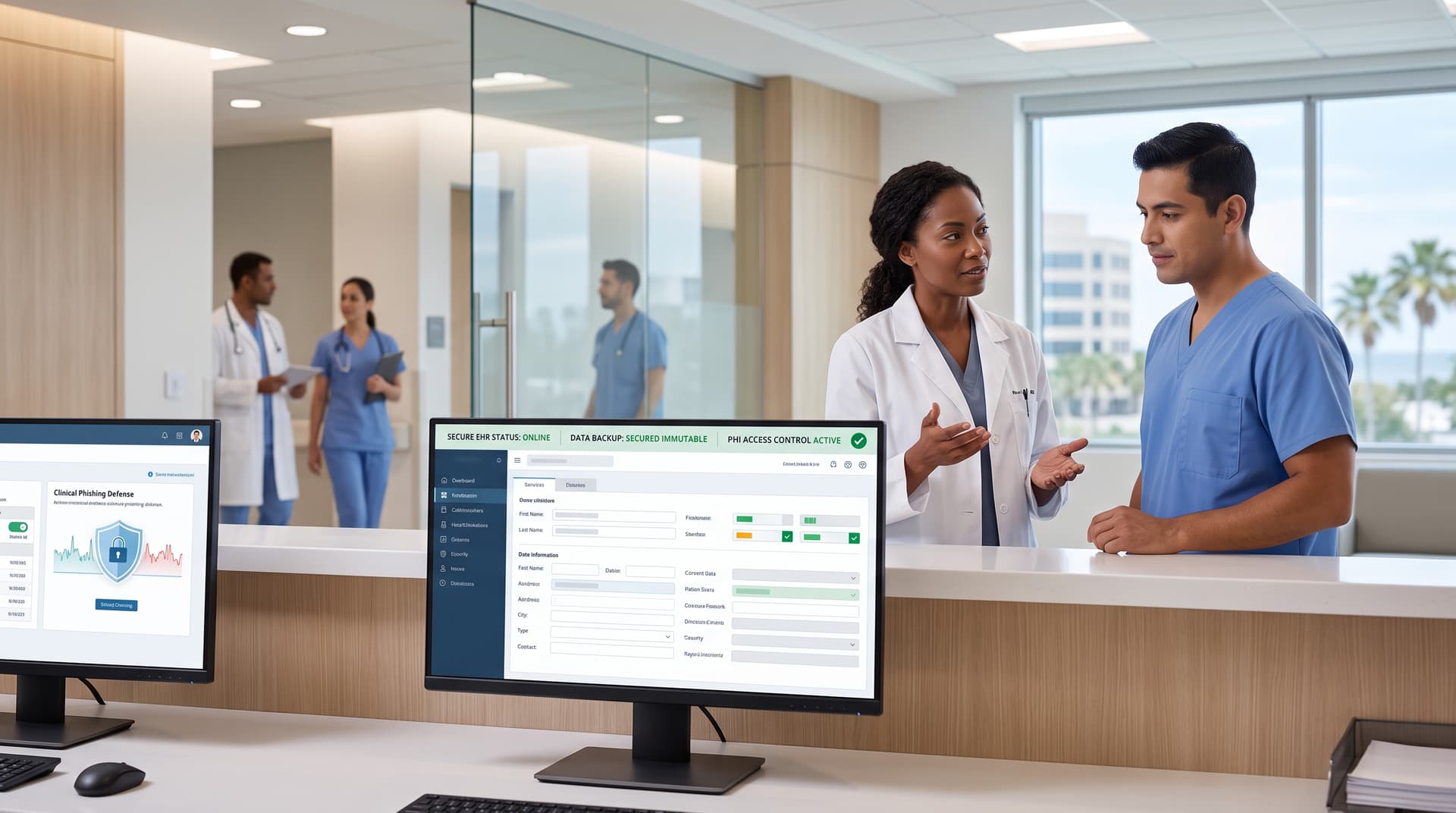
In modern clinical care, technology operates as the nervous system of patient care delivery. From busy outpatient surgical centers in Tampa Bay to regional multi-specialty health systems across Florida, clinical teams depend on Electronic Health Record (EHR) platforms, imaging systems, and digital communication tools every minute of the operating day. When an EHR goes offline or suffers severe latency, patient intake halts, diagnostic results stall, and clinical staff are forced onto emergency paper charting procedures—introducing operational friction and potential safety risks.
Simultaneously, healthcare providers operate under the strict mandate of the Health Insurance Portability and Accountability Act (HIPAA) Security and Privacy Rules. Healthcare IT leaders are charged with maintaining absolute confidentiality and integrity of Protected Health Information (PHI) while simultaneously ensuring high availability (HA). Security controls must never become a bottleneck to emergency patient care, nor can clinical convenience justify lax security postures that risk catastrophic data exposure.
Achieving this balance requires an operational framework that embeds compliance directly into system architecture, disaster recovery planning, and everyday workflows.
Architectural Redundancy: Ensuring High Availability for EHR Platforms
System uptime in healthcare is not merely an IT metric; it is a core clinical requirement. Modern clinical operations require an EHR infrastructure built for resilience against hardware failure, cloud provider outages, and environmental disruptions such as severe Gulf Coast weather events.
To maintain operational continuity, IT engineering teams must implement multi-layered redundancy across the network and application stack:
- Dual-ISP Redundancy and SD-WAN Routing: Clinical facilities should deploy secondary, diverse internet connections (such as fiber paired with low-latency satellite or cellular failover). Software-Defined Wide Area Networking (SD-WAN) automatically reroutes traffic around degraded links, ensuring zero-drop sessions for active EHR user sessions.
- Local Caching and Offline Readiness: For cloud-hosted EHR environments, deploying local edge appliances or hybrid caching nodes allows clinical staff to continue reviewing schedules and critical charts during unexpected internet blackouts.
- Database High Availability: On-premises and private cloud EHR databases require real-time synchronous replication across primary and secondary data clusters. Automated failover mechanisms should keep database downtime under 60 seconds during hardware faults.
Takeaway: True clinical continuity requires designing network topology so that physical disruptions—whether hardware failures or regional weather outages—fail over seamlessly without severing active clinical sessions.
For organizations modernizing their underlying network resilience, evaluating managed network services (Bitscaled Infrastructure Services) provides a baseline for active uptime monitoring.
Granular Access Controls & Least-Privilege Safeguards for PHI
The HIPAA Security Rule mandates that covered entities implement technical safeguards to restrict PHI access to the minimum necessary for a given role. However, rigid access policies can impede clinical workflows if not configured thoughtfully for fast-paced care teams.
Role-Based Access Control (RBAC) Tailored to Clinical Roles
Broad administrative access is a primary driver of insider exposure and compliance violations. System access should be segmented precisely according to clinical function:
- Triage and Intake Staff: Access limited to patient demographics, scheduling, and initial insurance verification fields.
- Nursing and Attending Physicians: Full read/write access to clinical notes, lab orders, and medication administration records for assigned patients.
- Billing and Administrative Officers: Access restricted to coding, claim processing, and financial records, with medical narrative fields obfuscated where unnecessary.
Streamlined Authentication at the Point of Care
Requiring complex passwords every time a nurse approaches a workstation in a high-traffic hallway creates frustration and leads to dangerous workarounds, such as shared logins or sticky notes under keyboards. Implementing single sign-on (SSO) integrated with proximity badge readers or biometric authentication allows clinical staff to tap in and tap out instantly while maintaining individual accountability and session lock timeouts.
Continuous Audit Logging and Behavioral Monitoring
HIPAA requires active monitoring of system activity. Automated log analysis tools should consolidate access logs across the EHR, domain controllers, and file repositories to flag anomalies in real time—such as an employee accessing records outside their clinic location or viewing high-profile patient files without an active care assignment.
Vendor Risk Management and Active BAA Enforcement
Modern healthcare delivery relies on an extensive ecosystem of third-party vendors, including digital forms processors, cloud storage providers, remote patient monitoring platforms, and IT managed service providers (MSPs). Under HIPAA, any third party that creates, receives, maintains, or transmits PHI on behalf of a covered entity is classified as a Business Associate and must sign a Business Associate Agreement (BAA).
However, executing a BAA is merely the legal starting point; it does not guarantee operational security.
Verifying Vendor Technical Security
Prior to onboarding any software platform or IT service provider, compliance and IT leads should execute a structured vendor security risk assessment:
- Encryption Standards: Confirm that all PHI in transit is secured using TLS 1.3 and all PHI at rest utilizes AES-256 bit encryption.
- Access Governance: Verify that vendor support staff do not possess unmonitored or persistent administrative access to your live production environment.
- Independent Audits: Request current SOC 2 Type II reports or ISO 27001 certifications to validate that the vendor's security assertions are audited by third parties.
Organizations can utilize automated external assessment tools, such as the Bitscaled Footprint Scan, to identify exposed public services and posture gaps before integrating external platforms.
Operational Matrix for HIPAA-Aware IT Infrastructure
Below is an illustrative operational matrix mapping critical compliance domains to concrete technical implementations and clinical impact:
| Domain | Technical Control Implementation | Operational & Clinical Impact |
|---|---|---|
| EHR High Availability | Dual SD-WAN failover + Hybrid caching | Prevents intake freezes during ISP outages; maintains flow. |
| PHI Identity & Access | SSO with proximity badges & MFA | Speeds up staff login while maintaining strict audit trails. |
| Vendor Risk (BAA) | Automated posture checks & SOC 2 reviews | Prevents third-party supply chain breaches from exposing PHI. |
| Data Recovery | Air-gapped, immutable backups with 15-min RPO | Guarantees recovery from ransomware without paying extortion. |
| Clinical Staff Defense | Role-tailored anti-phishing & domain checks | Reduces human error from fast-paced triage environments. |
Ransomware Resilience: Immutable Backups and Data Integrity
Ransomware remains one of the most severe operational threats to regional healthcare practices. Attackers actively target healthcare providers knowing that system downtime directly compromises patient care, placing extreme pressure on leadership to pay ransoms quickly.
To ensure that a ransomware incident does not force a practice to halt clinical operations or face catastrophic data loss, healthcare providers must adopt an immutable backup strategy.
The Principle of Immutability
Traditional backups connected to the primary network can be encrypted or deleted by sophisticated attackers once administrative credentials are compromised. Immutable backups utilize Write-Once-Read-Many (WORM) storage policies or S3 Object Locking, preventing any user or malicious script—even a domain admin account—from modifying or deleting backup datasets for a fixed retention period.
Disaster Recovery Testing and RTO/RPO Metrics
Backup infrastructure must be routinely validated through simulated restore exercises. IT teams should establish clear target metrics:
- Recovery Point Objective (RPO): The maximum tolerable period of data loss (e.g., maximum 15 minutes of clinical entry loss).
- Recovery Time Objective (RTO): The maximum allowable duration for restoring clinical applications to production status (e.g., under 2 hours).
Reviewing specialized disaster recovery frameworks via Bitscaled Backup & Recovery Services helps clinical organizations establish tested RPO/RTO baselines. Practice leads can evaluate their risk posture using the Bitscaled Ransomware Readiness Scorecard.
Mitigating Phishing Risks in High-Velocity Clinical Environments
While technical controls form the structural perimeter, human interactions remain a key vector for credential theft and network entry. Clinical staff work in fast-paced environments where urgent emails regarding lab results, vendor invoices, or administrative changes are received constantly. Attackers exploit this urgency using targeted phishing campaigns.
Tailored Security Awareness Training
Generic annual security training videos are rarely effective in changing operational habits. Healthcare providers should implement short, continuous micro-learning modules customized for specific job roles:
- Train front-desk personnel to spot fake patient record transfer requests or spoofed executive instructions.
- Conduct simulated phishing campaigns that mimic actual healthcare lures (such as fake portal notification emails or urgent HR policy updates).
Technical Email Defenses
To assist clinical staff, technical email security controls must filter out malicious traffic before it reaches the inbox:
- Domain Authentication: Enforce strict DMARC, DKIM, and SPF policies to prevent attackers from impersonating your clinic's domain. Check your domain hygiene using the Bitscaled Email Spoof Test.
- External Email Labeling: Automatically tag all emails originating outside the organization with clear visual banners to reduce success rates of internal spoofing attacks.
Building a Resilient Healthcare IT Ecosystem
Maintaining HIPAA compliance and safeguarding clinical continuity is not a one-time project; it is an ongoing operational commitment. By combining resilient network architecture, granular identity controls, rigorous vendor oversight, immutable backup solutions, and continuous staff awareness, healthcare organizations in Florida and beyond can protect patient data while delivering uninterrupted clinical care.
Whether managing a multi-location specialty clinic or a growing outpatient network, aligning your IT operations with HIPAA requirements requires specialized technical governance and continuous monitoring.
Take Action for Your Practice
Is your IT infrastructure fully prepared to maintain uptime while satisfying HIPAA Security Rule standards? Evaluate your posture, identify potential vulnerabilities, and safeguard clinical workflows today.
Request a HIPAA-aligned IT assessment from Bitscaled by exploring our Bitscaled Security Consulting Services to partner with technical specialists who understand the demands of modern healthcare operations. To learn more about our dedicated industry solutions, visit our Bitscaled Healthcare & Life Sciences Practice.