Connecting Core Operations: Robust API Workflows Across PSA, CRM, and Billing
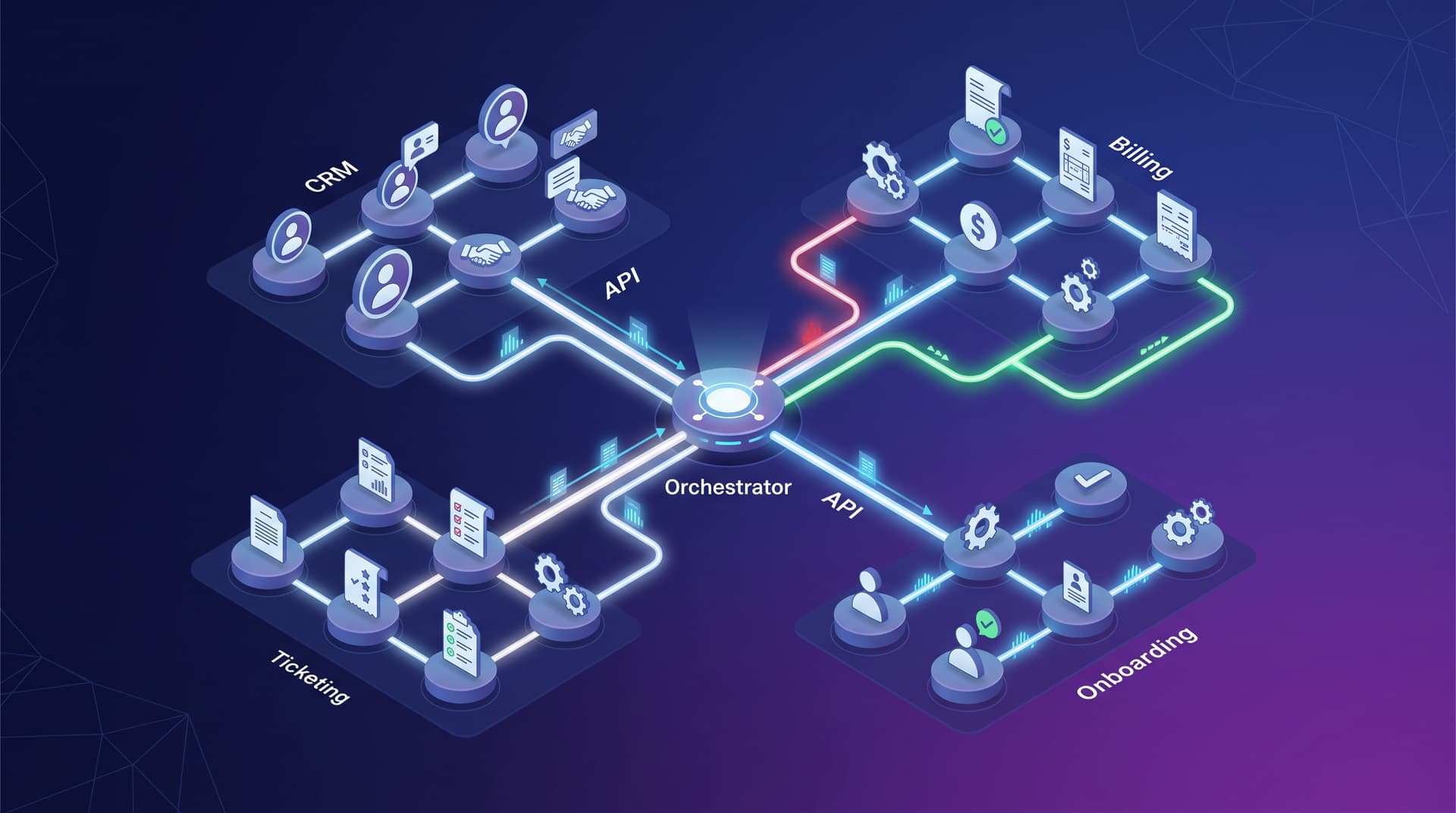
Modern enterprise operations rely on a distributed stack of specialized platforms. Your client management team operates inside a CRM, technical engineers manage work in a Professional Services Automation (PSA) platform or help desk system, accounting processes invoices inside an ERP, and HR provisions accounts across identity providers. While each individual software platform serves its dedicated purpose, operational velocity degrades when data must cross organizational boundaries.
Unifying these siloed systems requires robust workflow automation that goes beyond superficial data syncs. Without a deliberate architectural foundation, automated pipelines risk generating duplicate billing entries, dropping critical onboarding steps during network timeouts, or breaking quietly when UI layouts change.
To build reliable cross-system workflows, organizations must understand the fundamental differences between API-driven orchestration and UI bots, enforce strict idempotency across all transactional boundaries, and establish instant, actionable failure notifications.
API-Based Orchestration vs. UI Bots: Choosing the Right Integration Layer
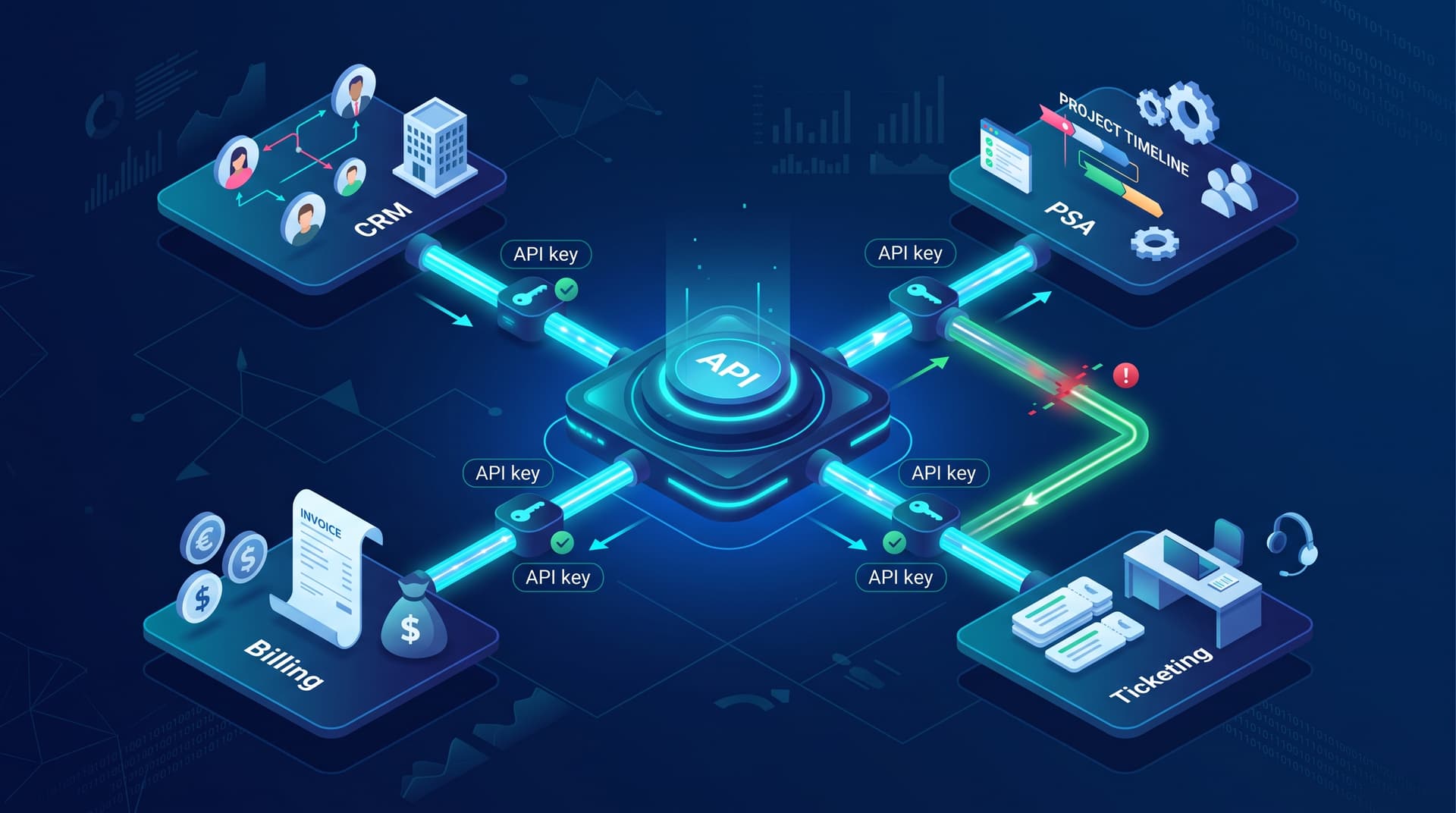
When engineering cross-system workflows, software teams generally choose between two core mechanisms: programmatically interacting with system APIs (REST, GraphQL, gRPC) or simulating human behavior via Robotic Process Automation (RPA) UI bots. While both methods move data between applications, their architectural stability, speed, and maintainability differ significantly.
Native API Integration
Direct API integration leverages structured endpoints, strong data schemas, and explicit HTTP status codes.
- Deterministic Contracts: Webhooks and RESTful endpoints operate on documented data schemas. When an object updates, structured JSON payloads transmit exact state changes instantly.
- High Throughput and Low Latency: Programmatic calls execute in milliseconds without needing to render visual elements, wait for DOM loads, or consume client display memory.
- Robust Error Reporting: APIs return standardized HTTP response codes (e.g.,
401 Unauthorized,429 Rate Limited,503 Service Unavailable) alongside diagnostic body payloads, enabling clear error handling.
UI Bots (Robotic Process Automation)
UI bots execute workflows by driving graphical user interfaces—clicking buttons, filling form fields, and scraping screen text.
- Legacy Compatibility: RPA excels when interacting with legacy on-premise systems, mainframes, or web applications that lack exposed APIs or webhook capabilities.
- Fragility to Layout Changes: Because UI bots rely on DOM selectors, coordinates, or visual anchors, minor updates to an application's user interface can instantly halt execution.
- Resource Overhead: Operating UI bots requires dedicated virtual machines, headful or headless browser engines, and extra wait loops to account for visual rendering delays.
Integration Selection Matrix
| Dimension | Native API Orchestration | UI Bots (RPA) |
|---|---|---|
| Primary Use Case | Modern SaaS, cloud ERPs, REST/GraphQL endpoints | Legacy desktop apps, closed web portals without APIs |
| Execution Speed | Sub-second execution (100ms–500ms per step) | Multi-second visual interaction (3s–15s per screen) |
| Breakage Risk | Low (bounded by API versioning & deprecation windows) | High (vulnerable to CSS, UI layout, or rendering updates) |
| Failure Visibility | Clear status codes and structured error bodies | Screenshot capture, DOM element missing exceptions |
| Concurrency Scale | High parallel execution via message queues | Limited by available worker environments and browser sessions |
For mission-critical workflows across systems like PSA platforms, CRMs, and financial engines, direct API orchestration should always be the primary path. RPA serves as a specialized tool reserved strictly for uncooperative legacy endpoints.
Idempotency: The Core Requirement for Multi-System Consistency
In distributed systems, network partitions, gateway timeouts (504s), and transient database locks are inevitable. When an automation pipeline submits a request to create an invoice or user account and receives a network timeout, the pipeline faces a dilemma: Did the destination server process the request before timing out, or did it fail before receiving it?
If the workflow engine blindly retries the operation, it risks executing duplicate transactions—such as billing a client twice or creating duplicate user records. If it does not retry, the step remains incomplete, leaving cross-system states out of alignment.
Enforcing Idempotency
An operation is idempotent if executing it multiple times produces the exact same result as executing it once. Achieving idempotency across multi-system orchestrations relies on three architectural patterns:
-
Unique Idempotency Keys: Every transactional payload should carry a deterministic, unique header or identifier generated from the source event. For instance, when converting an approved PSA ticket into a billing charge, the idempotency key can be constructed as a hash of the ticket ID, milestone ID, and timestamp (
hash(ticket_89412 + milestone_3 + 2026-09-10)). When the billing system receives a retried request with an identical key, it returns the existing record rather than creating a second charge. -
State-Check-Before-Write (Lookups): Prior to triggering a mutation call on a target system, the orchestration layer queries the target API using unique business keys (such as an external ticket reference or employee ID). If the record already exists, the pipeline retrieves the existing record's ID and transitions directly to the next workflow step.
-
Transactional Log Management: Maintain a centralized state record for every workflow run. Before initiating an API call, the state engine records the step status as
PENDING. Upon successful response, it updates toCOMPLETED. If a failure occurs, the engine reads the current step state to resume execution precisely where it stopped, avoiding re-executing previously finalized operations.
Takeaway: Never rely on simple time delays or blind retry loops across financial or identity systems. Designing idempotent payloads ensures that transient network glitches do not pollute downstream systems with duplicate entries or broken states.
Real-World Orchestration Scenarios
To understand how API orchestration and idempotency function in practice, consider two common enterprise automation scenarios.
Scenario 1: Automated PSA Ticket to Financial Billing Sync
When a managed service ticket or professional services project reaches sign-off, billing details must transfer from the technical help desk to accounting software for invoice generation.
- Trigger: A technician marks a ticket as "Approved for Billing" in the PSA tool, triggering an outgoing webhook.
- Payload Parsing & Deduplication: The orchestration platform validates the signature, extracts the ticket ID and line items, and generates an idempotency key.
- Pre-flight State Check: The orchestration layer queries the ERP's API for an invoice bearing the ticket's reference number.
- Execution: If no invoice exists, the workflow posts a new invoice request including the idempotency key.
- State Sync & Reconciliation: Upon receiving HTTP
201 Createdwith the new invoice ID, the workflow updates the PSA ticket custom field with the invoice link and flags the ticket status asBilled.
Scenario 2: Cross-Departmental User Onboarding
When a new team member joins an organization, HR enters their profile into the HRIS, requiring immediate provisioning across directory services, SaaS applications, and security tools.
- Step 1 (HRIS Event): The HR portal triggers an event for a new hire record.
- Step 2 (Directory Provisioning): The workflow calls Microsoft 365 or Google Workspace APIs to provision the user's primary identity and assign group licenses.
- Step 3 (Role-Based Access Assignment): Based on the employee's department code, the workflow provisions roles in the CRM, PSA, and financial dashboards.
- Step 4 (Equipment & Desk Setup): An automated request posts to the internal support system, creating an equipment setup task assigned to IT support.
- Step 5 (Audit Verification): The workflow verifies that all external API endpoints responded with HTTP
200/201, logs the completion in the security governance log, and notifies the hiring manager.
Resilient Failure Handling: Alerting, Retries, and Escalation
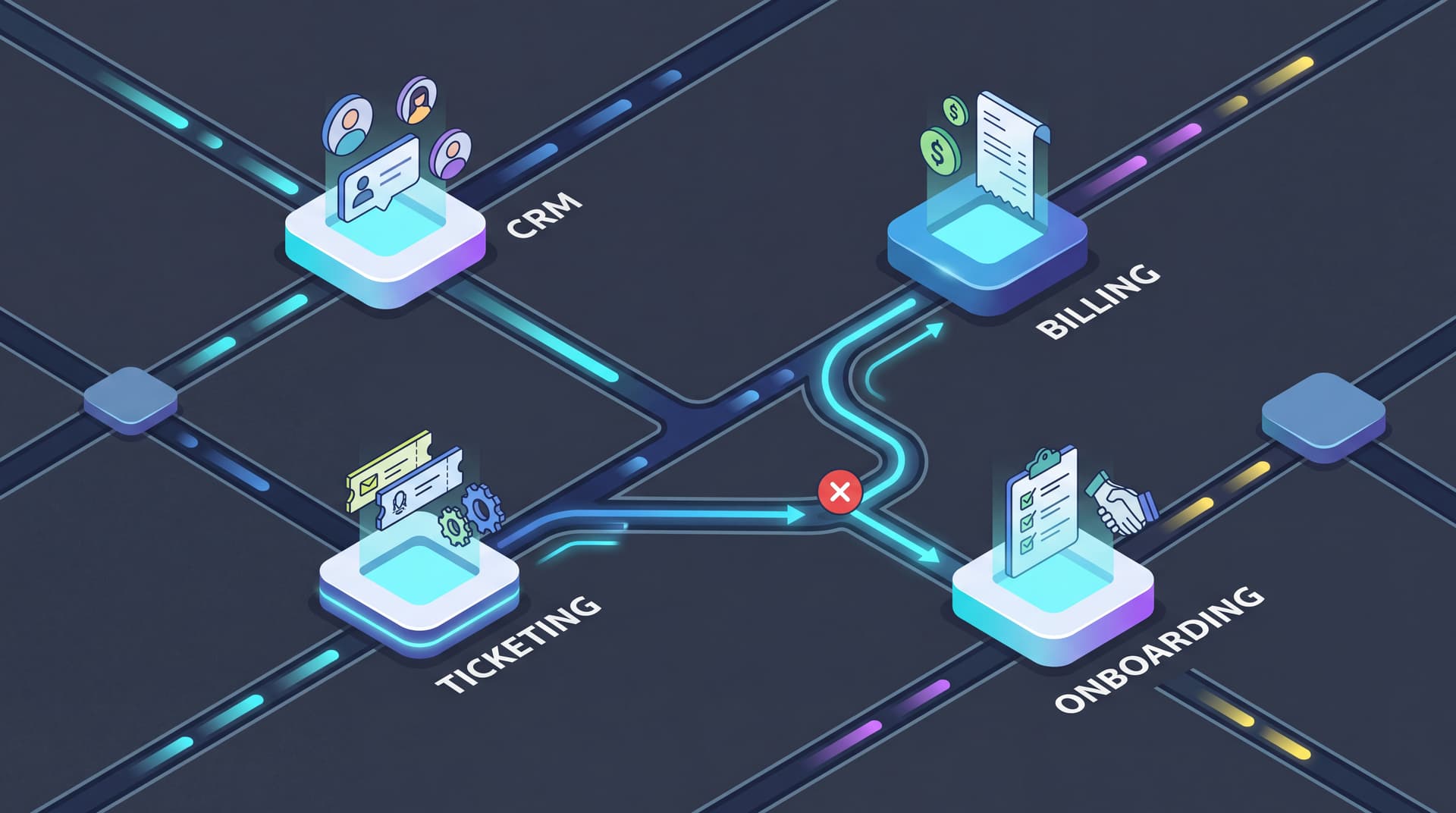
Even well-designed orchestrations encounter unexpected failures—expired OAuth tokens, upstream API outages, rate limits, or validation errors. A resilient automation architecture incorporates layered recovery mechanisms to manage these exceptions without silent failures.
Exponential Backoff and Jitter
When an API responds with temporary status codes such as 429 Too Many Requests or 503 Service Unavailable, immediate retries worsen system strain. The orchestration layer must apply exponential backoff with random jitter, spacing out subsequent retries to allow upstream services time to recover.
Dead-Letter Queues (DLQ) and Human-in-the-Loop Alerts
When retries exhaust their maximum threshold or encounter non-retryable client errors (such as 400 Bad Request due to a missing required field), the execution payload moves to a Dead-Letter Queue (DLQ).
- Isolate the Payload: The failed item is stored in the DLQ alongside full execution logs, request headers, and original payloads.
- Actionable Alerting: Rather than sending vague error emails, the system pushes a structured notification to the admin channel or opens a priority ticket in your support portal with direct context:
- Affected Workflow Name
- Source System & Record ID
- Specific Target API Response
- Direct Link to Re-run or Edit Payload
- Manual Override & Replay: Administrators can update missing data fields directly within the orchestration console and click "Replay Event" to resume execution from the failed step without restarting the entire pipeline.
Next Steps for Enterprise Workflow Orchestration
Building seamless cross-system connections requires transitioning from disconnected point-to-point scripts to an intentional integration strategy. By prioritizing native API endpoints, implementing idempotency keys, and establishing clear failure recovery procedures, enterprises eliminate manual data entry while maintaining operational integrity.
Ready to transform your operational efficiency? Map your highest-friction workflows with Bitscaled automation architects to design robust, fault-tolerant orchestration across your PSA, CRM, and financial platforms.