
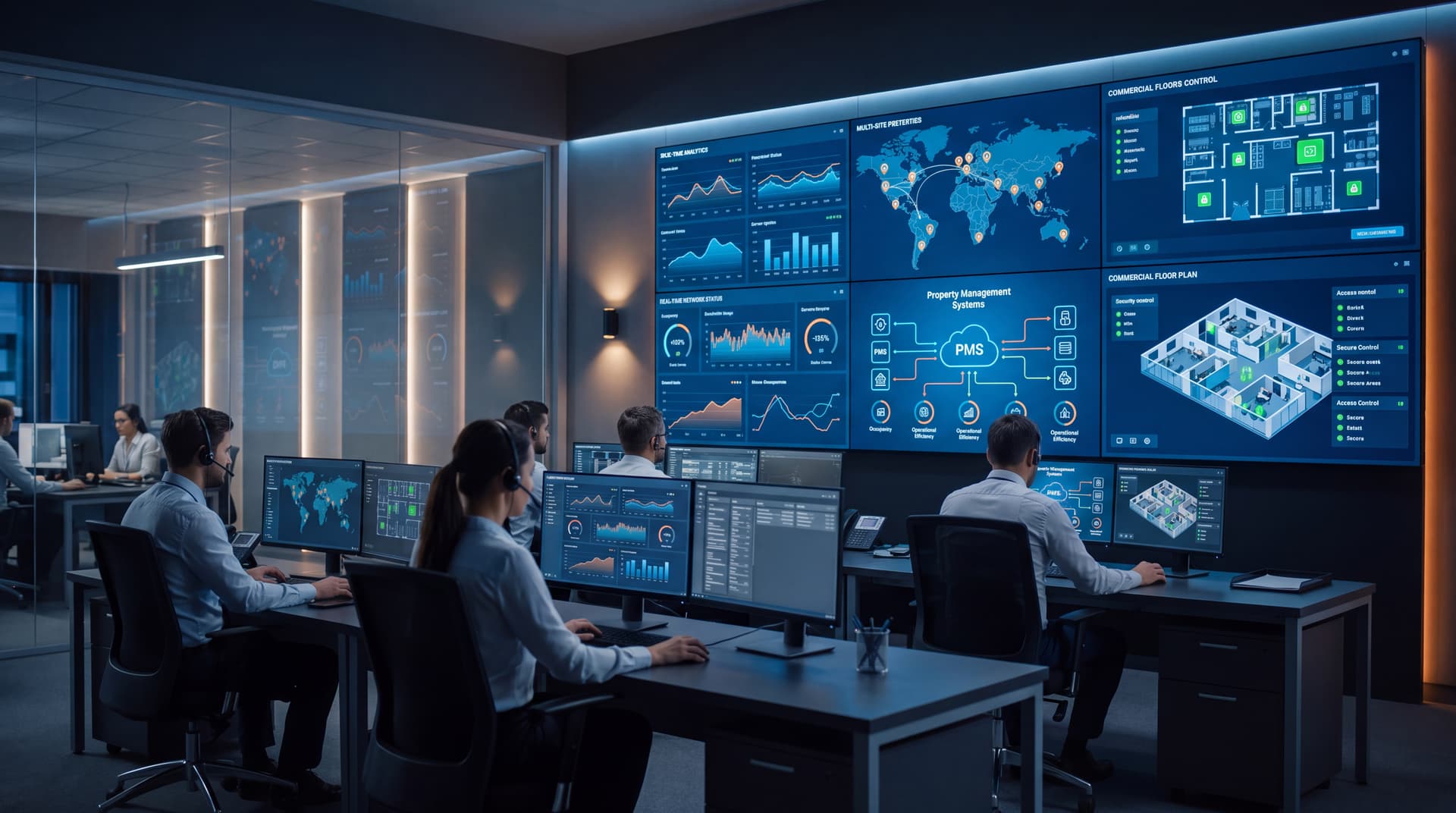
Scaling Property Operations: IT Infrastructure for Multi-Site Real Estate
Managing IT across multiple real estate developments and residential or commercial portfolios requires a shift from disjointed, site-by-site fixes to a cohesive operational standard. As property portfolios grow, operations leaders face the challenge of connecting disparate systems while keeping data secure and building services online.
To operate efficiently at scale, real estate organizations need an IT foundation that seamlessly links core property management systems, protects tenant communications, standardizes access hardware, and delivers reliable site connectivity.
1. Integrating PMS and Operational Data Across Sites
Your Property Management System (PMS) serves as the central engine for leasing, maintenance ticketing, and financial reporting. However, when property management IT is fragmented, staff waste hours manually transferring data between local site portals and corporate databases.
- API Integration: Connect cloud-based PMS solutions directly with accounting, tenant portals, and IoT building management controls.
- Automated Workflows: Ensure tenant onboarding, move-in checklists, and service dispatch trigger automatically across platforms.
- Centralized Analytics: Consolidate occupancy data and maintenance metrics across all regional properties into unified executive dashboards.
2. Securing Tenant Communications and Data Privacy
Modern tenants expect convenient digital channels for payments, maintenance requests, and announcements. Safeguard tenant privacy and mitigate liability with robust cybersecurity protocols.
- Encrypted Portals: Implement end-to-end encryption for tenant payment processing and lease documentation.
- Segmented Networks: Isolate tenant-facing messaging apps and Wi-Fi networks from administrative and operational management channels.
- Access Control Policies: Enforce role-based permission levels so site staff only access the tenant data necessary for their specific location.
3. Modernizing Multi-Site Access Control and Video Surveillance
Keyless door entry, automated gate control, and IP security cameras are critical for resident safety and operational efficiency. Centralizing control reduces on-site management overhead.
- Cloud-Managed Access: Grant or revoke vendor and tenant access credentials remotely across any building in your portfolio.
- Unified Surveillance: Centralize security camera feeds into secure cloud storage for auditability and incident response.
- System Redundancy: Deploy local failover hardware to ensure access control and security remain operational during internet outages.
4. Standardizing Multi-Property Network Infrastructure
Inconsistent network setups across different properties create security vulnerabilities and complicate IT management. Establishing standardized network architecture simplifies maintenance and troubleshooting.
- SD-WAN Deployment: Connect all property sites securely to central cloud resources using standardized software-defined wide area networking.
- Managed Network Equipment: Deploy identical routers, switches, and access points across sites to simplify remote monitoring and hardware replacement.
- Dedicated IoT VLANs: Isolate smart thermostats, elevators, and HVAC controllers on separate virtual networks to prevent lateral cyber threats.
Conclusion
Standardizing your property management IT framework transforms fragmented site operations into an agile, scalable enterprise asset. By unifying PMS integrations, security systems, and network architecture, property leaders reduce operational friction and enhance the tenant experience.
Unify property site IT standards with Bitscaled. Reach out to our real estate technology team today to audit and modernize your multi-property infrastructure.