The Flaw in Modern Monitoring: Telemetry Without Context
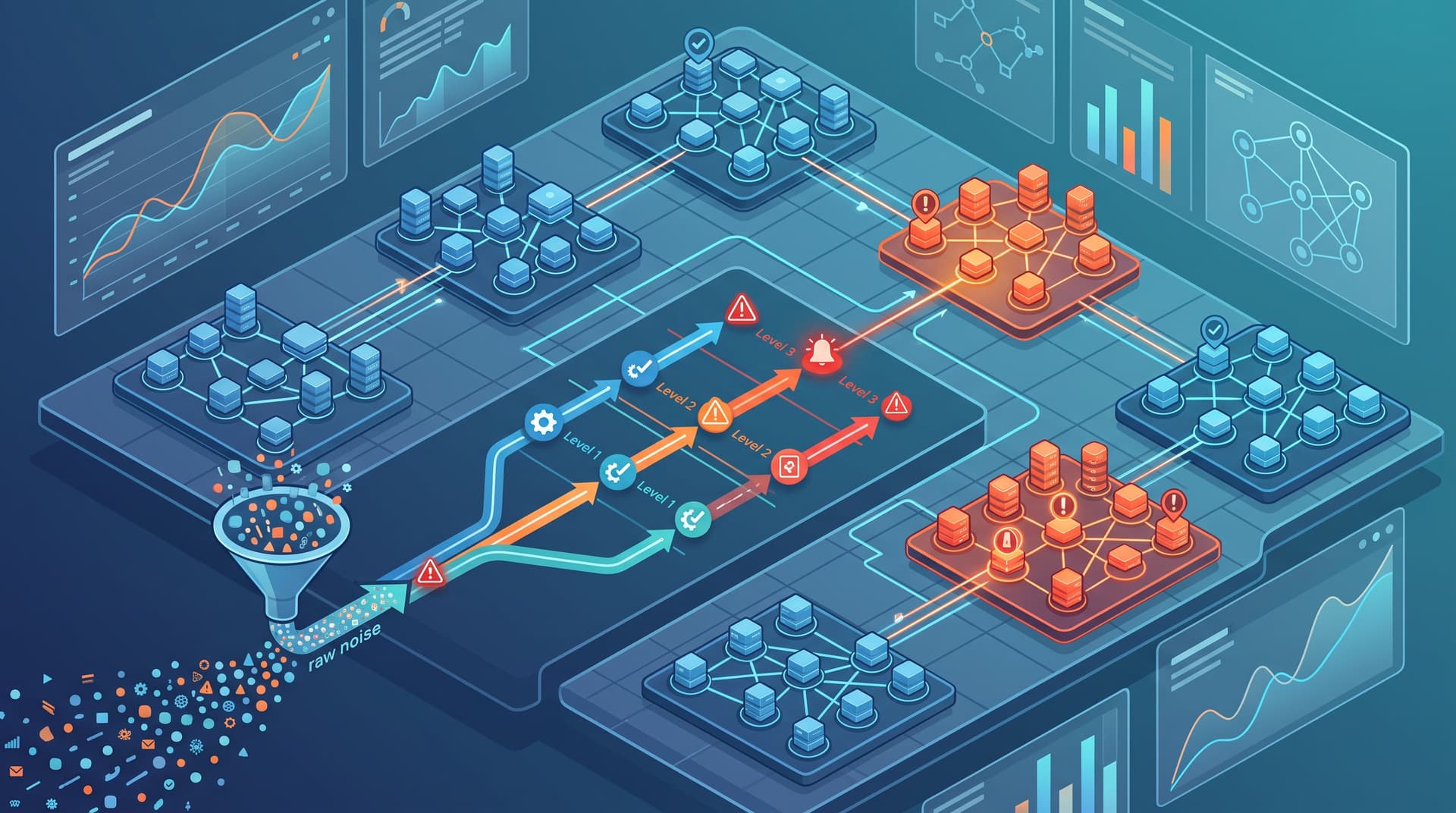
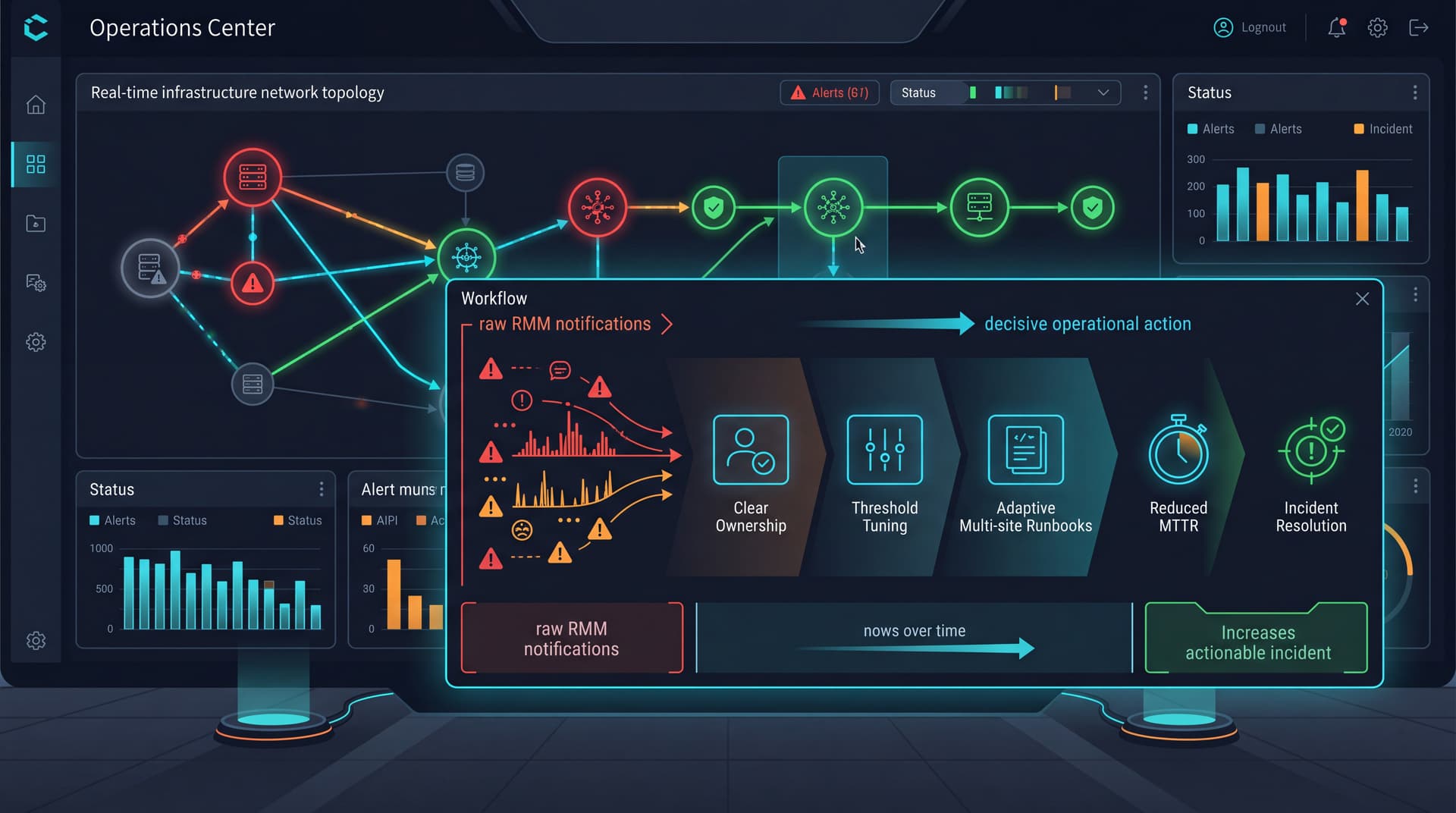
Most IT infrastructure operations suffer not from a shortage of monitoring data, but from an overwhelming surplus of uncontextualized noise. When remote monitoring and management (RMM) tools deliver hundreds of warning notifications a day, engineers develop natural filter immunity. Critical failures get buried under fleeting CPU spikes, temporary WAN blips, and unbatched backup notices.
Establishing a proactive operational posture requires bridging the divide between monitoring (detecting an anomaly) and meaningful response (resolving an impact). To move beyond reactive firefighting, operations leaders must restructure how telemetry maps to human action.
1. Disentangling Telemetry from Response Ownership
An alert without an assigned owner is merely an informational log entry. Transforming notifications into structured workflows requires three operational pillars:
- Unambiguous Escalation Ownership: Every alert tier must automatically map to a specific team or primary engineer. If everyone is responsible for monitoring a triage queue, no one is.
- Action-Oriented Runbooks: An alert notification should directly link to a step-by-step remediation runbook. If an engineer must spend fifteen minutes diagnosing how to handle a disk space warning, your system is inefficient.
- Transparent Client Communication: Differentiate internal technical alerts from client-facing service updates. Automated, clear updates maintain stakeholder trust without cluttering internal technical channels.
2. Adaptive Tuning for Multi-Site Environments
For multi-site small to mid-sized businesses (SMBs), applying uniform monitoring thresholds across every location guarantees high false-positive rates. Branch offices utilizing consumer-grade broadband or erratic satellite backhauls will trigger constant ping loss and latency warnings during peak business hours.
Strategies for Uneven Network Quality
- Dwell-Time Adjustments: Avoid triggering P2 or P1 alerts on instantaneous network drops. Implement mandatory dwell times (e.g., latency exceeding threshold for 10 consecutive minutes) before generating a ticket.
- Parent-Child Dependency Mapping: Configure RMM topology so that an edge router outage suppresses alerts for downstream switches, access points, and printers. Engineers should receive one actionable root-cause incident rather than fifty secondary alerts.
- Context-Aware Severity: A server going offline in a manufacturing plant outside operating hours requires a different response profile than an primary domain controller dropping mid-shift.
3. Tiered Escalation and After-Hours Governance
Unmanaged after-hours paging leads directly to staff burnout and missed critical incidents. Establishing strict escalation thresholds protects engineer well-being while safeguarding system availability.
- Tier 1 (Automated Self-Healing): Non-critical issues—such as service crashes that can be automatically restarted or temp files that can be auto-cleared—must trigger script execution before alerting humans.
- Tier 2 (Standard Business Hours): Non-impacting hardware warnings, minor disk thresholds, or redundant power supply alerts route to standard support queues for scheduled resolution.
- Tier 3 (Emergency After-Hours Page): Reserved strictly for complete site outages, primary business application downtime, or active security breaches. If an event does not directly halt operations, it waits until morning.
4. Measuring MTTR and Continuous Rule Refinement
System optimization relies on accurate tracking of key incident metrics. Focus on two critical operational metrics:
- Mean Time to Acknowledge (MTTA): Tracks how quickly an owner claims an incident.
- Mean Time to Resolution (MTTR): Tracks the total downtime from initial impact to full restoration.
Track your alert-to-ticket ratio weekly. If more than 15% of paged alerts end up closed as 'no action required' or 'transient issue,' perform immediate threshold tuning. Pruning legacy checks and stale monitoring templates is an ongoing operational requirement.
Transform Your Monitoring Operations
Achieving true operational resiliency requires more than deploying monitoring agents—it demands structured thresholds, clear ownership pathways, and disciplined execution.
Ready to convert raw telemetry into predictable uptime? Ask Bitscaled to tune monitoring thresholds and define alert ownership for your environment.