Designing Actionable Escalation Protocols for Distributed SMB Infrastructure
For many operations leaders managing multi-site infrastructure, the primary problem with system monitoring is not a lack of visibility. It is an overwhelming volume of uncontextualized noise. When remote management and monitoring (RMM) tools emit hundreds of notifications a day for temporary CPU spikes, minor latency hiccups, or transient WAN re-connections, real critical outages get buried in the flood.
To build a resilient IT operational model, organizations must bridge the gap between alert generation and decisive execution. Capturing telemetry is merely the diagnostic foundation. True incident response requires explicit ownership, deterministic runbooks, structured escalation pathways, and transparent communication protocols—especially across distributed SMB environments where WAN quality and network hardware vary wildly across regional locations.
Monitoring vs. Meaningful Response: Establishing Clear Ownership
A monitoring alert is an observation; an incident response is a workflow. High-performing operations teams treat these two concepts as fundamentally distinct. A raw telemetry ping indicating high memory usage on an application host is useless unless the system automatically assigns an owner, attaches standard operating procedures, and sets a timer for resolution.
To move from passive observation to active containment, incident management protocols must define three operational requirements for every high-severity alert class:
- Unambiguous Primary Ownership: Every alert that reaches a human screen must automatically map to a designated role (e.g., Tier 1 Network Operations, On-Call Systems Engineer) rather than a general team distribution list. When everyone owns an alert inbox, no one owns the incident.
- Executable Runbook Links: Notifications must include or directly link to step-by-step remediation procedures. Instead of instructing an engineer to "investigate host downtime," the runbook dictates verified verification steps (such as testing out-of-band management interfaces, checking upstream WAN handoffs, or validating local power distribution units) before triggering manual intervention.
- Structured Stakeholder Communication: Technical teams often focus solely on system restoration while ignoring downstream communication. A mature incident protocol defines explicit notification cadences for internal management and site leads. Automated status updates keep regional stakeholders informed without pulling the lead engineer off active diagnostic work.
Takeaway: Collecting telemetry without defined ownership merely accelerates alert fatigue. Every actionable alert must automatically route to a responsible role, link directly to a runbook, and trigger an automated communication path.
Adapting Thresholds for Multi-Site SMBs with Uneven Network Quality
Multi-branch enterprises—such as regional manufacturing plants, distributed legal offices, or multi-site healthcare clinics—frequently contend with inconsistent WAN performance. A branch operating on a commercial broadband link or 5G backup connection will naturally exhibit higher jitter and short-duration packet loss than a corporate headquarters backed by dual dedicated fiber handoffs.
Applying static, global monitoring thresholds across all locations guarantees continuous false positives. When an RMM platform triggers a high-severity outage alert for every 30-second WAN link flap, engineers quickly learn to ignore or mute incoming notifications.
Practical Strategies for WAN Threshold Tuning
To eliminate telemetry noise across uneven network topography, operations teams should implement localized baseline smoothing:
- Consecutive Failure Counting: Never alert on a single failed ICMP ping or HTTP health check. Configure probes to require multiple consecutive failed attempts (for example, 5 failed checks over a 3-minute window) before escalating to an actionable incident.
- Differentiated Site Baselines: Categorize network endpoints into reliability tiers. A core data center firewall should have strict ping thresholds (e.g., 2 consecutive failures), whereas a retail branch operating on asymmetric broadband should use relaxed evaluation intervals to accommodate standard ISP variance.
- Dependency Mapping and Parent-Child Logic: When a remote branch gateway drops offline, the monitoring architecture should suppress downstream alerts for local switches, access points, and IP phones. Generating a single "WAN Connectivity Lost" ticket is actionable; generating forty concurrent device alerts creates diagnostic chaos.
- Hysteresis and Flap Suppression: Require interfaces to maintain stability for a set period (e.g., 10 continuous minutes of clean telemetry) before auto-closing an incident or re-arming alert triggers. This prevents rapid open-and-close ticket loops during active circuit degradation.
| Location Profile | Circuit Type | Ping Interval | Failure Threshold | Actionable Trigger | (Illustrative Criteria) |
|---|---|---|---|---|---|
| HQ / Core Facility | Dual Dedicated Fiber | 30 Seconds | 2 Consecutive Drops | Immediate Tier 1 Notification | Core route unreachable > 60s |
| Regional Branch | Commercial Broadband | 60 Seconds | 4 Consecutive Drops | Tier 1 Ticket + ISP Auto-Check | Gateway unreachable > 4m |
| Remote Outpost | Cellular / Satellite Backup | 120 Seconds | 5 Consecutive Drops | Hold for 10m before Paging | High latency ignored; packet loss > 10m |
Structured Escalation Tiers and Sustainable After-Hours Handling
Incident response plans fail when after-hours emergency rosters depend on heroics rather than operational structure. Unfiltered after-hours paging leads to burnout, high turnover, and delayed responses to actual catastrophic outages.
Defining the Escalation Ladder
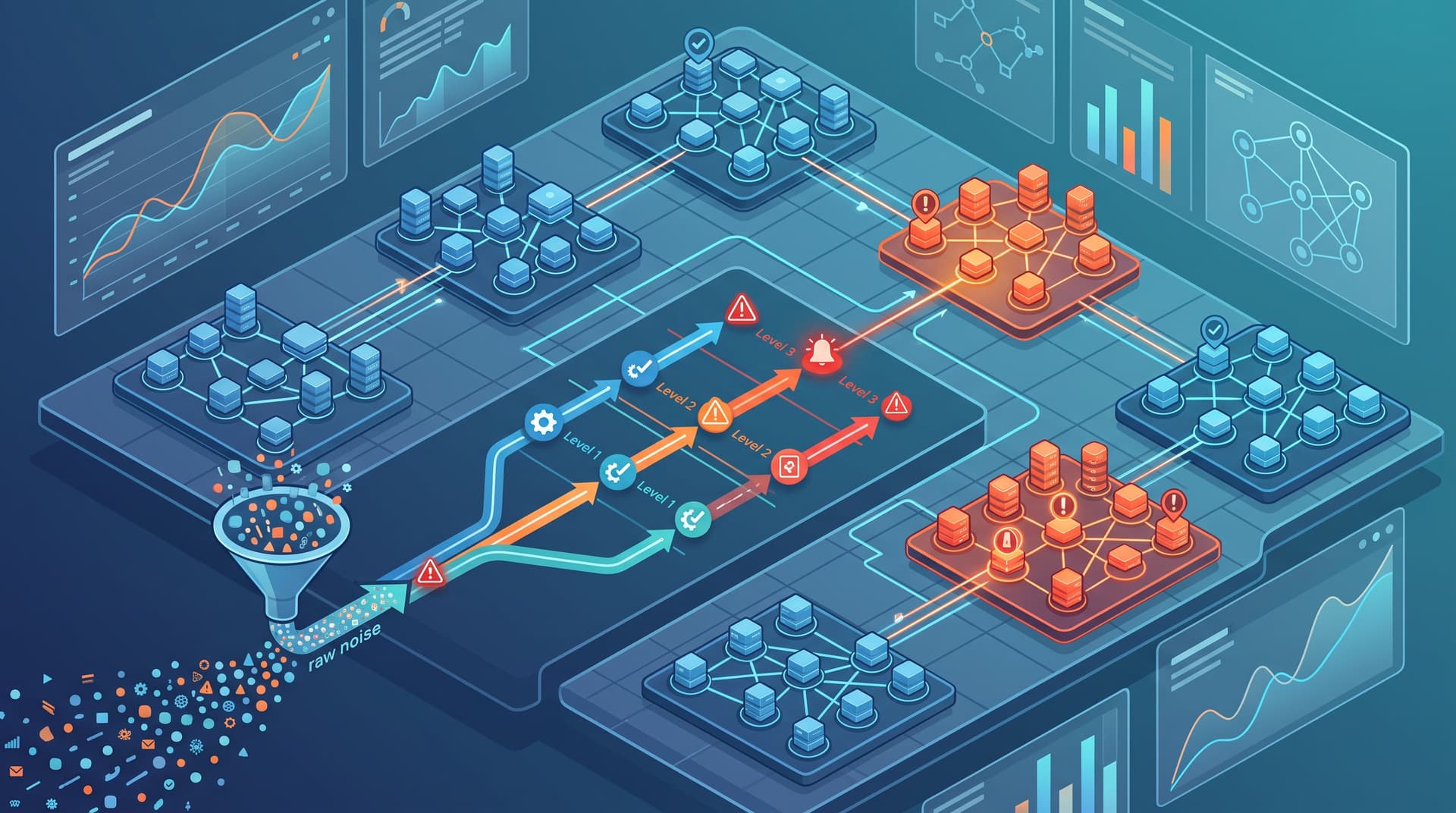
Sustainable operations rely on a multi-tiered operational model that filters noise before it reaches on-call engineering leadership:
- Automated Triage & Self-Healing (Tier 0): Non-critical services should attempt automated recovery before alerting humans. For example, if an unhandled service thread locks up, an automated orchestration script attempts a controlled service restart. If the service recovers and passes health checks, the incident is logged as a low-priority audit item rather than a middle-of-the-night page.
- Front-Line Incident Triage (Tier 1): Responsible for initial triage within 15 minutes of an event. Tier 1 verifies that the failure is genuine using runbook health checks, suppresses noise from scheduled maintenance windows, and executes initial containment procedures.
- Specialized Engineering Support (Tier 2/3): Called upon only when Tier 1 runbook steps fail to restore service within pre-defined SLA boundaries (e.g., 30 minutes for core infrastructure). Direct escalation paths must require a written summary of initial findings from Tier 1 to prevent diagnostic duplication.
Guarding After-Hours Quality of Life
After-hours paging protocols should be strictly restricted to Severity 1 (P1) events—defined as broad service outages impacting revenue, core site productivity, or security controls with no redundant failover path. All non-critical administrative alerts (such as disk usage reaching 75%, non-critical software updates failing, or secondary link degradation where redundancy holds) must be buffered into a morning review queue.
Measuring What Matters: Tracking MTTR and Operational Signal Quality
To drive continuous improvement in infrastructure monitoring, operations leaders must track objective performance metrics. Evaluating team effectiveness strictly by ticket volume is counterproductive; metrics should reward signal clarity and resolution speed.
Key Metrics for Engineering Leaders
- Mean Time to Acknowledge (MTTA): The elapsed time from alert generation until a human operator or automated triage engine accepts ownership of the incident ticket.
- Mean Time to Resolution (MTTR): The total time required to diagnose, contain, and fully remediate a verified outage. Reductions in MTTR directly reflect runbook clarity and effective threshold tuning.
- Signal-to-Noise Ratio (SNR): The proportion of actionable incident alerts against total notifications emitted by the RMM toolset. A healthy monitoring posture achieves an SNR where at least 85% of human-paged alerts require direct operational intervention.
- Repeat Incident Rate: The percentage of alerts that recur within 72 hours of ticket closure. High repeat rates signal superficial patching rather than root-cause remediation.
Next Steps: Tuning Monitoring Thresholds and Operational Ownership
Transitioning from reactive firefighting to a proactive operational baseline requires systematic threshold review, runbook creation, and explicit ownership modeling. Allowing uncalibrated RMM tools to dictate your team's daily schedule creates operational drag and hides true infrastructure risks.
Bitscaled provides specialized infrastructure governance and RMM optimization tailored to distributed organizations. Explore our full range of managed infrastructure services or learn more about our infrastructure monitoring architecture.
Ready to eliminate alert noise? Ask Bitscaled to tune your monitoring thresholds, establish site-specific baselines, and define clear alert ownership across your entire infrastructure environment.