Building Resilient Operations Through Cross-System Orchestration
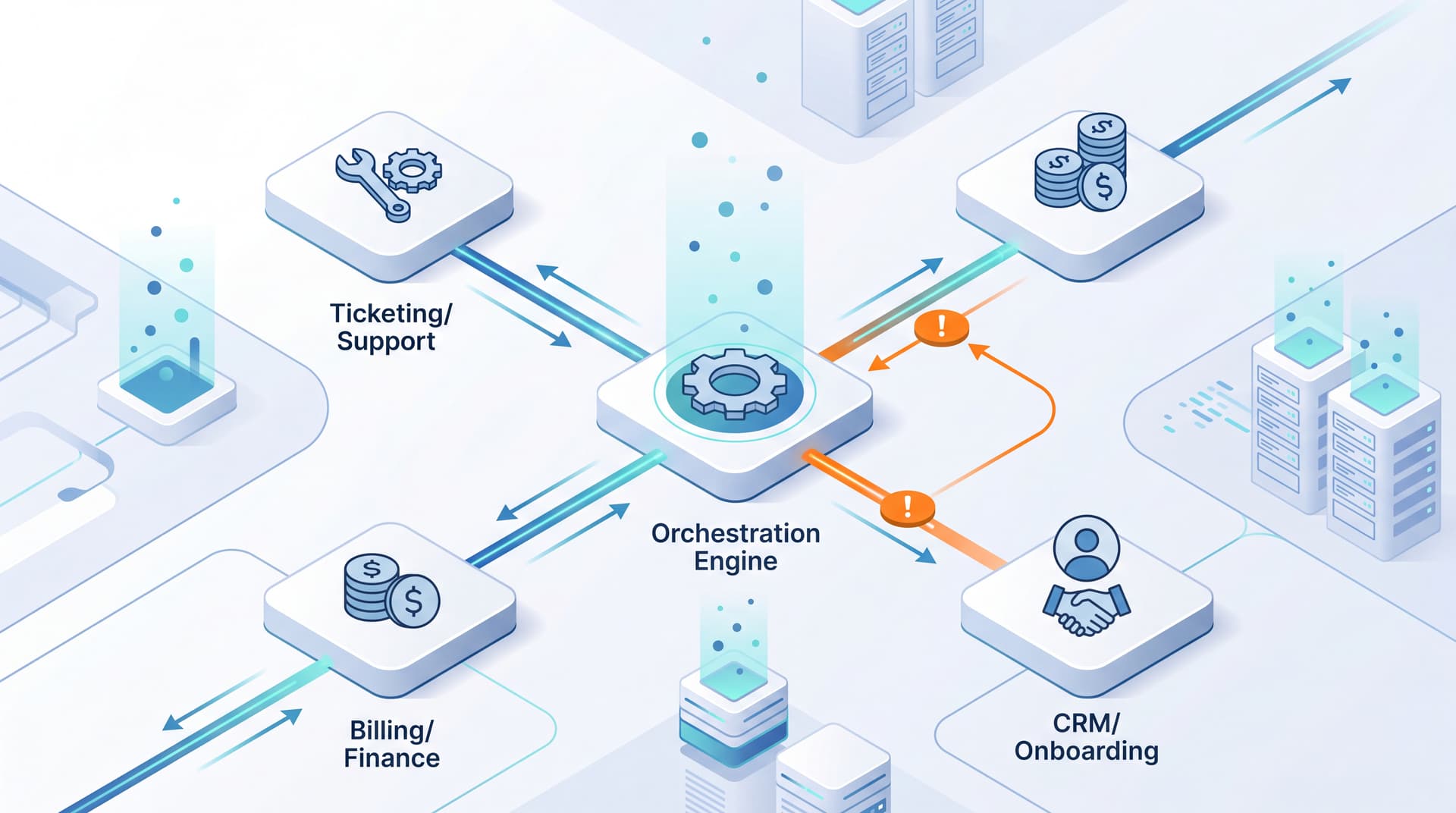
In modern IT environments, business processes rarely live within a single application. A standard client request can touch a Professional Services Automation (PSA) tool, a CRM, a finance platform, and multiple line-of-business applications. Moving data seamlessly across these boundaries requires robust workflow automation and a systems-thinking approach to cross-system orchestration.
API-Based Automation vs. UI Bots
When organizations begin automating, they often rely on UI bots (Robotic Process Automation or RPA) that mimic human clicks and keystrokes. While UI bots are highly effective for legacy systems lacking modern interfaces, they are inherently fragile. A simple interface update can break a UI-based workflow.
For true cross-system orchestration, API-based automation is the gold standard. APIs provide a direct, machine-to-machine communication layer that is version-controlled and structural. When your PSA talks to your finance software via an API, the integration is faster, more secure, and highly resilient to application updates.
The Critical Role of Idempotency
When orchestrating complex workflows, network timeouts and system glitches are inevitable. This is where idempotency becomes crucial.
An idempotent workflow ensures that if an automation script runs multiple times due to a retry after a temporary network failure, the end result remains exactly the same as if it had run only once. For example, if a workflow is designed to create a new user account, an idempotent design will first check if the account exists, preventing the creation of duplicate records or triggering unintended cascading errors across interconnected systems.
Smart Failure Notifications
Silent failures are the enemy of orchestration. A well-designed workflow automation system does not just execute tasks; it actively monitors its own health.
Instead of sending generic job failed emails that get buried in a crowded inbox, modern orchestration relies on contextual failure notifications. These alerts specify exactly which API endpoint timed out, what payload was rejected, and which step of the workflow needs attention, allowing engineers to resolve bottlenecks immediately.
Real-World Orchestration Examples
Connecting disparate systems unlocks massive efficiency gains. Here is how cross-system orchestration impacts everyday operations:
- Ticketing to Resolution: A high-priority alert triggers an API call that automatically creates a ticket in your PSA, assigns the correct engineer based on CRM data, and posts a notification in a dedicated team chat channel.
- Automated Billing: When an engineer logs project hours in the PSA, the workflow automation instantly synchronizes the data with your finance platform. It calculates the specific client rates and queues the invoice for approval, eliminating manual data entry.
- Seamless Onboarding: A new hire record created in your HR system triggers a cascading workflow that provisions Microsoft 365 accounts, assigns role-based access in your security tools, and orders hardware, all without a single manual IT ticket.
Next Steps
Achieving resilient, API-driven orchestration requires strategic planning and deep integration expertise. Map your highest-friction workflows with Bitscaled automation architects today and start building a more connected, efficient ecosystem.