Enterprise Integration Beyond Silos
Modern enterprise tech stacks rarely suffer from a lack of specialized tools. Instead, the challenge lies in the friction between them. When PSA platforms, CRMs, billing engines, and line-of-business applications operate in isolation, manual intervention becomes the default bridging mechanism. Unifying these platforms requires moving from simple point-to-point scripts to robust cross-system orchestration.
API-Based Automation vs. UI Bots
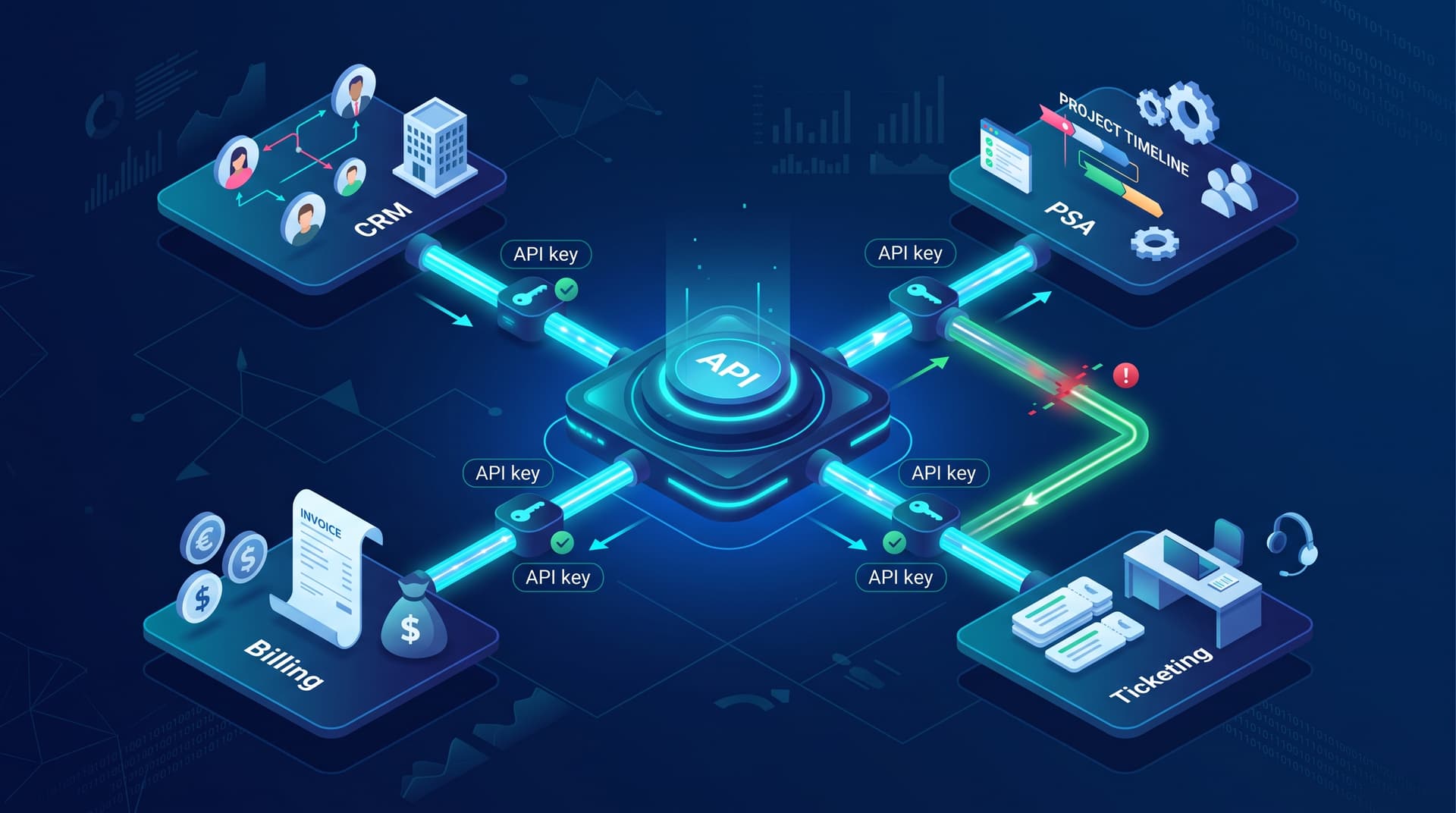
When connecting legacy and modern systems, architecture teams typically choose between direct API-based orchestration and Robotic Process Automation (RPA) UI bots.
- API-Based Orchestration: Interacts directly with application backends via REST, GraphQL, or gRPC endpoints. It is deterministic, high-throughput, and resilient to frontend layout changes. Payload validation and structured error codes allow for immediate error recovery.
- UI Bots (RPA): Simulates human clicks and keystrokes on graphical interfaces. While useful for legacy software lacking accessible endpoints, UI bots are fragile. Minor DOM updates, resolution shifts, or unexpected modal popups can break execution flows.
For mission-critical workflows across financial, ticketing, and administrative tools, API-driven integration remains the gold standard for long-term stability and execution speed.
Guaranteeing State Integrity with Idempotency
In distributed systems, networks drop connections, endpoints time out, and services restart mid-execution. Without careful engineering, retrying a failed automation payload can cause duplicate invoices, inflated ticket counts, or corrupted customer profiles.
Idempotency ensures that an operation can be applied multiple times without changing the result beyond the initial execution. Designing idempotent workflows involves:
- Deterministic Unique Keys: Assigning a unique correlation ID (e.g., combining
customer_idandbilling_period) to every transaction payload. - State Verification Before Execution: Querying the target system to confirm whether an entity or record already exists before sending a creation request.
- Upsert Semantics: Utilizing API endpoints that natively support update-or-insert operations rather than standard creation calls.
Operational Resilience: Notifications & Exception Handling
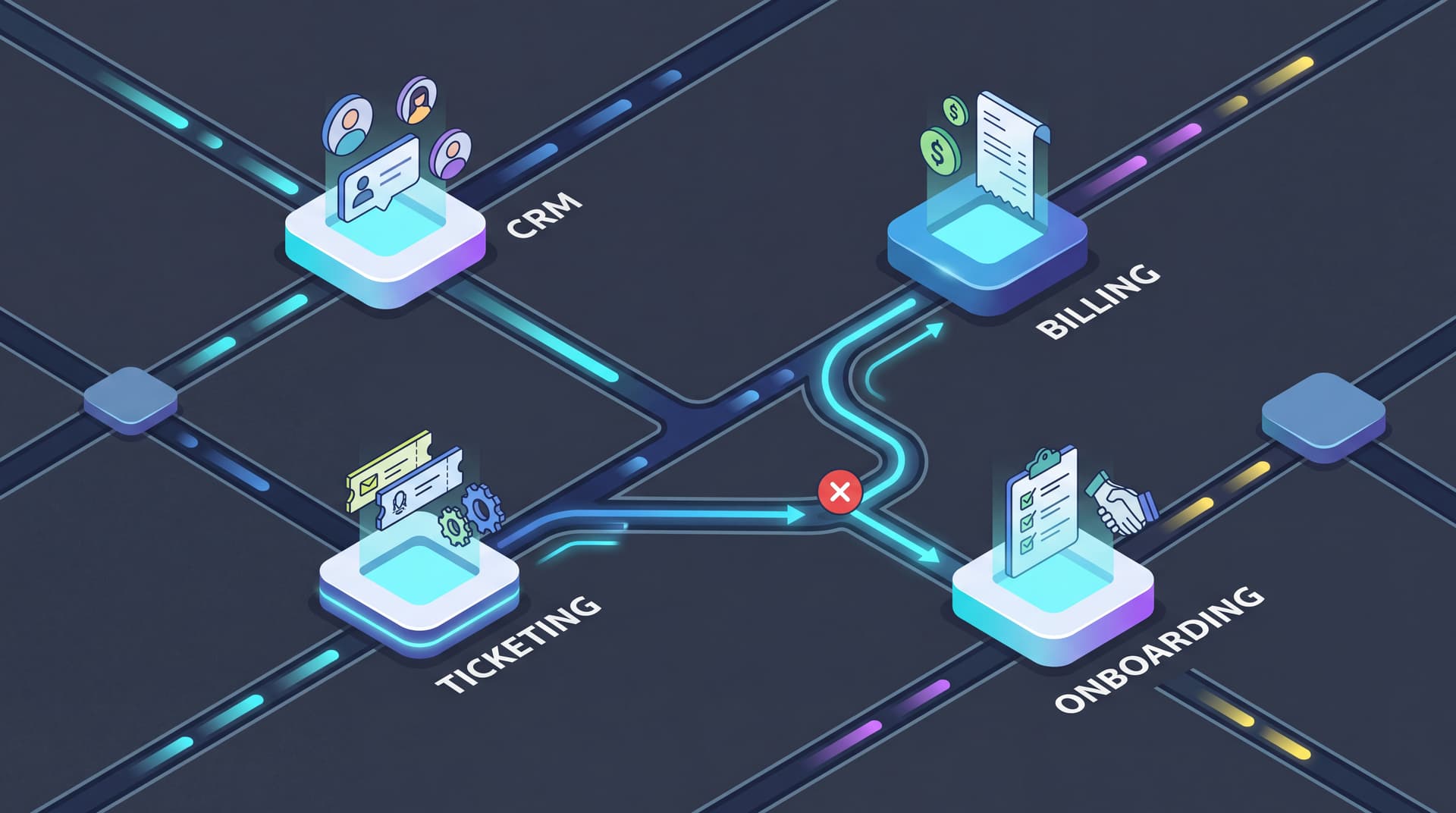
Automated pipelines should fail gracefully. Unhandled workflow failures lead to silent data drift, leaving operational teams unaware of discrepancies until downstream processes break.
Production-ready orchestration frameworks implement multi-layered exception handling:
- Automated Retry Policies: Exponential backoff with jitter for transient HTTP status codes (e.g., 429 Rate Limited, 503 Service Unavailable).
- Dead-Letter Queues (DLQ): Route persistent payloads that fail validation (e.g., 400 Bad Request) to isolated queues for inspection without blocking the primary pipeline.
- Context-Rich Alerts: Dispatch targeted notifications via Webhooks, Slack, or PagerDuty containing execution state, payload diffs, and precise stack traces so engineers can resolve edge cases quickly.
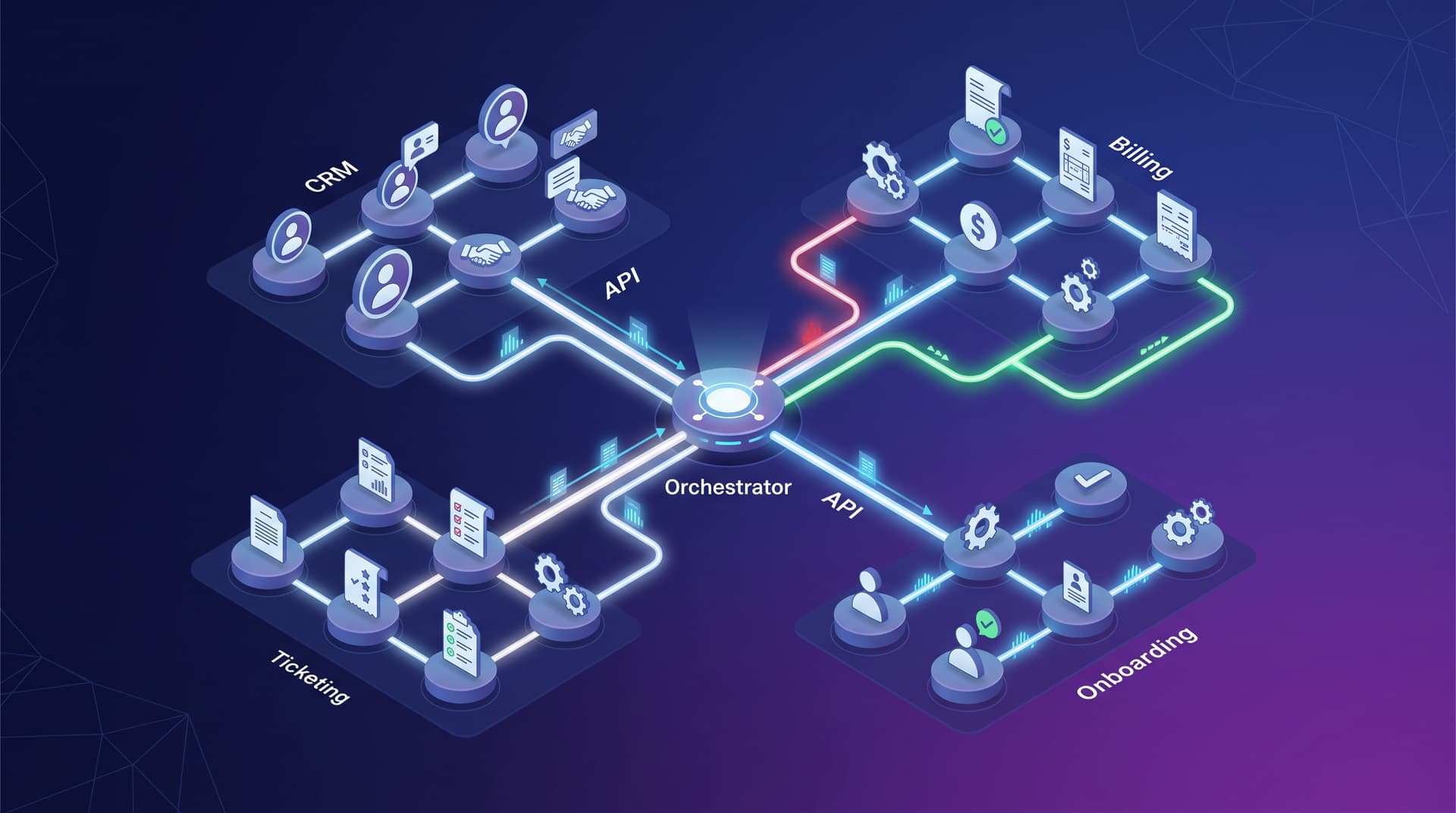
Orchestration in Action: Ticketing, Billing, and Onboarding
A unified orchestration workflow streamlines customer lifecycle management across departments:
- Opportunity Closure (CRM): A deal marks as "Closed-Won," triggering an orchestration event containing contract metadata.
- Automated Onboarding (Line-of-Business & Identity): The orchestrator provisions user accounts, provisions tenant workspaces, and sets permission groups via directory APIs.
- Billing Synchronization (Finance): An idempotent transaction creates the recurring subscription record and generates the initial invoice, attaching the exact CRM contract ID.
- Support Provisioning (PSA/Ticketing): A primary account ticket is generated in the support portal, populated with service-level agreement (SLA) tiers and account details.
By executing these steps through a centralized orchestration layer rather than fragmented webhooks, organizations maintain atomic execution across all systems.
Unifying Your System Architecture
Cross-system workflow automation turns disparate software investments into a cohesive operational engine. By emphasizing API-first integration, idempotency, and proactive alerting, enterprises can scale operations without increasing administrative overhead.
Map your highest-friction workflows with Bitscaled automation architects.