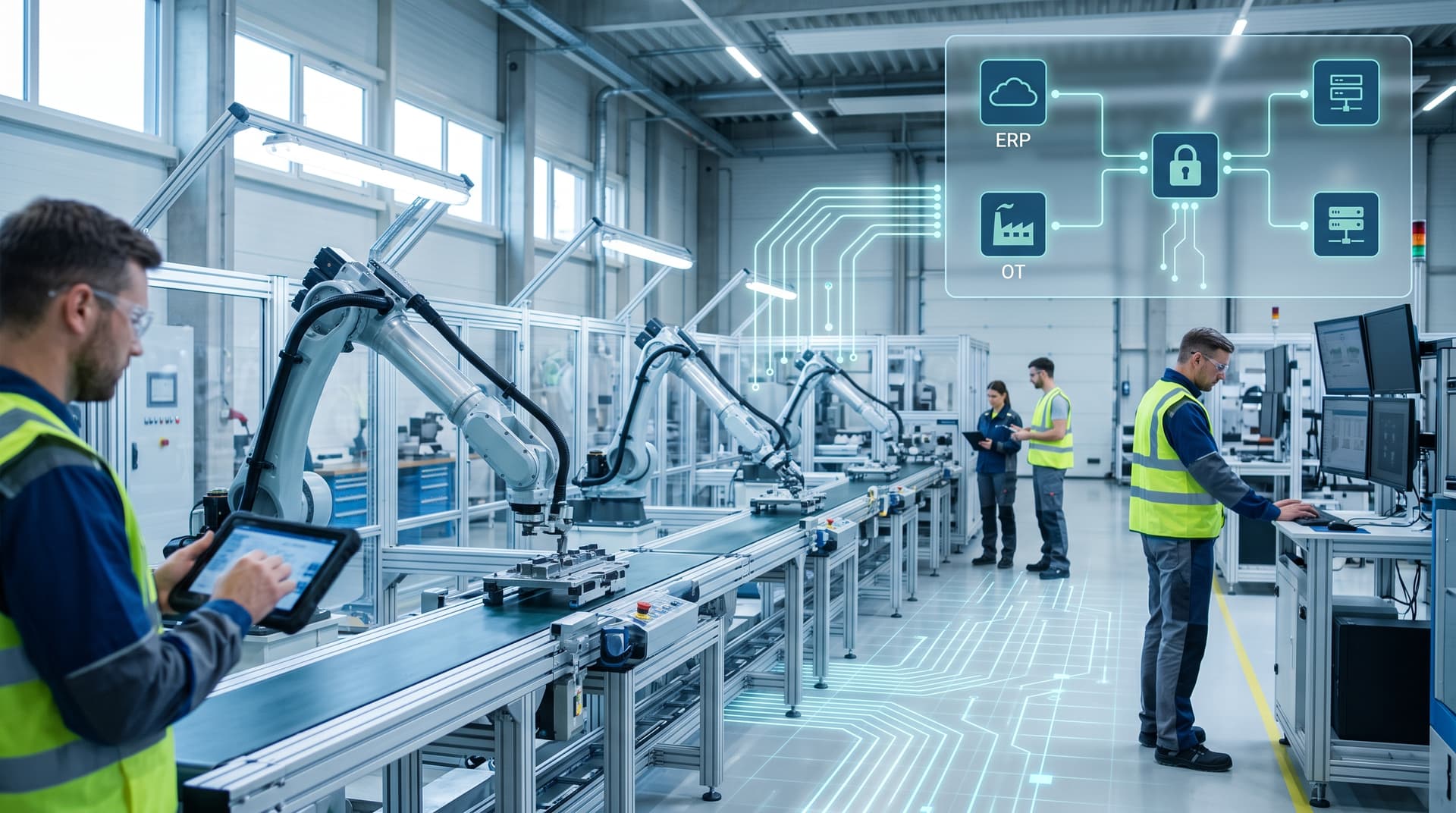
In advanced manufacturing environments, the line separating enterprise business logic from physical production has effectively dissolved. High-throughput facilities rely on real-time data flows between Enterprise Resource Planning (ERP) databases and Operational Technology (OT) assets on the factory floor. When an ERP application experiences latency, database locking, or an unscheduled outage, the operational impact spreads instantly beyond administrative offices down to assembly lines, automated staging areas, and dispatch bays.
When shop floor operators cannot validate bill-of-materials (BOM) changes, verify serial numbers, or confirm inventory movements within the enterprise software, production stalls. Understanding and mitigating these risks requires aligning enterprise IT capabilities with the zero-downtime imperatives of plant floor operations.
Framing the Real Cost of Industrial Downtime
In executive discussions, downtime is often simplified into abstract revenue loss metrics. On the plant floor, however, the impact of an ERP or network outage is immediate, complex, and compounding. Rather than relying on generic industry averages or speculative dollar figures, manufacturing leaders must frame downtime through four distinct operational vectors:
- Direct Material Spoilage and Yield Loss: In process and hybrid manufacturing, a sudden loss of ERP orchestration during a batch cycle can render raw materials unusable or lead to off-spec yields that fail quality compliance standards.
- Labor Inefficiency and Unplanned Idle Time: Line operators, warehouse pickers, and logistics staff become blocked when warehouse management modules or MES-to-ERP sync points go offline. Labor costs continue to accumulate while productive throughput drops to zero.
- Upstream and Downstream Logistics Bottlenecks: Just-In-Time (JIT) and Just-In-Sequence (JIS) delivery models demand precision. A delayed dispatch confirmation can result in missed shipping windows, carrier detention penalties, and line-side shortages for downstream customers.
- Contractual Non-Compliance and Relationship Erosion: Delayed shipments trigger contractual late-delivery penalties and compromise vendor performance scores with major OEM customers.
To safeguard production resilience, organizations must build an infrastructure that insulates core plant activities from enterprise disruptions while maintaining data integrity across the ecosystem.
Hardening ERP Availability for Real-Time Production Continuity
Enterprise ERP systems—whether deployed in multi-tenant cloud environments, hybrid infrastructures, or on-premises datacenters—were historically designed for batch processing, financial reporting, and periodic inventory reconciliation. Modern smart factories, by contrast, operate on sub-second control cycles. Bridging this operational gap requires high-availability architectures engineered specifically for manufacturing execution.
Local Edge Buffering and MES Decoupling
To ensure continuous operation during enterprise network interruptions or ERP maintenance, facilities should implement edge-tier buffering between the Manufacturing Execution System (MES) and the core ERP database. By staging material movements, quality control check-ins, and completed work-in-progress (WIP) transactions locally, shop floor hardware continues operating without disruption. Once the ERP connection is restored, store-and-forward mechanisms replay buffered transactions synchronously or asynchronously, reconciling database states without locking active production tables.
Transaction Queue Optimization
High-volume automated equipment generating constant telemetry can overwhelm enterprise ERP database connectors. Manufacturing IT teams must implement queuing middleware (such as message buses or event brokers) to aggregate and throttle transactional traffic coming from Level 2 and Level 3 OT systems. Prioritizing critical transactions—such as inventory depletion and safety holds—over background telemetry ensures that core business functions remain responsive during peak production shifts.
Enforcing Strong OT/IT Boundaries and Network Segmentation
Connecting shop floor networks directly to enterprise IT infrastructure introduces significant cybersecurity vulnerabilities. Ransomware and malware originating from corporate email phishing attacks or compromised office workstations can traverse flat networks and reach critical industrial machinery. Establishing strict, defensible boundaries between OT and enterprise IT is essential for operational continuity.
The Purdue Model in Modern Architecture
While cloud computing and industrial Internet of Things (IIoT) architectures have evolved traditional network topologies, the foundational principles of the Purdue Enterprise Reference Architecture (PERA) remain vital. Industrial networks must maintain distinct logical and physical segmentation:
- Level 0/1 (Process & Control): Physical machinery, sensors, actuators, and Programmable Logic Controllers (PLCs) executing direct process control.
- Level 2 (Control Systems): Human-Machine Interfaces (HMIs) and Supervisory Control and Data Acquisition (SCADA) software.
- Level 3 (Operations Management): Manufacturing Execution Systems (MES), batch management, and site-wide historian databases.
- Level 3.5 (Industrial DMZ): An isolated boundary layer hosting jump boxes, proxy servers, and data mirrors. Direct traffic between Level 4 and Level 2/1 must be strictly prohibited.
- Level 4/5 (Enterprise & Cloud): Enterprise Resource Planning (ERP), corporate networks, and external internet egress.
Microsegmentation and Inspection
Implementing Next-Generation Firewalls (NGFW) at the Level 3.5 boundary allows IT and OT security teams to enforce granular traffic policies. Deep Packet Inspection (DPI) should be applied to industrial protocols (such as Modbus, EtherNet/IP, PROFINET, and OPC UA) to ensure that enterprise systems can only issue approved data requests to shop floor jump hosts or historians. Unidirectional security gateways (data diodes) can be deployed where plant telemetry must feed cloud analytics tools without opening inbound logical paths into plant control zones.
Coordinated Maintenance and Patch Management Windows
One of the greatest sources of friction between corporate IT and plant operations is software patch management. IT teams prioritize rapid vulnerability mitigation, while OT managers prioritize continuous operational uptime and equipment stability. Applying an unverified operating system patch to a SCADA host during an active production run risks crashing critical control services.
Collaborative Patching Protocols
To reconcile these competing priorities, organizations must adopt a structured patching framework tailored to manufacturing constraints:
| Lifecycle Phase | Focus Area | Key Action Items |
|---|---|---|
| 1. Staging & Validation | Non-Production Environment | Test vendor-approved patches on non-production control hardware and simulated ERP connectors to verify compatibility. |
| 2. Scheduled Windows | Maintenance Turnarounds | Align major system updates with planned plant turnarounds, holiday shutdowns, or preventative maintenance cycles. |
| 3. Virtual Patching | Threat Mitigation | Deploy Intrusion Prevention System (IPS) signatures at the Level 3.5 DMZ boundary to inspect and block exploit attempts targeting unpatched OT systems until physical maintenance windows open. |
| 4. Rollback Readiness | Risk Mitigation | Perform complete system state backups (bare-metal images) of HMIs, historians, and integration servers prior to applying any patch, ensuring rapid recovery if failures occur. |
By treating patch deployment as a shared operational routine rather than an administrative mandate, organizations maintain strong security posture without risking unscheduled downtime.
Securing Supplier Portals and External Integration Points
Modern manufacturing relies heavily on external collaboration. Supplier portals, electronic data interchange (EDI) platforms, and real-time vendor integration channels allow raw material suppliers, third-party logistics (3PL) providers, and equipment OEMs to interact directly with ERP scheduling engines. However, these external interfaces also expand the facility's attack surface.
Protecting Just-In-Time Integration Channels
Supplier portals must be architected with zero-trust principles. External vendors connecting to internal inventory schedules or delivery portals should never gain broad network access to enterprise assets or industrial zones. Key security requirements include:
- Zero Trust Network Access (ZTNA): Replace traditional client-to-site VPNs with application-specific ZTNA solutions that grant vendors access only to specific web portals or API endpoints without granting underlying network routing.
- Multi-Factor Authentication (MFA) and Ephemeral Access: Require strong multi-factor authentication for all vendor logins, enforcing strict session timeouts and access approvals for remote equipment diagnostics.
- API Security and Rate Limiting: Secure all RESTful or SOAP APIs connecting supplier ERPs to core production scheduling with robust token authentication, schema validation, and rate-limiting controls to prevent denial-of-service conditions or unauthorized data scraping.
- Continuous Monitoring: Audit vendor access logs continuously through central security analytics, capturing anomalous file transfers, configuration modifications, or out-of-hours activity.
Takeaway: Unifying plant operations and ERP infrastructure requires balanced controls—insulating physical machinery behind strict OT boundaries while maintaining high-availability data pipelines for enterprise planning.
Building Resilient Manufacturing Operations
Achieving true alignment between plant floor OT systems and enterprise ERP platforms demands deliberate architecture, proactive governance, and deep cross-functional collaboration between IT engineers and operations personnel. By enforcing microsegmentation, deploying edge buffering middleware, coordinating patch schedules, and securing third-party entry points, manufacturers eliminate single points of failure while unlocking real-time operational visibility.
To learn more about optimizing your manufacturing infrastructure, explore our specialized Advanced Manufacturing Industry Solutions and learn how our Managed IT Services can stabilize production systems with Bitscaled manufacturing IT programs. You can also evaluate your operational exposure with our interactive Ransomware Readiness Scorecard.