Clinical Reliability and Data Governance: Modernizing IT Architecture for Regional Healthcare Providers
When a clinical practice experiences an unexpected network outage or an electronic health record (EHR) freeze, the consequences extend far beyond technical inconvenience. Patient care stalls, intake desks backlog, diagnostic images cannot be retrieved, and clinical staff are forced onto paper charts—a manual process that increases human error risks and slows patient throughput. In modern healthcare environments, IT infrastructure is directly intertwined with clinical outcomes and operational viability.
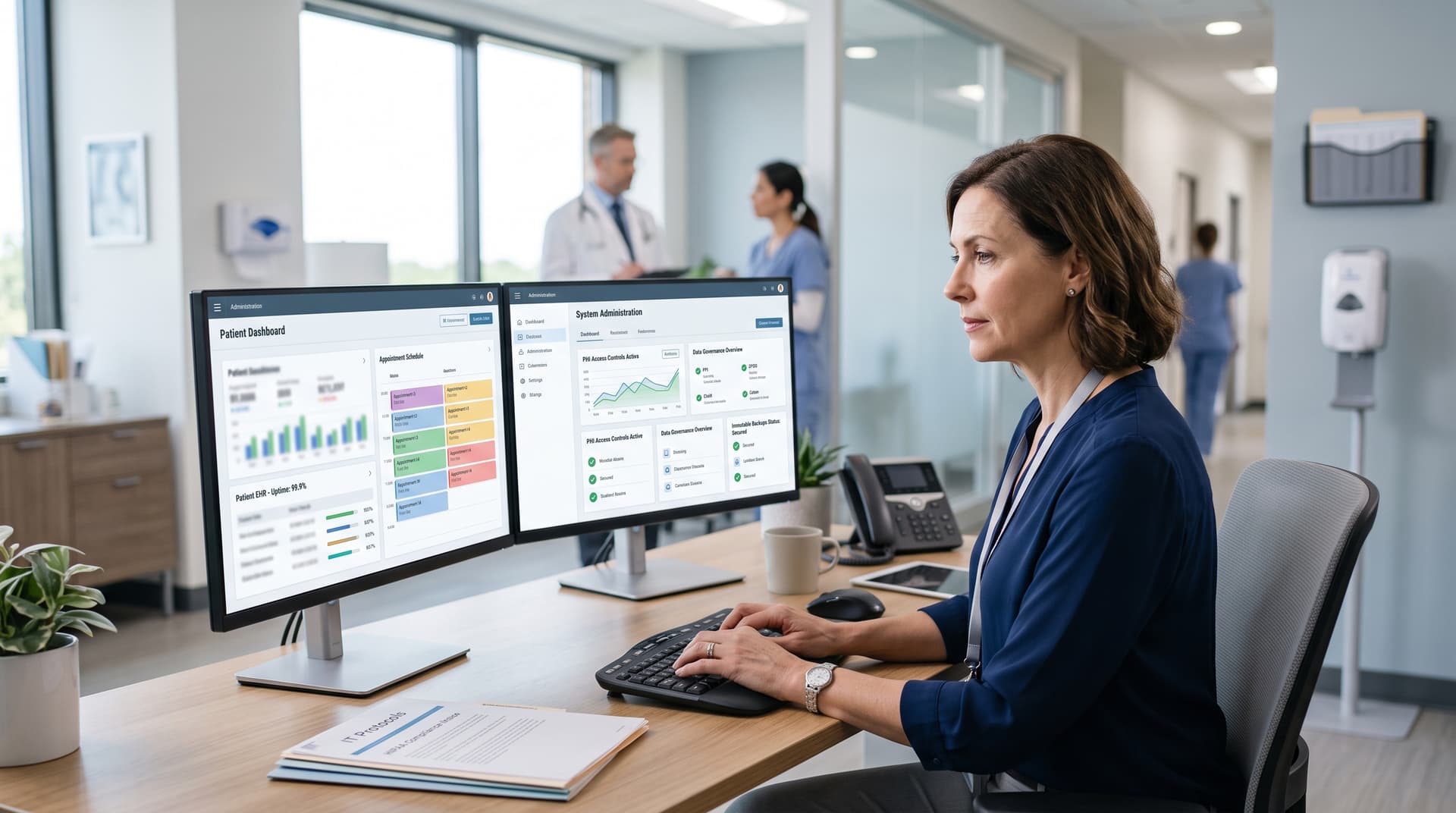
For medical practice administrators, compliance officers, and clinical operations managers across regional hubs—such as the expanding healthcare networks in Tampa Bay and throughout Florida—maintaining continuous system availability while safeguarding Protected Health Information (PHI) requires a dedicated operational strategy. Achieving this balance demands moving beyond passive compliance checklists to construct an IT ecosystem engineered for high availability, tight access controls, vendor accountability, and resilient disaster recovery.
Strategic EHR Uptime: Engineering Clinical Continuity
In a high-density ambulatory clinic or surgical center, seconds matter. Clinical staff rely on real-time chart access, e-prescribing tools, and laboratory integrations to deliver care efficiently. Achieving near-zero unscheduled downtime for cloud-hosted or on-premises EHR platforms requires redundant infrastructure and proactive monitoring tailored specifically to healthcare workflows.
Redundant Infrastructure and Carrier Diversity
Relying on a single internet service provider is a significant single point of failure for cloud-based EHR systems. Implementing Software-Defined Wide Area Networking (SD-WAN) paired with automatic failover to enterprise secondary connections (such as high-speed fiber from alternate carriers or cellular LTE/5G gateways) ensures that active clinical sessions persist uninterrupted during primary ISP degradation.
Proactive Maintenance and Staging
Routine system updates and database indexing must be scheduled outside peak patient care hours. By utilizing staging environments and automated system health checks, IT teams can validate updates prior to deployment, preventing software patches from disrupting morning patient intake.
| Operational Component | Standard IT Implementation | HIPAA-Aware Clinical Implementation |
|---|---|---|
| Network Connectivity | Single business-grade fiber connection | Dual-carrier active-active SD-WAN with seamless failover |
| EHR Patch Management | Automated overnight auto-updates | Staged testing with clinical application validation |
| System Monitoring | Standard ping and uptime alerts | Synthetic transaction checks monitoring login and charting speeds |
| Endpoint Security | Antivirus with periodic scanning | Endpoint Detection and Response (EDR) with real-time PHI telemetry |
Granular PHI Access Controls and Identity Lifecycle Management
Securing sensitive patient records requires strict enforcement of the principle of least privilege. Medical staff should only access the specific information necessary to perform their immediate job functions. Furthermore, identity management in healthcare environments must account for rapid clinical movement, shared workstations, and round-the-clock shift changes.
Role-Based Access Control (RBAC)
Role-based administrative policies ensure that front-desk receptionists, billing specialists, medical assistants, and attending physicians possess tailored permissions. For example, billing coordinators require access to insurance and demographic fields but do not need full access to clinical encounter notes or diagnostic imagery.
Frictionless Multi-Factor Authentication (MFA)
Implementing MFA across all clinical endpoints, remote portals, and web-based applications is essential for preventing unauthorized credential access. To avoid introducing friction into clinical workflows, practices can leverage hardware-based FIDO2 tokens, badged proximity taps, or push-notification authenticators that allow clinicians to authenticate in seconds without compromising security standards.
Session Management and Auto-Lock Controls
Workstations located in exam rooms or public-facing corridors must be configured with strict inactivity auto-lock policies. Combining physical proximity sensors or rapid badge-out software with short session timeouts mitigates the risk of unauthorized shoulder surfing or opportunistic record access when providers step away to attend to patients.
Takeaway: Security controls should never impede clinical care velocity. By integrating frictionless authentication methods like badge-tap MFA and automated session locking, practices uphold strict PHI privacy standards while maintaining optimal patient care flow.
Third-Party Vendor Risk and BAA Governance
Modern healthcare practices rely heavily on an ecosystem of third-party SaaS applications, digital intake forms, cloud storage platforms, and remote patient monitoring services. Under HIPAA regulations, engaging any third-party vendor that creates, receives, maintains, or transmits PHI on behalf of a covered entity requires a formal Business Associate Agreement (BAA).
Structuring a Rigorous Vendor Review Framework
- BAA Execution Prior to Onboarding: No vendor software or cloud infrastructure should ingest patient data prior to the legal execution of a comprehensive BAA that explicitly defines data ownership, incident notification obligations, and breach responsibilities.
- Technical Control Verification: Obtaining a signed BAA is an essential legal step, but technical controls must also be verified. Organizations must audit vendor SOC 2 Type II reports, encryption standards (such as AES-256 for data at rest and TLS 1.3 for data in transit), and vulnerability management practices.
- Continuous Vendor Auditing: Maintain an active inventory of all business associates, reviewing their security posture and contract terms on an annual basis or whenever significant configuration changes occur.
Immutable Backups and Regional Disaster Resilience
Ransomware threats targeting medical facilities aim to paralyze clinical operations by encrypting critical data repositories and local backup files. Additionally, practices operating in region-specific threat zones—such as Tampa Bay and greater coastal Florida—must account for physical disruption caused by tropical weather events, localized power loss, or municipal utility damage.
Immutable Architecture and the 3-2-1-1-0 Rule
To safeguard against data loss and extortion attempts, healthcare providers should implement immutable backup architectures. Immutable backups utilize Write-Once-Read-Many (WORM) storage controls, preventing backup data from being altered, encrypted, or deleted by unauthorized users or malware for a defined retention period.
Practices should follow the 3-2-1-1-0 rule:
- 3 copies of critical patient data
- 2 different storage media types
- 1 offsite copy hosted in a geographically separated region
- 1 immutable or air-gapped copy
- 0 errors verified through automated integrity restoration tests
Disaster Recovery and Clinical Recovery Timelines
Establishing precise Recovery Time Objectives (RTO) and Recovery Point Objectives (RPO) guarantees that clinical operations can resume within acceptable operational windows following an incident. For example, critical EHR databases may carry an RPO of under 15 minutes and an RTO of under 2 hours, ensuring minimal chart loss and rapid clinical resumption.
Human Risk Mitigation: Empowering Clinical Staff Against Phishing
While technical safeguards form the foundation of healthcare IT, human beings remain the primary vector for cyber intrusion. Clinical staff operating under heavy workloads and high-stress conditions are frequently targeted by socially engineered phishing emails, forged internal requests, and fraudulent vendor notifications.
Tailored Security Awareness Training
Generic security training often fails to engage medical staff. Effective awareness programs utilize short, context-specific micro-learning modules that highlight realistic clinical scenarios—such as fake lab result notifications, fraudulent prescription verification requests, or urgent e-fax updates.
Seamless Phishing Reporting Mechanisms
Nurses and administrative staff should be provided with single-click reporting mechanisms directly within their email clients. Encouraging an open, non-punitive reporting culture ensures that when a staff member accidentally clicks a suspicious link, the security operations center is notified immediately, enabling swift containment.
Strengthening Operational Infrastructure
Achieving seamless clinical continuity and robust data governance is an ongoing operational discipline. By pairing high-availability EHR architecture and strict identity controls with immutable backups and active third-party governance, practice managers can protect patient privacy without compromising clinical efficiency.
Bitscaled partners with regional healthcare practices to design and maintain HIPAA-aligned operational environments engineered for uptime and compliance rigor. To evaluate your organization's infrastructure readiness and clinical backup safeguards, learn more about our Healthcare IT Solutions or explore our comprehensive Cybersecurity Services.
Next Steps for Clinical Operations Leaders
- Audit current network redundancy and failover capabilities across all clinic locations.
- Review your active Business Associate Agreement (BAA) registry and verify vendor technical controls.
- Evaluate your ransomware readiness using Bitscaled's interactive Ransomware Readiness Scorecard.
- Request a HIPAA-aligned IT assessment from Bitscaled to pinpoint gaps in system availability and PHI protection.