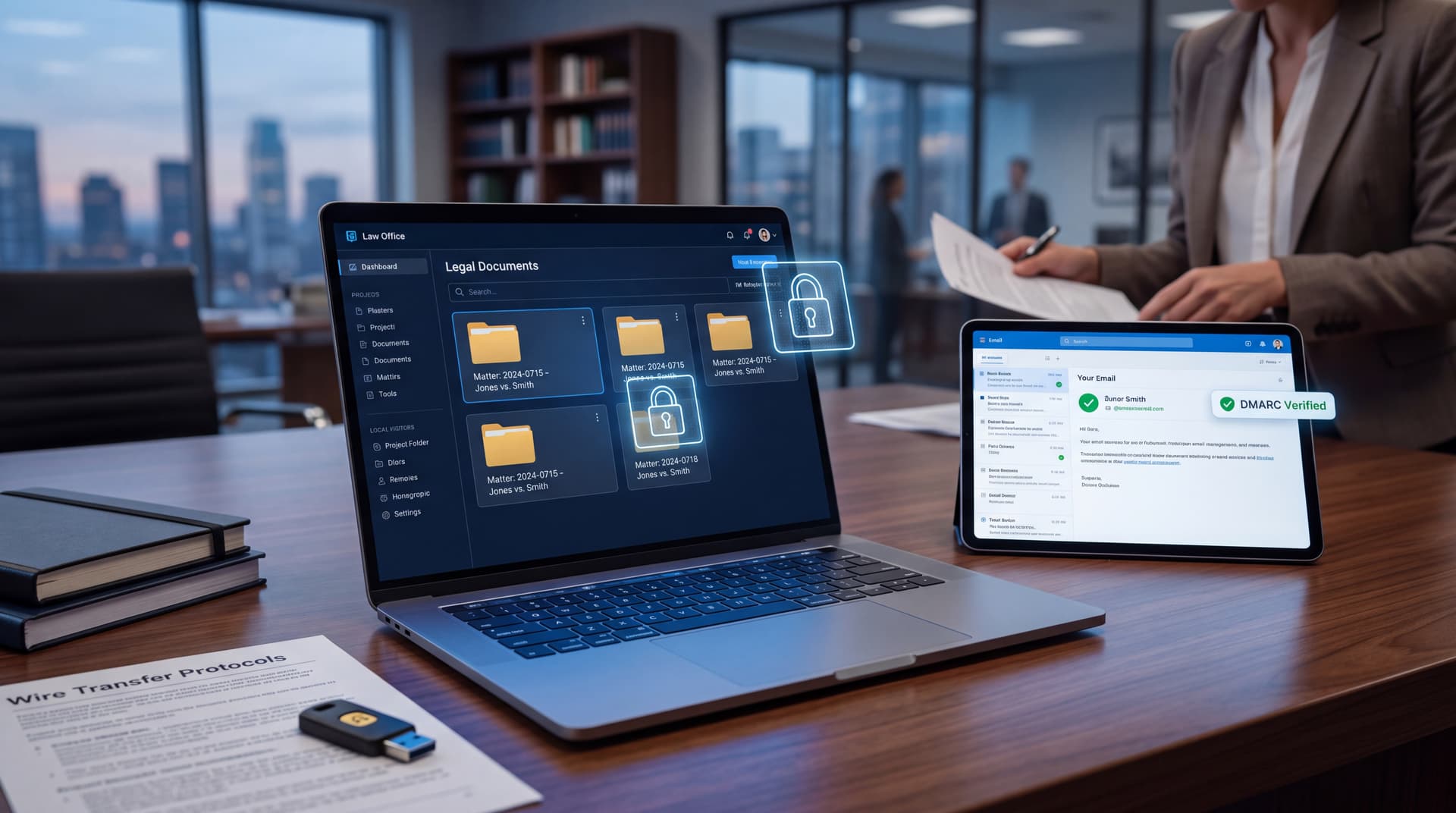
Mitigating Malpractice Risk in Law Firm IT: Matter Isolation, Email Authenticity, and Wire Protection
For law firms, cybersecurity is not merely an operational IT requirement—it is a direct extension of ethical responsibility and professional duty. Under ABA Model Rule 1.1 (Competence) and strict state bar confidentiality rules, managing partners and firm administrators must ensure client data remains completely privileged and inaccessible to unauthorized parties.
As threat actors increasingly target legal practices through business email compromise (BEC) and sophisticated phishing attacks, law firms must modernize their technical infrastructure. This guide covers the critical pillars of law firm IT security: matter-level data isolation, cryptographic email trust protocols, secure file sharing, and standardized wire-fraud prevention workflows.
1. Enforcing Matter-Level Data Isolation
Legacy legal IT environments often granted broad document access across entire practice groups or firm-wide active directories. This creates immense malpractice exposure when ethical walls are breached or internal accounts are compromised.
Modern matter security requires granular access controls based on the principle of least privilege:
- Dynamic Ethical Walls: Automatically restrict file access based on client conflicts and practice areas, ensuring attorneys only access records relevant to their active matters.
- Zero Trust File Governance: Enforce contextual permissions so that even if an associate's credentials are compromised, the adversary cannot exfiltrate unassigned matter files.
- Audit-Ready Logging: Maintain comprehensive access logs detailing who viewed, modified, downloaded, or shared any document within a matter container.
2. Eliminating Email Spoofing with DMARC, SPF, and DKIM
Email is the primary attack vector for legal cybercrime. Attackers frequently impersonate firm partners or senior associates to issue fraudulent instructions to clients or title companies. Establishing complete email authenticity requires mandatory deployment of three interconnected protocols:
- SPF (Sender Policy Framework): Specifies which mail servers are authorized to send email on behalf of your firm's domain.
- DKIM (DomainKeys Identified Mail): Attaches a cryptographic signature to outgoing messages, guaranteeing the content was not altered in transit.
- DMARC (Domain-based Message Authentication, Reporting, and Conformance): Enforces strict policies (
p=reject) instructing receiving servers to drop unauthenticated messages claiming to come from your domain.
Without an enforced DMARC reject policy, bad actors can easily spoof your domain, placing your firm's reputation and client trust at catastrophic risk.
3. Transitioning from Email Attachments to Secure File Sharing
Sending sensitive matter files or closing binders via unencrypted email attachments introduces critical security vulnerabilities. Standard email transit can be intercepted, and once an attachment is sent, the firm loses control over its lifecycle.
To preserve client confidentiality:
- Deploy Client Portals: Utilize encrypted, authenticated portals for exchanging sensitive documents and wire instructions.
- Enforce Link Expiration and Revocation: Share documents via expiring, password-protected links with dynamic watermarking rather than static PDFs.
- Disable Unsecure Downloading: For delicate deal rooms, restrict local file downloads and prevent clipboard copying.
4. Engineering Bulletproof Wire-Fraud Prevention Workflows
Real estate closings, settlement distributions, and escrow transfers make law firms prime targets for wire fraud. A single compromised email thread can lead to millions of dollars in misdirected funds and immediate professional liability claims.
Law firms must combine technical controls with non-negotiable operational workflows:
- Out-of-Band Callback Verification: Require verbal confirmation via a pre-established telephone number prior to releasing any wire instructions.
- Automated Banner Alerts: Implement automated email client banners highlighting external senders, subtle domain typos, or altered payment instructions.
- Dual-Authorization Controls: Require two independent partner approvals within accounting software before releasing escrow transfers.
Elevate Your Firm's Security Posture
Safeguarding client trust requires proactive IT governance. By combining matter isolation, rigorous email authentication, secure file distribution, and verified wire controls, your firm eliminates existential malpractice risks and establishes a resilient digital foundation.
Harden email authentication and access controls with Bitscaled to ensure your firm remains secure, compliant, and trusted by every client you represent.