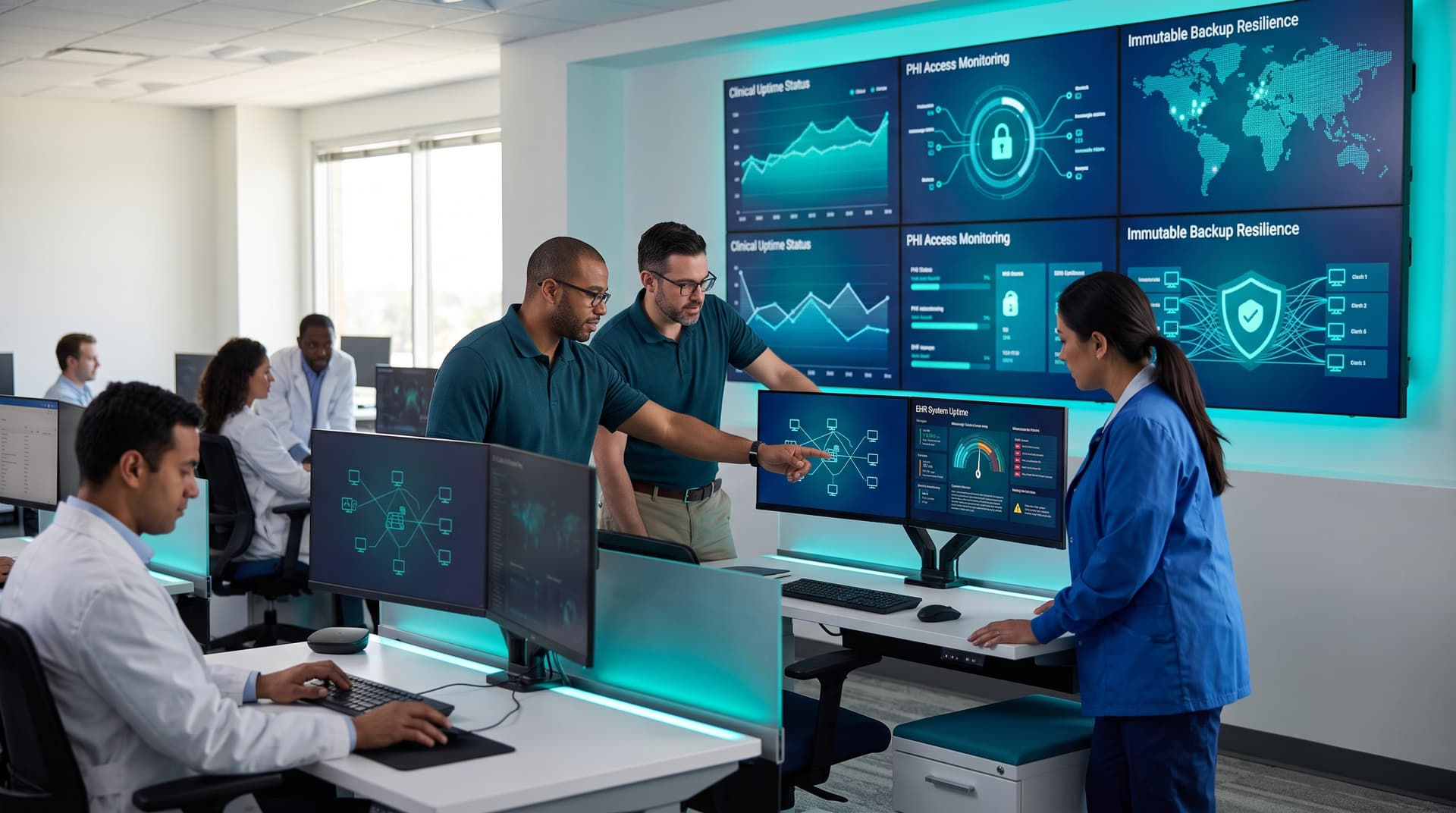
Peak operational windows reveal the true maturity of an organization's IT infrastructure. In SMBs across Florida and Tampa Bay—from bustling outpatient medical clinics and fast-moving law firms to regional logistics warehouses and precision manufacturing floors—the difference between revenue generation and an operational stall often comes down to a fifteen-minute window. When morning patient check-ins begin at 8:00 AM, when court filings must hit an electronic docket by noon, or when a warehouse loading dock releases its morning freight manifests, system responsiveness is non-negotiable.
Yet, many growing businesses operate under a fragile state of "working until it breaks." In these environments, IT stability depends heavily on single individuals performing ad-hoc troubleshooting, applying manual hotfixes, or bypassing standard protocols under stress. This culture of reactive heroics creates unpredictable downtime, security exposure, and operational friction precisely when the business can least afford it.
Transitioning to predictable managed IT requires shifting from individual firefighting to structured, repeatable operational governance. By establishing documented configuration standards, enforcing transparent escalation paths, maintaining rigorous endpoint baselines, and executing disciplined patch management cadences, managed service providers (MSPs) turn volatile IT environments into quiet, dependable utilities.
Eliminating the Heroics Culture
In many lean organizations, IT management defaults to an informal, reactive model. When a critical database connection drops during peak morning dispatch, an internal staff member or local technician jumps in to restart services, patch scripts on the fly, or temporarily disable security software to restore connectivity. While this intervention appears heroic in the moment, it leaves behind undocumented alterations, unpatched vulnerabilities, and technical debt.
A heroics-driven culture masks fundamental operational risks:
- Hidden Single Points of Failure: Technical knowledge remains trapped in personal notes or individual memory rather than standardized repositories.
- Inconsistent Configurations: Devices deviate from baseline security and operational policies over time, leading to configuration drift.
- Unpredictable Downtime: Systems are addressed after failure occurs, causing cascading delays during core revenue-generating hours.
A mature MSP model eliminates reliance on heroics by replacing ad-hoc fixes with defined operational standards. When technical problems arise, resolution follows pre-engineered runbooks rather than guesswork. This approach ensures that performance remains constant whether it is a quiet Tuesday afternoon or the busiest end-of-quarter push.
Documented Standards and Systemic Baselines
Predictable technology operations start long before a user opens a support ticket. They depend on maintaining strict environment baselines across every workstation, server, network switch, and cloud service.
Documented Technical Standards
Every workload must operate according to clear, written technical standards. This includes explicit rules for network segmentation, user access rights, cloud file permissions, and device provisioning. When network components or endpoints are deployed without adherence to documented architecture, minor environmental updates can trigger unexpected service outages.
Endpoint Baselines
An endpoint baseline defines the required software state, security telemetry, and performance thresholds for every laptop, desktop, and mobile device. By standardizing operating system builds, essential productivity software, localized firewall rules, and endpoint detection agents, IT operators can quickly identify anomalies. If an endpoint breaches baseline thresholds—such as abnormal CPU utilization or disabled monitoring agents—automated telemetry alerts engineers before the user experiences a workflow crash.
Patch Cadence and Escalation Ownership
Two critical operational pillars separate high-performing managed IT from basic helpdesk support: predictable patch management and clear escalation paths.
Structured Patch Cadence
Unplanned updates and deferred patches represent two sides of the same operational hazard. Mid-day reboot prompts disrupt critical workflows, while indefinitely delayed patches expose networks to severe security vulnerabilities.
A disciplined patch cadence addresses both risks:
- Staged Deployment: Updates are tested in sandbox environments prior to production rollout to prevent application conflicts.
- Off-Hours Maintenance Windows: System updates, reboot sequences, and third-party software upgrades are scheduled during pre-agreed non-business hours.
- Emergency Patching Protocols: Critical security advisories are evaluated against strict risk criteria, with clear change control procedures for rapid deployment.
Escalation Ownership
When technical issues occur during critical business windows, response latency is often caused by ambiguous handoffs. In an unmanaged or poorly structured environment, a low-tier helpdesk technician might retain a complex database latency ticket for hours before escalating it to a senior engineer.
Professional managed IT enforces clear escalation ownership. Tickets are classified immediately by business impact rather than simple queue placement. If Tier-1 technicians cannot resolve an issue within a defined window (such as 15 minutes for critical production bottlenecks), automated escalation protocols transfer ownership directly to specialized Tier-2 or Tier-3 infrastructure engineers, complete with full diagnostic logs.
Operational Scenarios: High-Pressure Windows in Action
To understand the practical impact of structured managed IT, consider how standardized operations perform during two high-stakes business scenarios.
Scenario A: The Legal Briefing & Court Filing Deadline
At a high-volume law firm, paralegals and attorneys prepare a complex filing due by 5:00 PM. At 3:30 PM, multiple workstations lose access to the document management system due to a localized network switch loop caused by an unauthorized peripheral connected in a conference room.
- Unmanaged Approach: The internal office coordinator attempts to troubleshoot local router settings, calls an external contractor, and manually restarts servers. The filing deadline is missed, resulting in procedural risk and wasted billable hours.
- Structured MSP Approach: Automated network monitoring detects the physical port anomaly instantly. The MSP's network operations team isolates the offending switch port remotely, restores document server access within eight minutes, and dispatches a notification detailing the root cause to the firm's administrative lead.
Scenario B: The Manufacturing & Logistics Shift Change
A regional logistics facility begins its 6:00 AM shift change, transferring regional freight tracking data to mobile scanners across the warehouse floor. A software update released overnight by a third-party vendor causes connection timeouts on un-baselined handheld devices.
- Unmanaged Approach: Floor supervisors spend two hours manually reconfiguring wireless network keys on forty devices while freight trucks idle outside the loading dock.
- Structured MSP Approach: Because device configurations are anchored to a central endpoint management profile, the MSP rolls back the incompatible software container across all handhelds via automated policy push at 5:45 AM—fifteen minutes before shift start—ensuring zero operational delay.
Qualitative Operational Comparison
To visualize how operational governance changes daily performance, consider the practical differences between reactive IT management and standardized managed IT:
| Operational Dimension | Reactive IT Model (Heroics-Driven) | Standardized Managed IT (Process-Driven) |
|---|---|---|
| System Visibility | Discovered when users report failures | Real-time continuous monitoring & telemetry |
| Patch Scheduling | Ad-hoc user prompts or complete neglect | Staged off-hours execution with change control |
| Issue Escalation | Undefined handoffs; tickets stall in queues | Tier-bound SLA triggers & automated ownership transfer |
| Device Configuration | Variable per user; manual setup | Standardized baseline images & central management |
| Root Cause Analysis | Rare; focus is on immediate hotfixes | Mandatory post-incident reviews and process updates |
Takeaway: True IT stability is achieved when critical daily workflows operate quietly, predictably, and without reliance on emergency workarounds or individual heroics.
Pre-MSP Operational Assessment Checklist
Before engaging a Managed Service Provider, business leaders and operational leads should evaluate prospective partners against clear technical criteria. Use this practical checklist during preliminary discussions:
1. Baseline Documentation & Asset Mapping
- Does the MSP audit and document all network topologies, credentials, and endpoint inventory during onboarding?
- Are device baseline configurations enforced automatically via central management software?
2. Service Level Agreements & Escalation Ownership
- Are ticket resolution expectations based on operational impact rather than standard submission order?
- Does the provider publish clear, documented escalation pathways from Tier-1 support to senior systems engineers?
3. Patch Cadence & Maintenance Schedules
- Are operating system and application patches tested in staging before production deployment?
- Does the provider offer scheduled off-hours maintenance windows aligned with your core operating hours?
4. Security & Endpoint Governance
- Is Endpoint Detection and Response (EDR) standard across all user devices?
- Are remote access policies governed by centralized access management and multi-factor authentication?
5. Operational Reporting & Business Alignment
- Does the MSP provide regular operational reports covering patch compliance, system uptime, and ticket trends?
- Are strategic technology reviews conducted periodically to realign infrastructure with business growth?
Partnering for Long-Term Operational Stability
Achieving consistent, quiet IT performance during high-pressure operating windows is not a matter of luck; it is the result of deliberate operational design. By eliminating reliance on informal heroics and establishing rigorous baselines, Tampa Bay and Florida businesses can protect revenue, support staff productivity, and maintain client trust.
Bitscaled delivers structured, reliable infrastructure support designed for high-volume operational environments. Explore our Managed IT Services or utilize our Microsoft 365 Security Snapshot to begin evaluating your organization's technical foundation.
To take the next step toward predictable technology operations, contact Bitscaled today to schedule a comprehensive managed IT assessment for your business.