From Fragile Scripts to Engineered Bot Operations
Robotic process automation (RPA) promises significant throughput improvements for back-office operations, but unengineered bots frequently fail under real-world operational pressure. Achieving long-term uptime requires moving beyond simple UI recording and treating workflow bots as critical system components. This guide outlines how operations managers can systematically evaluate processes, design resilient exception handling, and deploy continuous monitoring.
Candidate Selection: Engineering Criteria for RPA
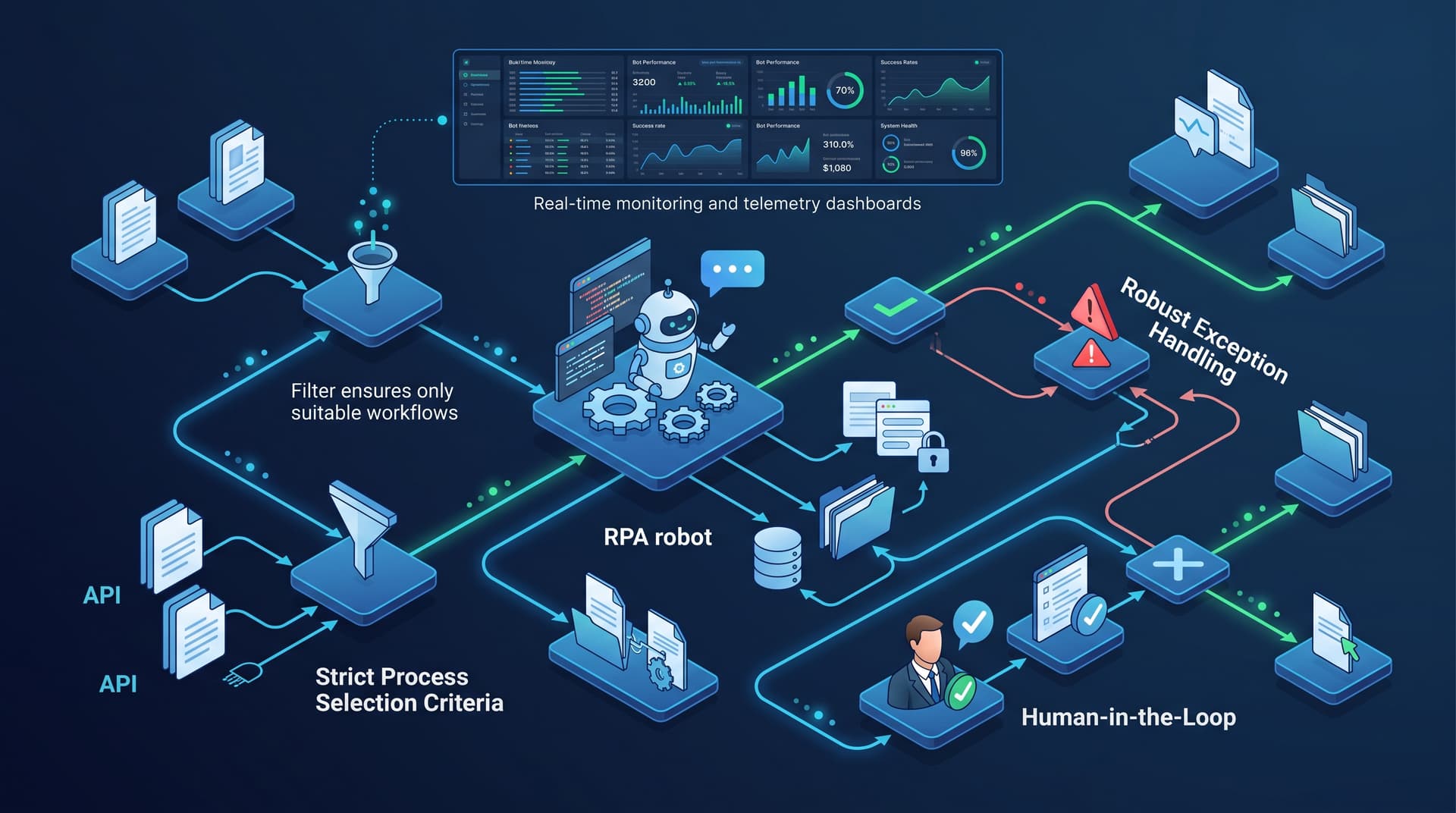
Not every repetitive task belongs in an RPA pipeline. High-reliability RPA deployments require processes that meet strict technical criteria:
- Deterministic Business Logic: Rules must be absolute, with clear binary outcomes for every branch.
- Structured and Digital Inputs: Inputs should consist of standard digital assets like PDFs, CSVs, or structured database records.
- Stable Target Interfaces: Applications should have stable UI elements and predictable maintenance schedules.
- High Frequency and Volume: Tasks executed daily or hourly yield the fastest operational payback.
Workflow Transformation: Accounts Payable Invoice Matching
To understand the operational shift, consider a standard Accounts Payable (AP) workflow before and after RPA integration:
Before RPA (Manual Workflow)
- Finance staff opens incoming emails with PDF invoices.
- Staff manually cross-references line items against purchase orders in the ERP.
- Staff logs into the accounting portal to record invoice details and flag discrepancies via email.
- Result: High cycle times and potential human data-entry errors during peak billing cycles.
After RPA (Engineered Workflow Bot)
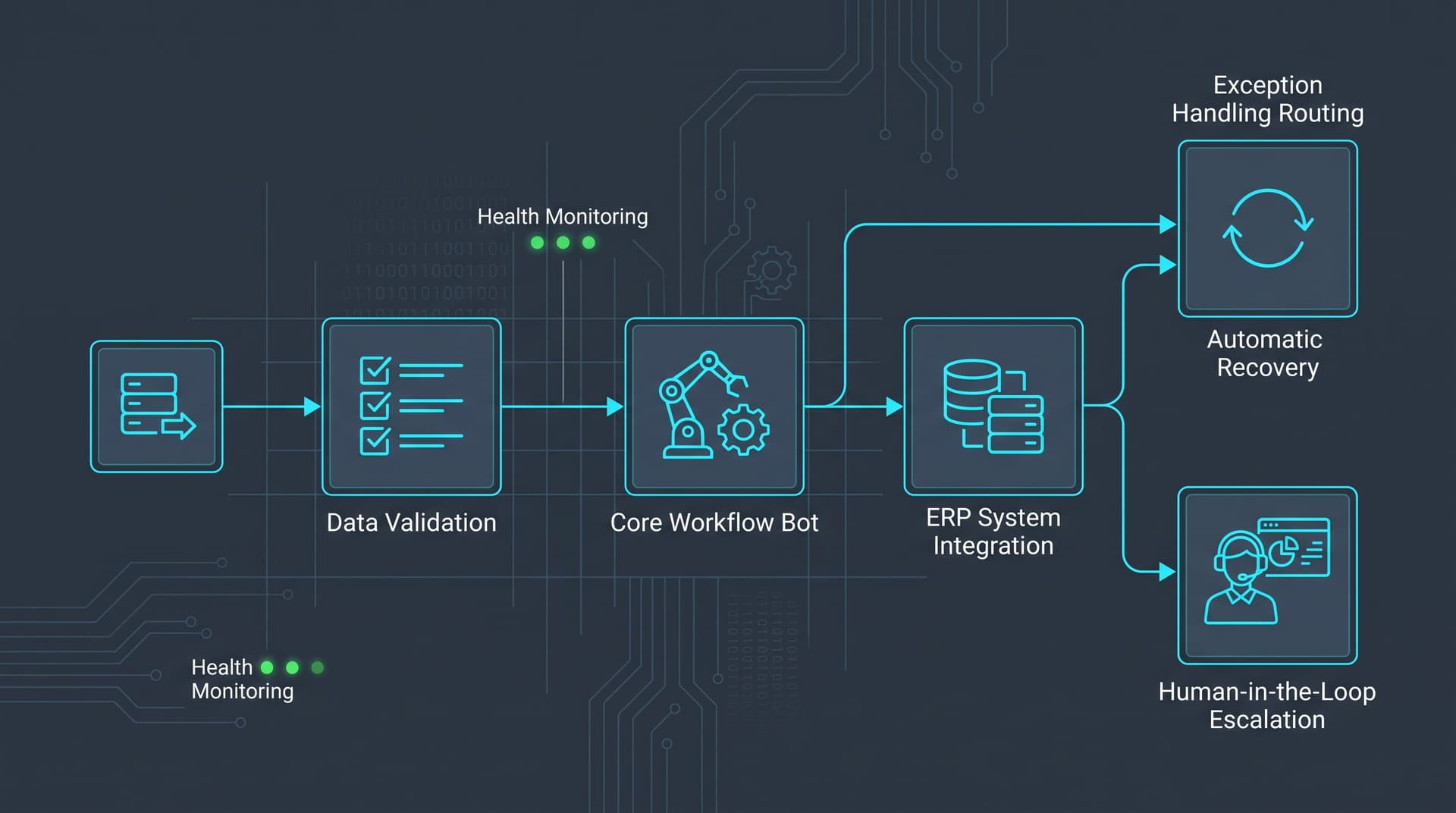
- Bot monitors the AP inbox and extracts structured data from incoming PDF invoices.
- Bot queries the ERP via UI or database calls to match line items automatically.
- Standard invoices are posted directly for payment; discrepancies trigger a structured human-in-the-loop exception ticket.
- Result: Rapid, repeatable invoice posting with human intervention reserved exclusively for true discrepancies.
Exception Handling and Operational Monitoring
Reliability depends on distinguishing between System Exceptions (e.g., target system downtime, network timeouts) and Business Exceptions (e.g., vendor tax ID missing, price mismatch):
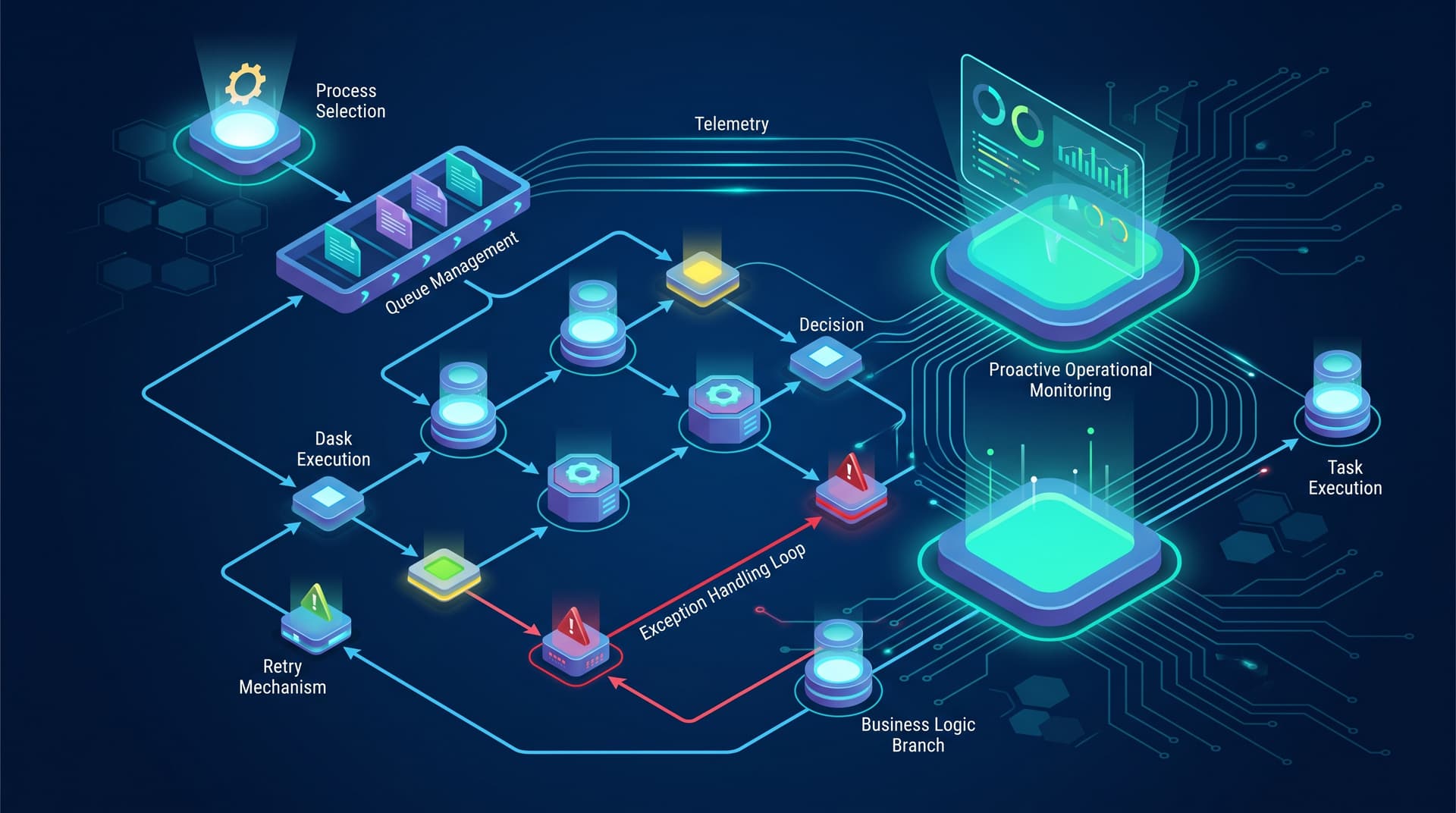
- Retry Mechanisms: Transient system faults should trigger exponential backoff retry policies before escalating.
- Graceful Failure Isolation: A single failed record must never crash the entire queue; bots should isolate failed transactions and continue processing.
- Telemetry and Dashboarding: Monitor key metrics like success rates, average transaction velocity, queue depth, and exception counts in real time.
When NOT to Use RPA
While RPA excels at bridging legacy systems, it is not always the correct architectural choice. Avoid RPA under these conditions:
- APIs Are Available: Native REST or SOAP APIs are inherently more stable and faster than UI-based automation.
- Unstable User Interfaces: If underlying web or desktop applications undergo frequent layout updates, maintenance overhead will outweigh operational gains.
- Unstructured Decision Making: Tasks requiring subjective judgment or contextual evaluation are better suited for AI workflows or human operators.
Engineering Sustainable Automation
Sustainable RPA requires disciplined process evaluation, structured exception handling, and continuous operational oversight. By targeting high-stability workflows and maintaining clean boundaries between human judgment and automated execution, teams can unlock consistent efficiency gains.
Ready to elevate your operational efficiency? Identify your first RPA candidate process with Bitscaled.