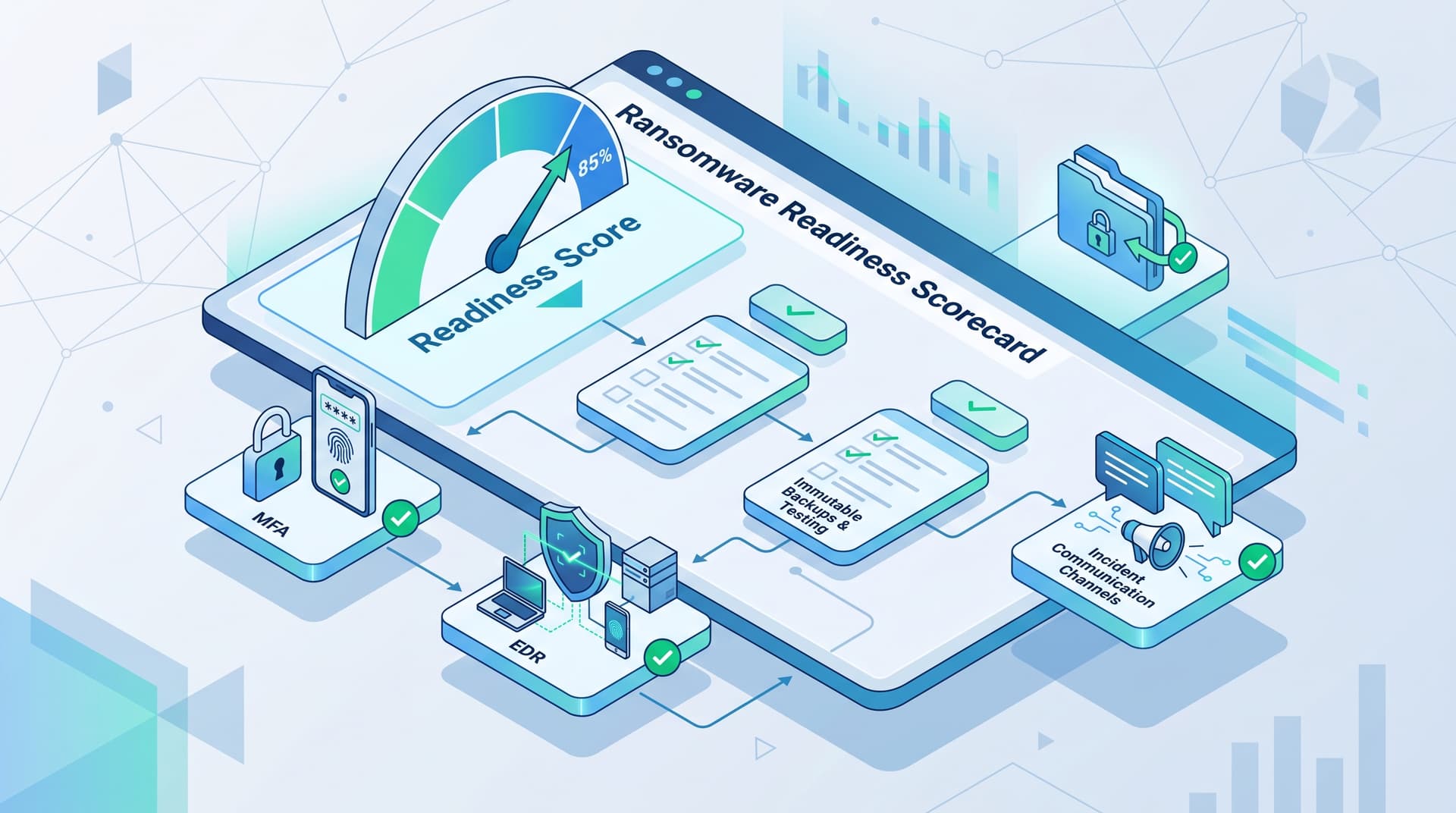
From Score to Action: Translating Ransomware Readiness into Operational Resilience
For executive leadership teams, cyber insurance renewals and board audits are no longer simple annual checkboxes. Underwriters and compliance auditors demand measurable proof of cyber resilience, evaluating your organization's capability to withstand, contain, and recover from sophisticated ransomware attacks.
Completing Bitscaled's Ransomware Readiness Scorecard provides a vital baseline. However, a score is only as valuable as the execution that follows. Translating your assessment band into a prioritized remediation plan ensures your team addresses critical security gaps before an incident occurs.
Score Bands and Operational Priorities
Readiness scores typically fall into three primary bands:
- Foundational (Below 60%): Immediate exposure to identity compromise and uncontained lateral movement.
- Developing (60%–84%): Essential defenses are present, but operational gaps remain in testing, coverage, or emergency response workflows.
- Resilient (85%+): Strong technical controls combined with validated, regularly tested response mechanisms.
Regardless of where your score lands today, remediation should follow a structured priority path.
Priority 1: Identity and Endpoint Safeguards (MFA & EDR)
Identity management and endpoint control form the primary containment boundary against ransomware deployment.
- Universal Multi-Factor Authentication (MFA): Enforce phishing-resistant MFA across all remote access points, administrative accounts, and cloud environments. Partial MFA deployments remain a primary vector for credential theft.
- Endpoint Detection and Response (EDR): Deploy managed EDR across 100% of server and workstation endpoints. Ensure agent isolation controls and 24/7 detection monitoring are active to halt lateral movement instantly.
Priority 2: Immutable Backups and Backup Testing
Backups are your ultimate safety net against data loss and extortion—provided they cannot be encrypted or wiped by attackers.
- Immutability and Isolation: Store critical backups in write-once-read-many (WORM) storage or air-gapped repositories that cannot be altered using compromised domain administrator credentials.
- Routine Backup Testing: Moving beyond backup completion checks, perform regular restore validation testing. Verifying clean operational recovery under realistic conditions ensures recovery time objectives (RTO) and recovery point objectives (RPO) can actually be met.
Priority 3: Incident Response Contacts and Communication Plans
Technical controls must be supported by operational clarity when network availability is compromised.
- Incident Response (IR) Escalation Trees: Maintain vetted, out-of-band contact lists for internal leadership, external legal counsel, cyber insurance breach coaches, and specialized IR retainers.
- Out-of-Band Communication Plans: Primary email and messaging tools may be compromised during an active incident. Establish alternative, secure communication channels to coordinate technical and executive responses safely.
Next Steps: From Scorecard to Tabletop Exercise
Evaluating your security posture is step one. Validating your readiness under pressure is what builds true organizational resilience.
Start by taking Bitscaled's Ransomware Readiness Scorecard to pinpoint your high-priority remediation targets. Once your baseline is established, schedule a custom tabletop exercise with Bitscaled to test your incident response team, refine communication plans, and ensure audit readiness.