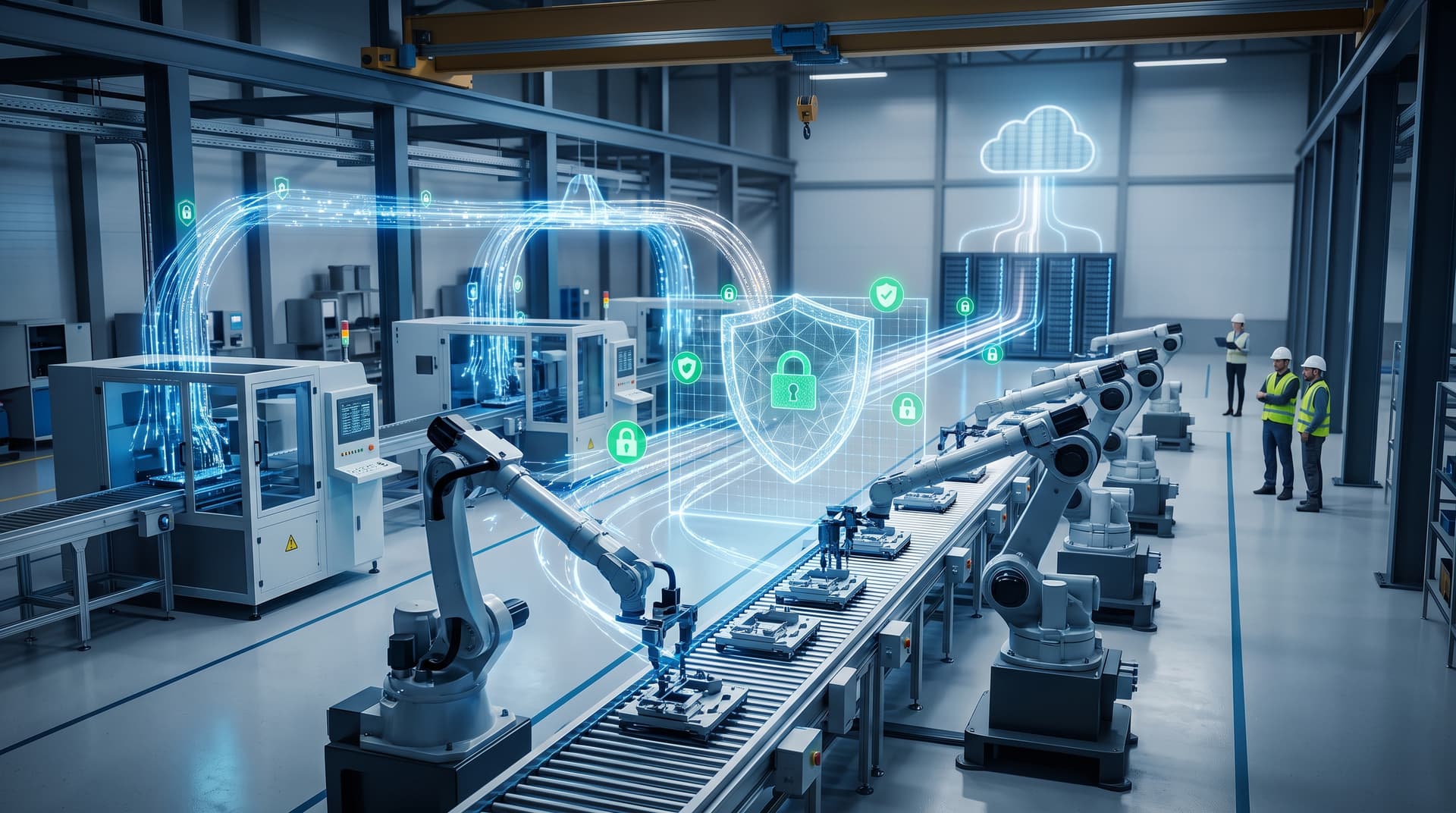
Resilient Industrial Operations: Bridging ERP Systems with Plant Floor Execution
Modern manufacturing facilities operate on tight schedules, lean inventories, and just-in-time delivery models. At the heart of these operations lies the complex ecosystem connecting Enterprise Resource Planning (ERP) platforms with Operational Technology (OT) on the plant floor. While ERP platforms manage master schedules, bill of materials (BOM), inventory accounting, and customer dispatch, OT systems—including Programmable Logic Controllers (PLCs), Human-Machine Interfaces (HMIs), Supervisory Control and Data Acquisition (SCADA) systems, and Manufacturing Execution Systems (MES)—directly orchestrate the physical machinery.
When these two domains communicate seamlessly, manufacturers achieve high operational velocity, real-time yield tracking, and precise inventory control. However, when the boundary between IT and OT is poorly architected or vulnerable to network disruptions, the impact is felt immediately on the shop floor.
The Real Cost of Downtime on the Factory Floor
In an advanced manufacturing environment, system downtime cannot be measured solely by IT ticketing metrics or server reboot times. Unplanned outages at the interface of ERP and OT introduce immediate, compounding financial and physical consequences across the entire enterprise:
- Scrapped Raw Materials and In-Process Inventory: Interrupted batch processing often leads to thermal, chemical, or dimensional degradation of raw materials, requiring complete disposal of batch loads.
- Idle Labor and Secondary Bottlenecks: Line workers, machine operators, and logistics staff are forced into non-productive waiting states while downstream processes become congested.
- Missed Delivery Schedules and SLA Penalties: Delayed production runs trigger expedited shipping fees, contract penalties, and long-term erosion of customer trust.
- Safety and Re-Validation Overheads: Sudden system drops can trigger emergency shutdowns, requiring lengthy safety inspections, recalibrations, and quality re-validations before restarting equipment.
Rather than treating ERP availability as a purely corporate IT responsibility, operations leads and plant managers must view enterprise systems as critical utilities that directly sustain physical throughput.
Establishing Robust OT/IT Boundaries
Historically, plant networks relied on physical air-gapping to keep industrial automation secure. Today, the demand for real-time telemetry, automated job dispatch, and enterprise resource visibility renders absolute isolation impractical. Instead, manufacturing organizations must implement structured network segmentation that isolates sensitive OT zones while facilitating controlled data exchange with enterprise systems.
Following established industrial cybersecurity frameworks, such as ISA/IEC 62443, organizations construct multi-layered architectures that enforce strict boundary rules:
Comparative Framework: Enterprise IT vs. Industrial OT Governance
| Architectural Layer | Typical Systems & Functions | Key Security & Network Requirements | Primary Risk Factors |
|---|---|---|---|
| Enterprise IT (Level 4/5) | ERP, CRM, Business Intelligence, Supply Chain Portals | Standard corporate firewalls, central identity provider (IdP), zero-trust network access | Ransomware, phishing, cloud service outages |
| Industrial DMZ (Level 3.5) | Data historians, patch mirrors, jump hosts, staging databases | Unidirectional gateways, strict proxying, dual-homed security appliances | Lateral movement from corporate network to OT |
| Plant Operations (Level 3) | MES, SCADA servers, local batch management | Segmented VLANs, role-based access control, active anomaly detection | Compromised operational software, unauthorized remote access |
| Control & Sensing (Levels 0–2) | PLCs, RTUs, HMIs, drives, physical sensors | Isolated fieldbus networks, disabled physical ports, strict protocol filtering | Direct exploit of legacy unauthenticated protocols |
Takeaway: Never establish direct database-to-PLC or direct client-to-control network connections. All ERP-to-plant communication must pass through an Industrial DMZ using middleware, message brokers, or secure API gateways that sanitize data and queue transactions asynchronously.
Navigating Patch Windows and ERP High Availability
Enterprise ERP updates, database patches, and operating system maintenance are non-negotiable for maintaining cybersecurity and system stability. However, scheduling routine maintenance windows in 24/7 or continuous-run manufacturing environments presents a persistent operational challenge.
If a plant floor MES or SCADA system relies on synchronous database calls to the ERP for every job release or barcode scan, an ERP reboot directly halts production. To decouple production lines from enterprise IT maintenance schedules, plant IT architects must build local resiliency layers.
Resiliency Strategies for Continuous Uptime
- Asynchronous Store-and-Forward Buffering: Implement edge gateways and local MES data stores that queue material movements, inspection results, and production counts locally during enterprise system offline windows. Once the ERP returns online, queued transactions automatically sync back to core enterprise databases without operator intervention.
- Staged Patching Sequences: Avoid monolithic, plant-wide IT maintenance windows. Group production lines into distinct operational cells and execute rolling updates during planned tool changes, preventive maintenance (PM) shifts, or product line changeovers.
- Redundant Application Containers and Clusters: Deploy ERP application tiers and integration middleware across high-availability clusters with automated failover capabilities, ensuring database maintenance does not disrupt active API services.
Maintenance Window Readiness Checklist
- Local MES/SCADA systems confirmed capable of operating in offline/buffered mode for at least 12 continuous hours.
- Barcode scanners, labeling printers, and vision systems configured to use local caching services during network isolation.
- Pre-maintenance health checks validated on all edge integration nodes and Industrial DMZ proxies.
- Emergency manual fallback procedures documented and accessible on physical paper or ruggedized offline tablets at each supervisor station.
- Rolling rollback plan tested and verified prior to executing production-tier database or ERP upgrades.
Securing Supplier Portals and Vendor Access
Modern manufacturing ecosystems rely heavily on third-party vendors, OEM technicians, and supply chain partners. Equipment vendors frequently require remote access to service specialized robotics or update controller firmware, while suppliers require portal access to track raw material consumption and trigger automated replenishment.
While these integrations streamline maintenance and supply chain logistics, vendor access points represent one of the most significant attack vectors targeting industrial environments.
Hardening External Access Points
- Zero-Trust Privileged Access Management (PAM): Vendor technicians must never be granted broad VPN access to plant networks. Implement ephemeral, session-based PAM solutions that require explicit operational approval before a remote connection is opened.
- Isolated Session Jump Hosts: Require all remote vendor sessions to terminate at a secure jump host within the Industrial DMZ. Record all remote desktop and command-line sessions for security auditing and operational compliance.
- Supplier Portal Isolation: Host vendor-facing inventory and ordering portals in isolated cloud or corporate DMZ environments. Never allow direct connections from vendor portals into internal SCADA networks or local manufacturing execution databases.
- Multi-Factor Authentication (MFA) & Hardware Tokens: Enforce mandatory phishing-resistant MFA for all external supplier access and vendor maintenance portals without exception.
Operational Governance and Unified Systems Visibility
Achieving sustained alignment between manufacturing IT and plant operations requires ongoing cross-functional governance. Plant floor engineers and corporate IT teams must break down traditional operational silos to establish unified visibility across both environments.
By integrating plant network security telemetry into central security monitoring platforms, IT and OT leadership gain a single pane of glass into potential network bottlenecks, unauthorized connection attempts, and equipment communication anomalies before they result in downtime.
When security and availability are treated as integrated operational requirements, plants preserve high throughput, protect critical intellectual property, and build a resilient foundation for long-term digital transformation.
Transform Your Manufacturing IT Infrastructure
Ensuring high ERP availability while hardening plant floor OT networks requires specialized architecture, rigorous security controls, and operational focus. Bitscaled partners with advanced manufacturers to build resilient IT/OT architectures, secure vendor access channels, and deploy high-availability infrastructure tailored for continuous production environments.
Explore our dedicated Advanced Manufacturing Solutions or learn more about our Managed Infrastructure Services and Cybersecurity Services to protect and scale your operations. Contact our team today at Bitscaled to schedule an operational continuity assessment.