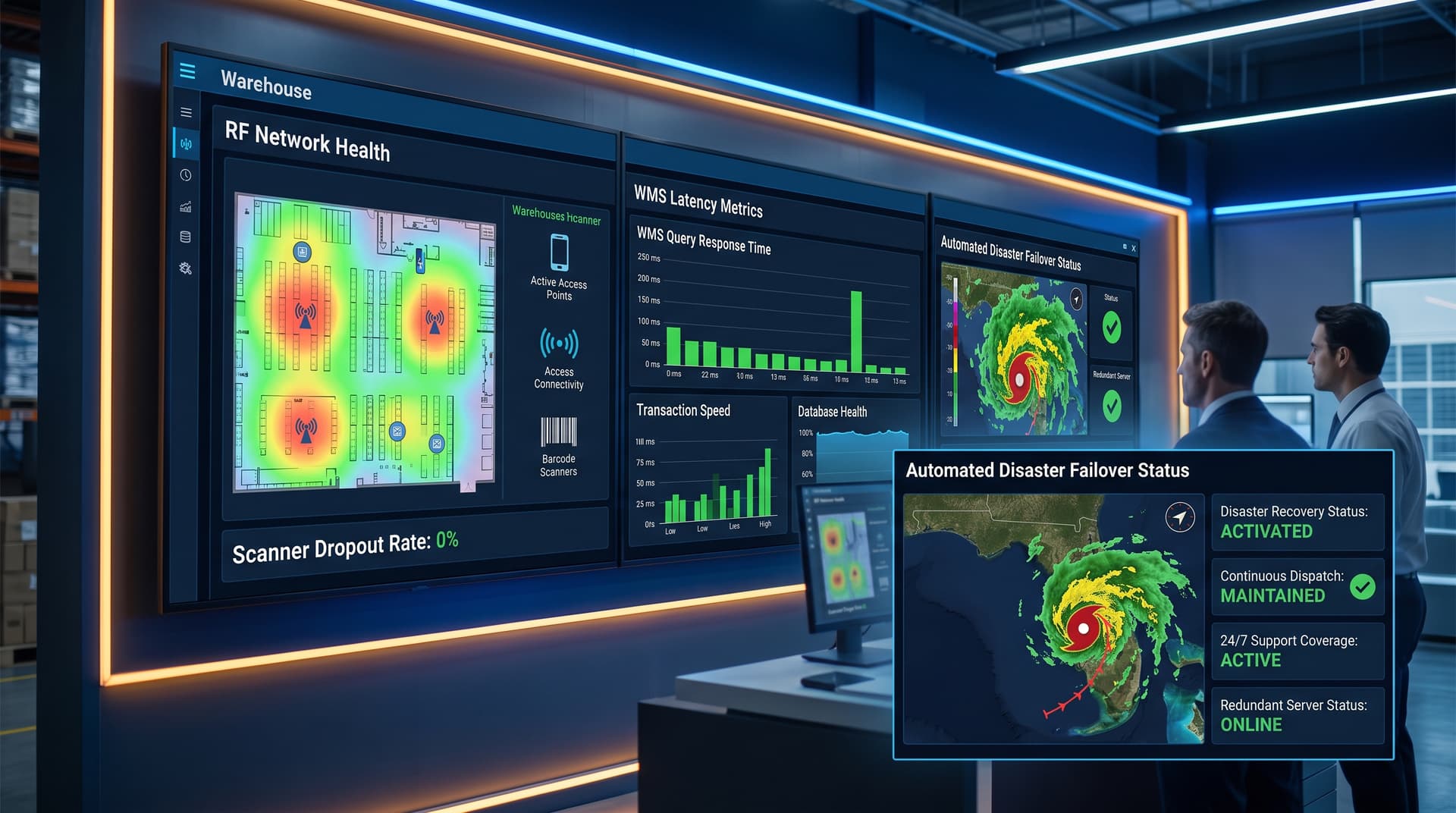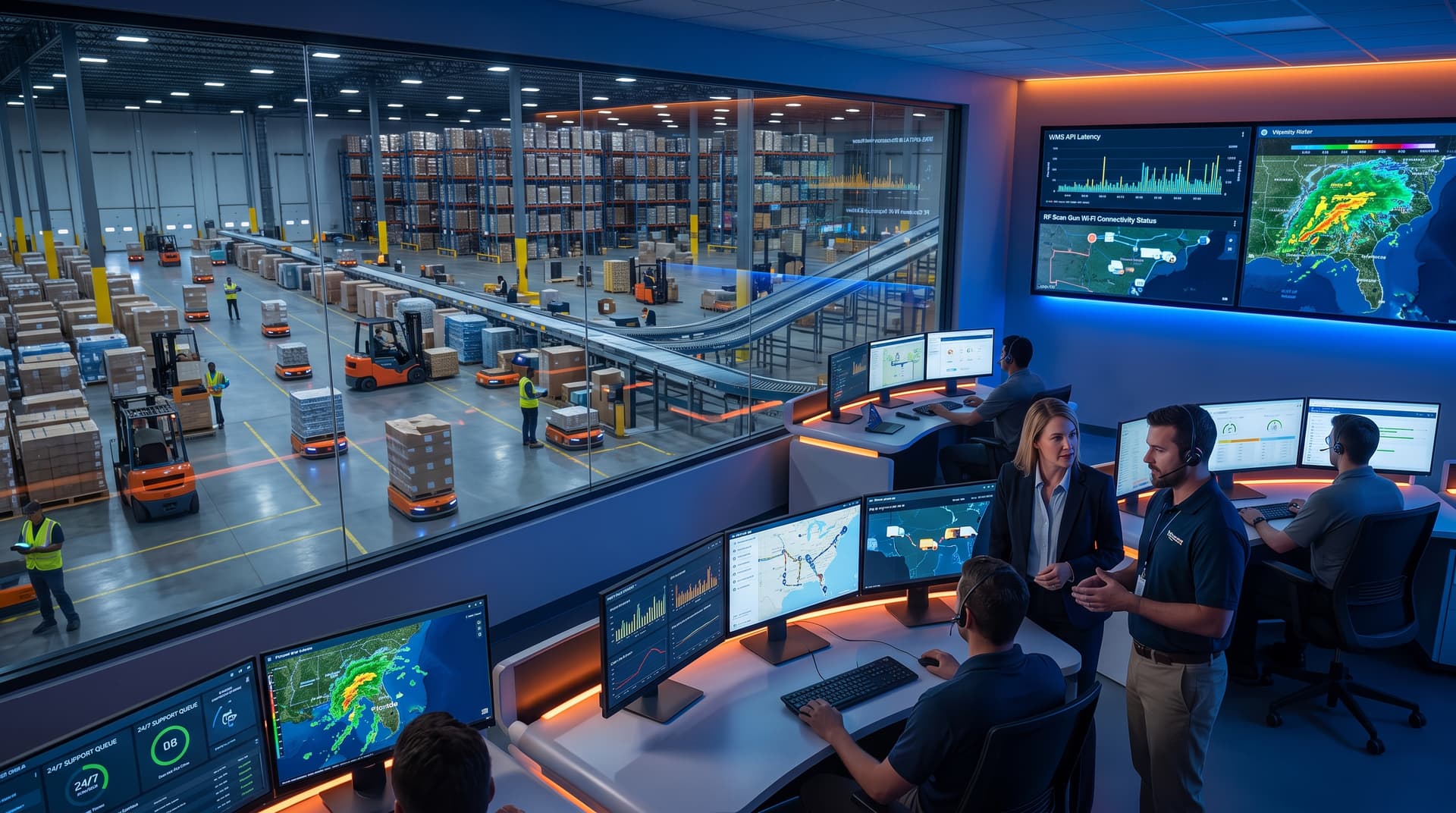
In high-throughput distribution environments, a three-second delay on an RF scan gun is not merely a technical nuisance—it is an operational tax that compounds across thousands of daily picks. When warehouse management systems (WMS) lag or transportation management systems (TMS) fail to synchronize dispatch schedules, fulfillment cycles slow down, dock doors back up, and order accuracy suffers. For logistics facilities operating across Florida and high-velocity corridors, these infrastructure challenges are further amplified by severe weather threats, grid volatility, and round-the-clock shift schedules.
Achieving peak operational throughput requires treating logistics IT not as a background utility, but as an active driver of facility uptime. By engineering resilient radio frequency (RF) networks, optimizing database transaction flows, establishing dedicated after-hours support models, and implementing weather-hardened continuity plans, operations leaders can safeguard their margins and keep freight moving continuously.
Resolving RF Wi-Fi Disconnects Across Dense Racking
Industrial warehouse environments represent one of the most challenging radio frequency environments in enterprise networking. High-density steel racking, tall stacks of corrugated materials, metal shipping containers, liquid inventory, and constantly moving material handling equipment create severe signal attenuation, multipath interference, and dynamic RF shadows. Standard enterprise wireless deployments fail quickly under these conditions.
When handheld RF scan guns drop connections while selectors move down aisles, several operational breakdowns occur simultaneously:
- Session Timeouts: Warehouse selectors are forced to manually log back into WMS terminal sessions, wasting minutes per occurrence.
- Transaction Duplication: Scans fail to register on the application layer while completing on the device, creating stock reconciliation discrepancies.
- Unpredictable Pick Routes: Loss of real-time server acknowledgment stalls pick-path guidance on voice and screen-directed units.
Engineering High-Density Industrial Wi-Fi
To achieve uninterrupted roaming for handheld devices, network architects must transition from omnidirectional overhead access points (APs) to targeted directional coverage patterns. Key technical practices include:
- Aisle-Specific Directional Antennas: Installing narrow-beam patch antennas pointing down racking aisles confines the RF footprint where selectors travel, preventing signal bleed into adjacent aisles and reducing co-channel interference.
- Fast BSS Transition Standards (802.11r/k/v): Enabling IEEE roaming standards ensures handheld scanners pre-authenticate with target access points before dropping the current connection. This reduces handoff times from several seconds down to under 50 milliseconds.
- Elevated Power Tuning and Dynamic Channel Assignments: Static power levels often lead to asymmetry, where scan guns receive strong downlink signals from APs but fail to send uplink packets back due to smaller internal antennas. Calibrating transmit power matching device output prevents silent drops.
Eliminating WMS and TMS Latency and Processing Bottlenecks
Even with optimal wireless connectivity, warehouse productivity halts if the WMS or TMS experiences system latency. When a selector scans a barcode, that event initiates a rapid chain of backend queries: validating inventory location, locking stock allocation, updating order status, and calculating the next optimal pick location. If database response time lags by even one second per item, overall facility throughput drops precipitously.
Root Causes of Supply Chain Software Latency
WMS and TMS processing slowdowns typically stem from three technical choke points:
- Database Lock Contention: High-volume picking shifts generate simultaneous write requests to central inventory tables, creating locks and queue wait times.
- Unoptimized Batch API Polling: Legacy integrations between TMS dispatch systems and WMS inventory modules frequently rely on aggressive polling routines that saturate application servers during peak hours.
- Network Bandwidth Bottlenecks: Unmanaged network traffic across local area networks (LAN) allowing background software updates or video security streams to compete with critical transaction data.
To maintain sub-second response times across picking, packing, and shipping workflows, operations teams must implement dedicated integration patterns and network traffic prioritization. Modern messaging queues (such as Kafka or RabbitMQ) can decouple non-critical background data synchronization from active order picking operations. Furthermore, Quality of Service (QoS) routing policies must tag and prioritize WMS and TMS application packets over general enterprise traffic.
| Issue Area | Operational Symptom | Infrastructure Solution |
|---|---|---|
| RF Scan Guns | Screen freezing, dropped sessions, mid-aisle disconnects | Directional antenna arrays, 802.11r fast roaming, matched transmit power |
| WMS Database | Multi-second delay on scan confirmation, slow allocation | Query indexing, transaction queue decoupling, localized edge caching |
| TMS Sync | Delayed dock assignment, carrier dispatch queue lags | Asynchronous API webhooks, prioritized QoS bandwidth classification |
| Power / Grid | Network dropouts, server reboot loops during storms | Online double-conversion UPS arrays, automated ATS generator testing |
Takeaway: Sub-second WMS response times require a holistic approach combining structured database indexing, QoS network prioritizing, and fast-roaming RF design.
Structuring After-Hours IT Support for 24/7 Operations
Logistics operations do not pause at 5:00 PM. Third-shift order processing, early morning cross-dock transfers, and midnight fleet dispatches are central to meeting stringent service level agreements (SLAs). However, traditional IT support models often operate on standard business hours, leaving off-shift operations teams reliant on basic on-call rotas or delayed ticketing queues.
When an access point fails or a label printer server crashes at 2:00 AM, waiting until morning business hours can stall dozens of outbound trailers and cause missed delivery windows. Facilities require proactive, 24/7 operational coverage engineered specifically for supply chain systems.
Key Components of Supply Chain Technical Support
- Automated Infrastructure Telemetry: Implementing synthetic monitoring transactions that simulate end-to-end WMS and scan gun workflows every minute. System anomalies alert engineers before warehouse staff experience outages.
- Direct Tier-3 Support Routing: Bypassing entry-level helpdesks during night shifts so shift supervisors connect directly with engineers who understand logistics infrastructure.
- Self-Healing Infrastructure Automation: Deploying automated remediation scripts that dynamically restart stalled print spoolers, reset locked database sessions, or clear temporary device buffers without human intervention.
Through integrated managed services available via Bitscaled Managed IT Services, distribution facilities can bridge the gap between day-shift management and overnight operational continuity.
Florida Storm-Season Continuity and Facility Resilience
Operating logistics facilities in Florida presents distinct environmental risks. Tropical weather events, severe lightning storms, and localized flooding frequently disrupt grid power, sever terrestrial fiber optic lines, and test physical facility infrastructure. Maintaining continuous distribution capability during storm season requires robust redundancy across power and connectivity paths.
Dual-WAN Failover and Session Persistence
A single severed fiber optic cable during localized storm cleanups can isolate an entire distribution hub. Facilities must implement primary and secondary Internet paths using diverse physical mediums—for example, primary dedicated fiber combined with a secondary low-Earth-orbit (LEO) satellite array or high-speed cellular 5G connection. Using SD-WAN architecture with automated, hitless failover allows active WMS and TMS sessions to maintain connection state even if a primary circuit drops.
Power Cleanliness and UPS Topology
Power surges and momentary brownouts cause unmanaged network switches and access points to reboot, leading to 10-to-15-minute operational halts while hardware re-initializes. Distribution centers should deploy online double-conversion Uninterruptible Power Supply (UPS) units. Unlike standby systems, online double-conversion units continuously condition incoming utility power, providing zero-transfer-time battery fallback while filtering out voltage spikes caused by severe weather.
For facilities equipped with emergency diesel generators, testing Automatic Transfer Switches (ATS) under load before storm season ensures that facility operations switch seamlessly from battery fallback to generator power during prolonged grid failures. Learn more about business continuity planning through Bitscaled Backup & Disaster Recovery.
Strategic Roadmap for Warehouse Technology Upgrades
Upgrading logistics IT infrastructure requires a structured, phased approach that minimizes disruption to ongoing facility operations. Operational leaders can evaluate their current posture across four key stages:
- Assessment and RF Mapping: Conduct dynamic passive and active site surveys across racking aisles, loading docks, and mezzanine floors during active shifts to identify signal drop zones and interference sources.
- Network Infrastructure Hardening: Upgrade core switching hardware to support High-Power PoE (Power over Ethernet), install directional wireless access points, and establish QoS bandwidth queues for critical application traffic.
- Redundancy and Failover Implementation: Deploy dual-WAN SD-WAN gateways, verify automated database backup schedules, and install online double-conversion UPS protection across all network closets.
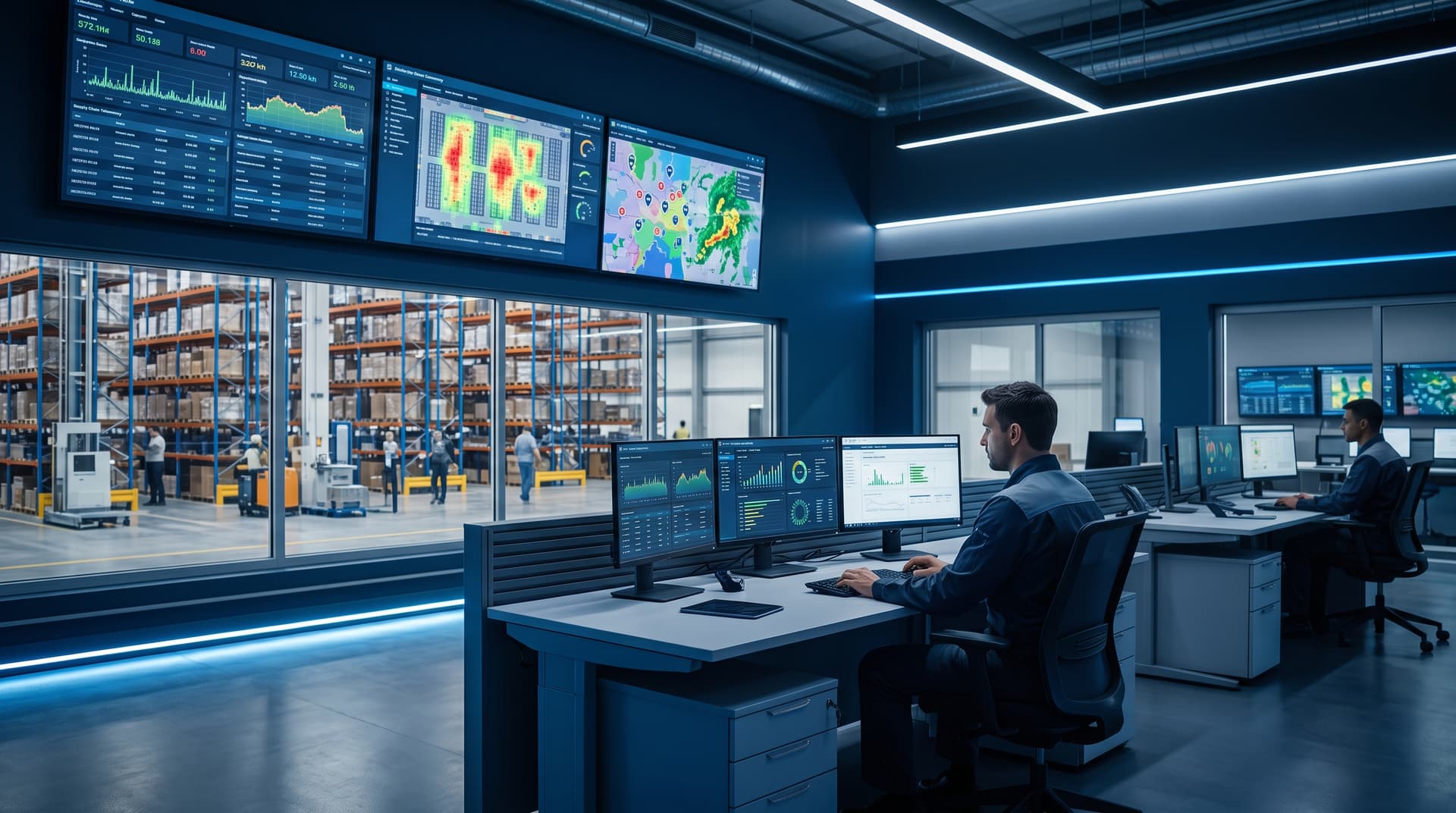
- Operational Monitoring and SLA Enforcement: Connect warehouse devices and infrastructure to centralized telemetry platforms like the Bitscaled Control Dashboard to track real-time network health, system latency, and terminal session uptime.
Elevate Your Distribution Reliability
In modern supply chain management, throughput velocity depends directly on the reliability of underlying technology infrastructure. By eliminating scan gun dropouts, minimizing application latency, maintaining 24/7 technical support, and building resilient disaster recovery capabilities, distribution hubs can guarantee consistent dispatch execution under any operational conditions.
Improve dispatch and warehouse uptime with Bitscaled. Explore tailored industry solutions at Bitscaled Logistics & Warehousing or speak directly with our supply chain infrastructure experts through our Contact Page.