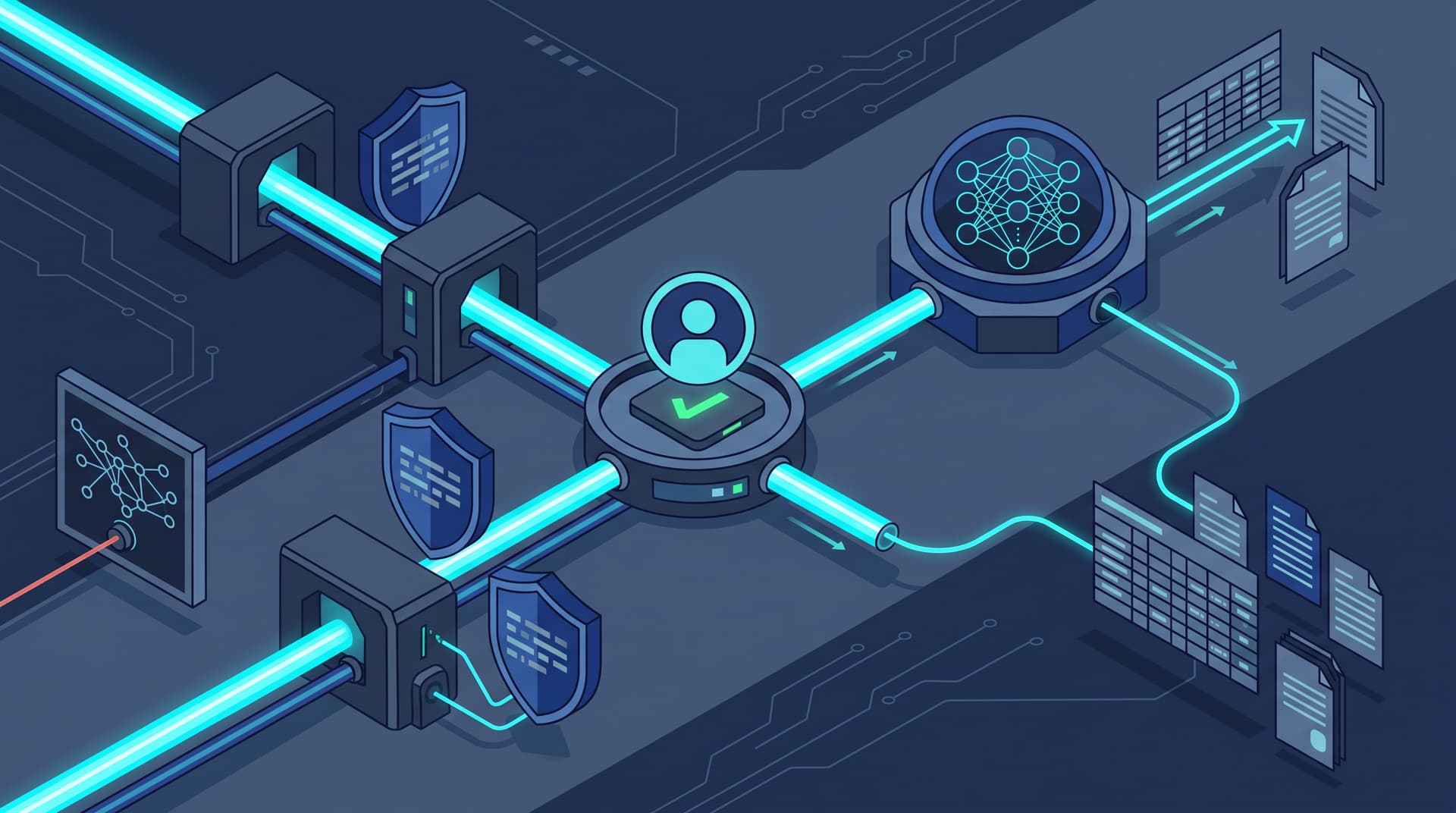
Governing AI Automation in MSP Operations: Data Boundaries, Human Approvals, and Connector Security
The rapid proliferation of generative artificial intelligence has presented Managed Service Providers (MSPs) and enterprise IT leaders with a dual mandate: accelerate operational efficiency or risk falling behind, while simultaneously maintaining rigid control over corporate and client data. Early adoption cycles were frequently characterized by fragmented experimentation and ad-hoc script integration—practices that inadvertently introduced shadow IT, unmonitored API connections, and data leakage risks.
As organizations transition from casual testing to production-grade deployment, governance must be built directly into the workflow architecture rather than appended as an afterthought. Achieving governed AI adoption requires establishing clear data boundaries, enforcing mandatory approval flows, maintaining granular audit logging, and hardening connector security. Through Bitscaled AI Development services, enterprise leaders can deploy resilient AI workflows that deliver measurable operational velocity without compromising security postures.
The Governance Imperative: Core Pillars of Enterprise Control
Deploying AI workflows across enterprise infrastructure demands a security-first approach. Without strict controls, automated models can process sensitive telemetry, improperly modify system states, or expose confidential client communications. Governed adoption relies on four foundational operational pillars:
1. Hardened Data Boundaries
Data boundaries define where information can flow and how long it persists. In a governed environment, enterprise data passed to large language models (LLMs) must remain strictly isolated within defined tenant boundaries.
- Zero-Retention Guarantees: Ensuring API endpoints utilized for processing operational workflows operate under strict zero-data-retention agreements, preventing model providers from training on client telemetry or proprietary ticket data.
- Client Data Segregation: Enforcing cryptographic or logical partitioning between distinct tenant contexts so that contextual retrieval engines never leak data across organizational lines.
- Data Masking and Anonymization: Stripping Personally Identifiable Information (PII), API keys, and credential patterns at the ingress gateway before prompts are transmitted to inference engines.
2. Human-in-the-Loop Approval Flows
Autonomous execution is appropriate for low-risk read actions, but write actions affecting infrastructure, client billing, or contract commitments require deterministic gates.
- Risk-Tolerant Automation: Low-risk actions (e.g., generating draft summaries) execute automatically, while high-impact actions (e.g., executing power scripts, changing ticket statuses, or modifying account tiers) require human approval.
- Contextual Escalation: Automated workflows present structured recommendations alongside confidence scores, enabling human operators to accept, modify, or reject actions within existing workspace interfaces like the Bitscaled Dashboard.
3. Granular Audit Logging and Lineage
Compliance frameworks require comprehensive traceability for every automated action.
- Prompt and Payload Telemetry: Logging exact input prompts, retrieved context blocks, model versions, and raw output responses in immutable audit stores.
- Execution Lineage: Tracking the precise sequence of events from initial trigger to human review and final API call execution.
- Anomaly Monitoring: Tracking sudden shifts in request volumes, token usage, or unexpected error rates to flag potential automated workflow drift.
4. Connector Security and Scoped Access
AI workflows interact with the enterprise tech stack via connectors and APIs. Weak connector design converts an isolated AI model into an unmonitored administrative vector.
- Least-Privilege Scoping: Granting connectors only the explicit API permissions required for their specific function rather than broad tenant-wide administrative privileges.
- OAuth 2.0 and Short-Lived Tokens: Eliminating static API keys in favor of dynamic authentication flows managed through centralized secret management services.
- Egress Filtering: Restricting connector outbound requests to explicit domain allowlists to mitigate server-side request forgery (SSRF) and data exfiltration vectors.
Three Real-World MSP Use Cases and Their Risk Profiles
Enterprise clients and MSP operations teams consistently ask for AI integration across three primary operational areas. While each delivers significant productivity gains, each carries specific operational and security risks that require governance controls.
Use Case 1: Automated Ticket Triage and Routing
- Operational Goal: Process incoming helpdesk requests, extract key entities, classify urgency, and assign tickets to the appropriate engineering queue to optimize service level agreements (SLAs).
- The Operational Value: Reduces initial triage time from hours to seconds, allowing tier-1 engineers to focus immediately on resolution rather than manual categorization.
- Associated Risks:
- Prompt Injection Attacks: Malicious actors may submit ticket text specifically crafted to override systemic instructions, triggering unauthorized escalation or execution of administrative webhooks.
- Hallucinated Priority Escalation: Incorrect classification of routine requests as critical outages, leading to alert fatigue and inefficient engineer utilization.
- Governance Controls: Input sanitization pipelines scrub incoming ticket text of control sequences before model evaluation. Ticket priority shifts that trigger emergency paging must pass through human-in-the-loop review or strict validation rules within Bitscaled Ticket Management.
Use Case 2: Document and Contract Summarization
- Operational Goal: Ingest lengthy Master Services Agreements (MSAs), statements of work (SOWs), or vendor security documentation to generate executive briefs and identify non-standard liability clauses.
- The Operational Value: Speeds up account management and legal review cycles, allowing team leaders to parse complex technical and financial commitments in minutes.
- Associated Risks:
- Confidentiality Breaches: Routing unencrypted client contracts to public consumer LLM endpoints, exposing confidential terms and proprietary architectures.
- Omission of Critical Terms: Models hallucinating or missing subtle legal qualifiers (e.g., indemnification caps or auto-renewal windows), leading to misinformed executive decisions.
- Governance Controls: Summarization is strictly routed through private enterprise model instances with zero retention policies. Generated summaries display inline citations linking directly to source paragraph clauses, requiring account managers to verify flagged terms before agreement sign-off.
Use Case 3: CRM and Service Desk Data Enrichment
- Operational Goal: Aggregate external public intelligence, technographic data, and domain records to enrich client profiles in CRM and service desk systems automatically.
- The Operational Value: Equips account managers and vCIOs with real-time operational context during quarterly business reviews without requiring manual research.
- Associated Risks:
- Data Overwrites: Unverified external web scraping data automatically overwriting validated primary records in the CRM database.
- Scope Creep in Write Operations: Connectors granted broad database update rights accidentally altering billing structures or primary contacts.
- Governance Controls: AI enrichment outputs are deposited into staging fields rather than directly updating core database entities. Connectors operate using read-only API credentials combined with scoped write webhooks restricted exclusively to the staging tables.
Governance Control Comparison
The following matrix illustrates how operational guardrails are applied across common MSP automation scenarios:
| Automation Use Case | Primary Security / Operational Risk | Mandatory Control Boundary | Human Approval Requirement |
|---|---|---|---|
| Ticket Triage & Routing | Prompt injection, queue misclassification | Strict input sanitization & SLA logic gates | Required for emergency SLA escalation |
| Document Summarization | Data exposure, missed contractual terms | Zero-retention enterprise endpoints | Mandatory sign-off prior to contract execution |
| CRM Data Enrichment | Database overwrites, scope creep | Staging table segregation & read-only keys | Manual approval for core record updates |
Takeaway: AI workflow automation delivers sustainable enterprise ROI only when data boundaries, connector scoping, and human approval gates are architected into the system from day one.
Operationalizing Governed AI Adoption with Bitscaled
Achieving governed AI adoption requires moving beyond fragmented point solutions to a unified orchestration framework. Organizations seeking to deploy scalable AI automation must adopt a structured implementation methodology:
- Taxonomy & Boundary Mapping: Define precise data classification tiers and identify sensitive data types that require pre-processing sanitization.
- Connector Hardening: Audit existing API credentials across ticket systems, CRMs, and monitoring tools, converting static keys to short-lived scoped tokens.
- Workflow Integration & Gate Placement: Integrate automated intelligence agents alongside deterministic workflow logic, placing human approval steps at critical operational control points via Bitscaled Platform Governance.
- Continuous Telemetry & Audit Analysis: Implement immutable logging and real-time monitoring to detect workflow drift, schema changes, or unexpected model responses.
By establishing strict guardrails around data ingress, model processing, and execution connectors, enterprise leaders can unlock the full potential of AI automation while maintaining uncompromised operational security.
Take the Next Step in Governed AI
Ready to modernize your operations without exposing sensitive client data? Talk to Bitscaled about AI workflow pilots with guardrails and measurable ROI.