Sustainable Digital Modernization: A Phased Approach to SMB Operational Change
For growing businesses and mid-market organizations, the traditional promise of digital transformation often arrives wrapped in an all-or-nothing proposition. Legacy software vendors and traditional consultancies frequently champion massive, multi-year "big-bang" replatforming initiatives—projects that promise to replace every legacy application, database, and operational workflow in one heroic cutover.
Yet, historical experience across mid-market enterprise IT tells a strikingly different story. Multi-year monolithic migrations carry immense risk. They lock capital into long developmental cycles before producing any tangible operational value. Crucially, they alienate the very teams expected to use the new systems by dumping massive, disruptive change upon them all at once. When adoption fails, leadership is left with astronomical budget overruns, custom code technical debt, and zero net improvement in core operational yield.
At Bitscaled, we advocate for a pragmatic alternative: phased digital modernization. By breaking complex systems into modular, value-driven releases, mid-market executives can modernize core architecture, de-risk software delivery, and measure real-world adoption at every stage.
The Trap of Big-Bang Replatforming vs. Phased Modernization
Why do so many ambitious transformation programs stall mid-flight? The root cause is rarely technical incompetence; rather, it is structural misalignment between project scope, organizational risk tolerance, and human change management capacity.
When a mid-market enterprise commits to a single massive cutover, several structural failure points emerge:
- Extended Time-to-Value: Operations remain tied to legacy bottlenecks for 18 to 36 months while engineering teams build behind closed doors.
- Defensive Organizational Resistance: Employees spend months anticipating a sudden total overhaul of their daily workflows, creating anxiety, pushback, and passive resistance.
- Compounding Scope Creep: As business requirements evolve during a multi-year development cycle, initial requirements become obsolete before code ever touches production.
- All-or-Nothing Cutover Risk: A single failed integration or unexpected edge case on launch day can halt manufacturing lines, stall billing cycles, or corrupt customer records.
Modernizing through incremental, modular delivery flips this equation completely. Instead of waiting years for a hypothetical payoff, organizations realize operational efficiency gains within weeks or months. Each release targets a specific business bottleneck—such as automated order intake, legacy database synchronization, or consolidated executive dashboards—allowing teams to validate performance and adjust course before moving to the next operational domain.
Operational Maturity Model: Self-Scoring Your Organization
To implement a pragmatic modernization strategy, leadership must first assess current operational capabilities. The following illustrative qualitative maturity model provides a framework for SMB and mid-market executives to self-evaluate across four critical dimensions: System Architecture, Data Integration, Change Readiness, and Adoption Measurement.
Illustrative SMB Modernization Maturity Framework
| Maturity Level | System Architecture | Data Integration | Change Management & Readiness | Adoption Measurement |
|---|---|---|---|---|
| Level 1: Ad-Hoc / Reactive | Monolithic legacy desktop software or legacy spreadsheets; high technical debt. | Manual data entry across disconnected silos; duplicate spreadsheets. | Minimal formal communication; training occurs reactively after issues arise. | No metrics tracked; success judged informally by lack of user complaints. |
| Level 2: Standardized | Cloud-hosted applications with isolated operational databases. | Point-to-point batch synchronization or manual file imports/exports. | Scheduled department briefings and standardized documentation. | System logins and baseline usage metrics tracked monthly. |
| Level 3: Orchestrated | Modular service layers with API integrations connecting core functions. | Real-time event-driven data flows across operational business units. | Iterative user champion networks, role-specific onboarding, and active feedback loops. | Feature-level user engagement, workflow completion rates, and error frequencies monitored. |
| Level 4: Optimized | Cloud-native, microservices or event-driven architecture with high flexibility. | Unified data mesh or warehouse; real-time operational analytics. | Continuous change integration; agile feedback embedded into workflow updates. | Quantitative yield tracking, business cycle time reduction, and proactive usability optimization. |
Takeaway: Modernization is not about jumping overnight from Level 1 to Level 4 across your entire IT stack. True success lies in elevating specific, high-friction business functions by one level at a time, ensuring employee adoption keeps pace with technical deployment.
Scoring Your Current Capabilities (Self-Assessment Checklist)
To evaluate where your organization currently stands, run this practical operational audit across your leadership and department heads:
- Data Flow Continuity: Can data travel from initial customer request to billing without manual copy-pasting across disparate screens?
- System Decoupling: Can a single core system (e.g., inventory or CRM) be updated or replaced without breaking three other dependent internal applications?
- Feedback Frequency: Do software users have a direct, structured mechanism to report friction and influence workflow improvements each sprint?
- Adoption Telemetry: Does leadership have visibility into exact feature usage and process bottlenecks, or rely solely on subjective feedback?
- Release Cadence: Can your technology team or engineering partner ship small, functional operational improvements bi-weekly rather than quarterly or annually?
Structuring the Phased Delivery Pipeline
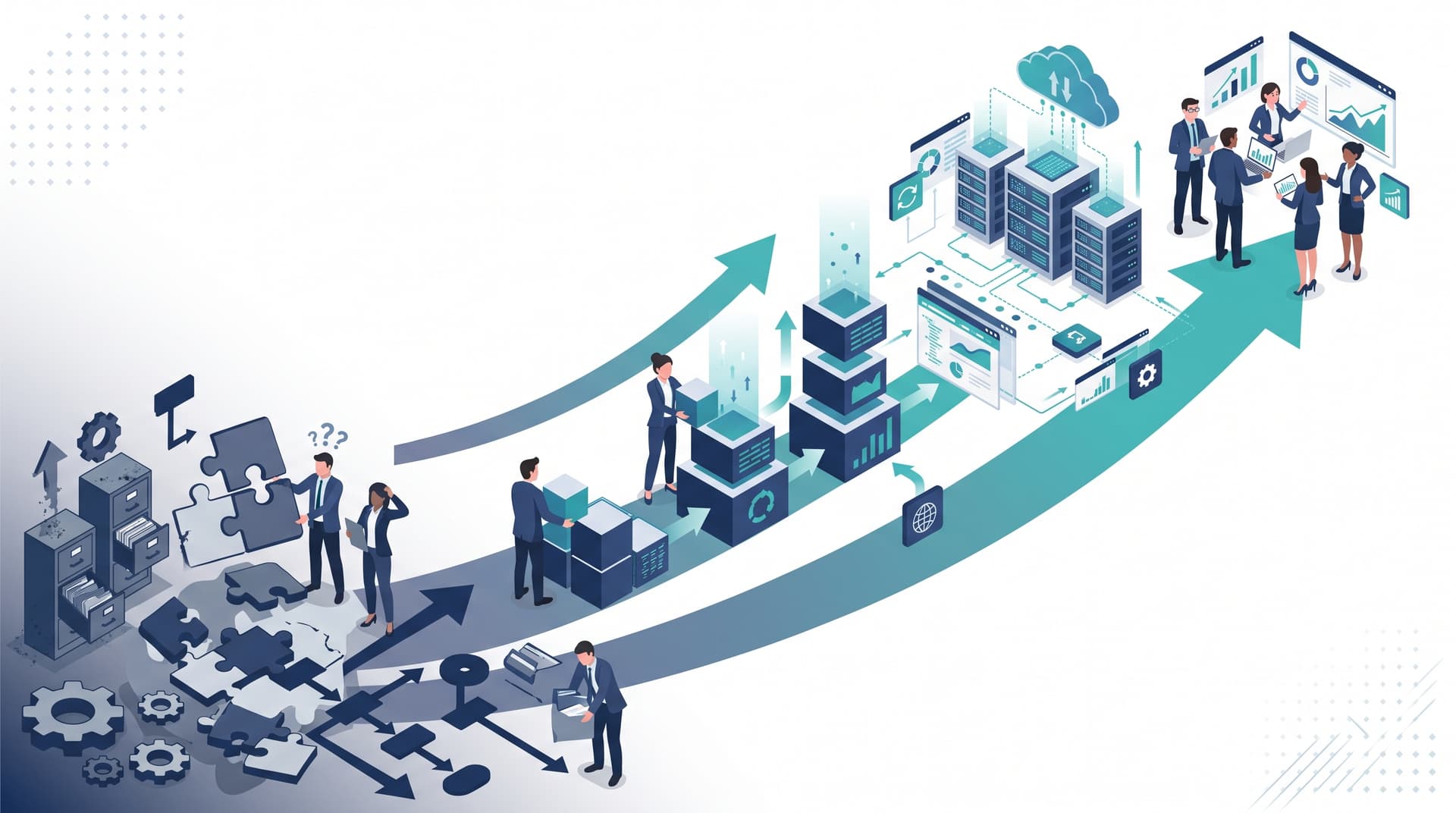
Executing an incremental modernization strategy requires a disciplined release pipeline that prioritizes high-value, low-risk operational wins early. This builds executive confidence and creates organizational momentum.
+-------------------------------------------------------------------+
|                     PHASED MODERNIZATION ROADMAP                  |
+-------------------------------------------------------------------+
|                                                                   |
| [ Phase 1: Operational Discovery & API Decoupling ]               |
|   • Map core business workflows & identify high-friction bottlenecks|
|   • Wrap legacy databases with secure API layers                  |
|                                                                   |
| [ Phase 2: Targeted High-Yield Workflow Modernization ]            |
|   • Re-architect high-friction UI/UX for primary operators         |
|   • Implement real-time automated validation & data synchronization|
|                                                                   |
| [ Phase 3: Change Management & User Champion Acceleration ]       |
|   • Run targeted pilot groups with operational team champions     |
|   • Gather telemetry on task completion speeds & user friction     |
|                                                                   |
| [ Phase 4: System Refinement & Enterprise-Wide Scale ]            |
|   • Retire legacy operational silos systematically                |
|   • Expand integration layers across secondary departments         |
|                                                                   |
+-------------------------------------------------------------------+
1. Scoping by Value Streams
Rather than modernizing by department or application, organize projects around cross-functional value streams—such as Order-to-Cash, Procure-to-Pay, or Customer Onboarding. Focus engineering resources on the single sub-process causing the greatest operational delay.
2. Modernizing via the Strangler Fig Pattern
Rather than rewriting legacy databases from scratch, place secure API wrapper layers around existing infrastructure. New cloud applications can read and write to these wrappers while legacy logic continues running uninterrupted. Over time, core services are migrated piece by piece until the legacy core can be safely decommissioned without downtime.
Operational Change Management: Driving Measurable User Adoption
A common misconception in digital transformation is that operational friction is purely a technical problem. In reality, the success of software engineering depends heavily on human behavior. If frontline workers find a modern interface confusing or feel alienated by sudden workflow changes, they will seek workarounds, keep offline spreadsheets, or revert to manual processes.
Effective change management is not a communications email blast sent the day before software rollout; it is an active discipline integrated into every development cycle.
Embedded Champion Networks
Identify power users in each department early during the discovery phase. Involve these internal champions in interface reviews, workflow testing, and acceptance validation. When frontline workers see their peers actively shaping the software tools, organizational trust rises dramatically.
Continuous Telemetry and Feedback Loops
Build user analytics directly into application workflows. Track key metrics such as:
- Task Completion Time: How long does an operator spend processing a single record compared to the legacy system?
- Error and Exception Rates: Where are users dropping off or making entry errors?
- Active Workflow Usage: Are employees adopting the new automated features or falling back on legacy manual exports?
By analyzing this objective telemetry alongside qualitative user feedback, product teams can refine user interfaces, eliminate friction points, and deliver targeted training where it is needed most.
Measuring Transformation ROI Beyond Code Velocity
In traditional IT projects, success is often evaluated by software metrics: lines of code committed, story points delivered, or system uptime. For business executives, however, these metrics offer little insight into actual enterprise performance.
True digital transformation ROI must be measured through operational yield and enterprise velocity:
- Cycle Time Reduction: Measuring the elapsed time required to execute a complete core business process before and after software deployment.
- Operational Error Rates: Quantifying the reduction in manual rework, misplaced orders, or data reconciliation errors.
- User Onboarding Time: Tracking how quickly new staff can become fully productive using modern, intuitive interfaces versus complex legacy software.
- License and Infrastructure Arbitrage: Consolidating redundant third-party software subscriptions and legacy server maintenance costs as decoupled modules replace old platforms.
Partnering with Bitscaled for Outcome-Focused Transformation
Modernizing enterprise software does not require multi-year downtime, multi-million dollar write-offs, or high-stress system cutovers. By combining disciplined software engineering, modular cloud architecture, and embedded operational change management, mid-market organizations can achieve dramatic operational improvements in manageable, high-yielding iterations.
At Bitscaled, our digital transformation consulting services help business leaders design, execute, and scale pragmatic modernization roadmaps tailored to their unique operational needs. Whether you are looking to decouple legacy monolithic databases, automate complex cross-functional workflows, or build custom cloud applications, our team delivers high-impact systems that your workforce will actually adopt.
Ready to de-risk your enterprise technology strategy? Plan a phased modernization roadmap with Bitscaled today or explore our broader software development capabilities.