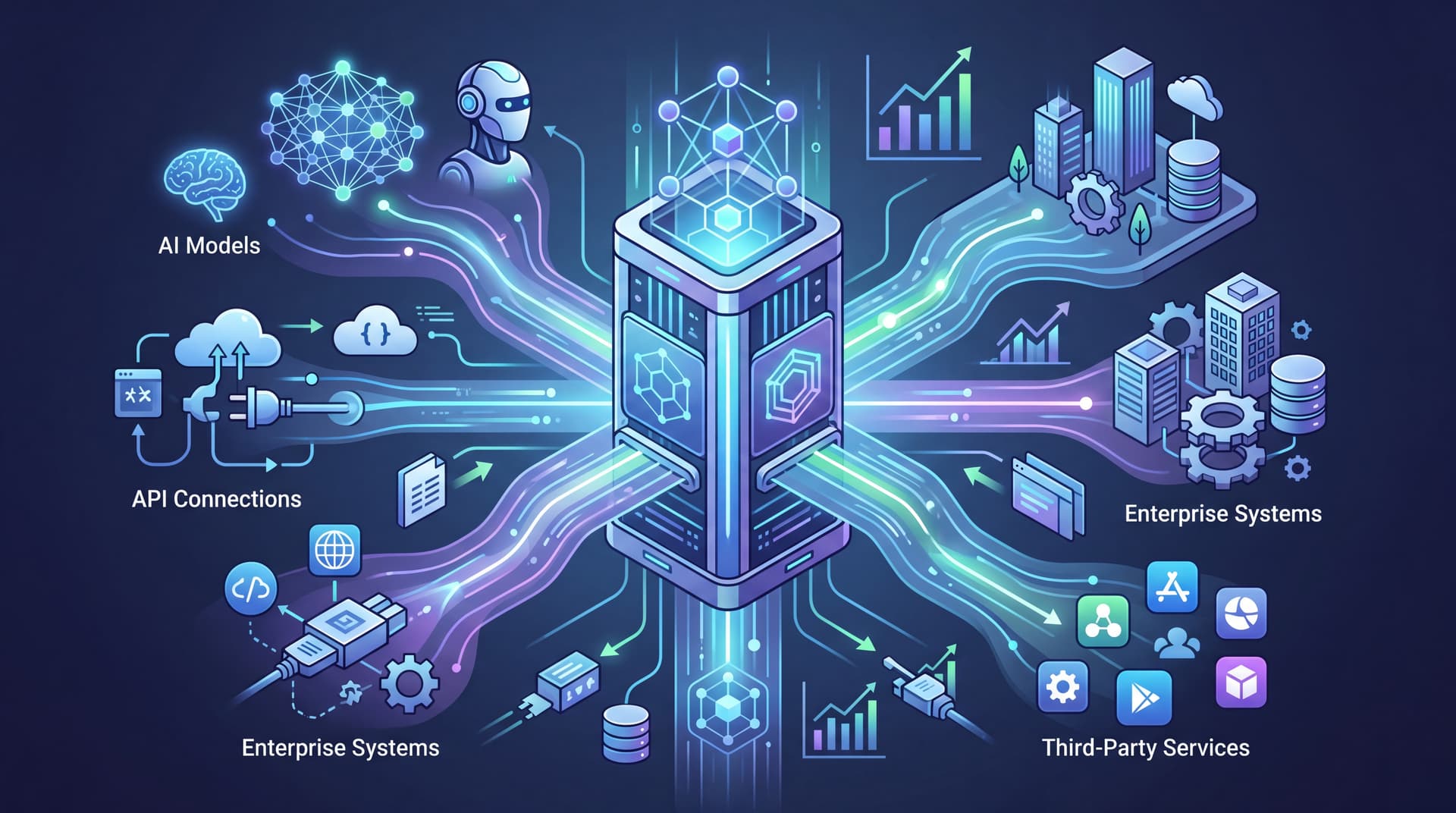
Introduction to Model Context Protocol (MCP) Servers
In the rapidly evolving landscape of artificial intelligence, enterprises face a critical challenge: how to seamlessly integrate AI models with their diverse data sources, APIs, and internal systems. Enter the Model Context Protocol (MCP), an open-source standard introduced by Anthropic in November 2024 that is revolutionizing how organizations connect AI applications to external tools and resources.
MCP servers represent a paradigm shift in AI infrastructure, providing a standardized, secure, and scalable way to bridge the gap between large language models (LLMs) and the enterprise ecosystem. For IT Managed Service Providers (MSPs) and businesses looking to leverage AI capabilities, understanding MCP servers is no longer optional—it's essential.
What Are MCP Servers?
At its core, an MCP server is a standardized interface that acts as a gateway between AI models and external services. Think of it as a universal translator that allows AI applications to communicate with databases, APIs, cloud services, and internal tools through a common protocol.
The Model Context Protocol follows a client-server architecture where:
- MCP Host: The AI application (such as Claude Desktop, custom AI agents, or enterprise chatbots)
- MCP Client: Lives within the host and manages communication with MCP servers
- MCP Server: The external service that provides context, data, or capabilities to the AI model
This architecture ensures clean separation of concerns: the AI model focuses on reasoning and language processing, while MCP servers handle data retrieval and action execution.
How MCP Servers Work: Architecture Deep Dive
Communication Layer
MCP servers utilize JSON-RPC (Remote Procedure Call) as their primary communication protocol, enabling structured, bidirectional communication between clients and servers. The protocol supports two main transport mechanisms:
Stdio Transport: Uses standard input/output streams for local process communication, ideal for same-machine operations with minimal latency and no network overhead.
Streamable HTTP Transport: Enables remote server communication through HTTP POST requests with optional Server-Sent Events (SSE) for real-time streaming capabilities. This transport supports standard authentication methods including OAuth, bearer tokens, and API keys.
Key Components of MCP Server Architecture
- Request Handlers: Process incoming requests from MCP clients and route them to appropriate internal functions
- Context Stores: Maintain session state and contextual information across interactions
- Session Orchestrators: Manage multiple concurrent connections and handle authentication
- Caching Layers: Optimize performance by storing frequently accessed data
- Tool Registry: Exposes available functions and capabilities to connected clients
Request Flow
When a user interacts with an MCP-enabled AI application, the following sequence occurs:
- The user makes a request (e.g., "Show me today's customer analytics")
- The MCP host analyzes the request and determines which server capabilities are needed
- The MCP client sends a JSON-RPC request to the appropriate server
- The server validates the request, executes the necessary operations (database queries, API calls, etc.)
- The server returns structured results to the client
- The client passes the data back to the AI model
- The AI model processes the information and generates a natural language response
MCP Servers and API Integration
One of MCP's most powerful features is its ability to streamline API integration for AI applications. Traditional approaches required developers to write custom integration code for every API endpoint, creating maintenance nightmares and duplicated effort.
Simplified API Connectivity
MCP servers transform this process by:
Standardized Interface: Developers define API connections once using OpenAPI specifications or simple tool definitions, and the MCP server handles all communication details.
Automatic Tool Discovery: MCP clients can query servers to discover available tools and their parameters dynamically, enabling flexible integrations without hardcoded dependencies.
Authentication Management: MCP servers handle OAuth flows, API key management, and token refresh logic, centralizing security concerns away from the AI application layer.
Error Handling: Built-in retry logic, rate limiting, and error translation ensure robust API interactions even when external services have issues.
Real-World API Integration Examples
Organizations are implementing MCP servers to connect AI agents with:
- CRM Systems: Salesforce, HubSpot integration for customer data retrieval and lead management
- Databases: MongoDB, PostgreSQL, ClickHouse for natural language database queries
- Cloud Services: AWS, Azure, Google Cloud for infrastructure management
- Development Tools: GitHub, GitLab for code repository operations
- Communication Platforms: Slack, Microsoft Teams for automated messaging
- Data Processing: Apache Kafka, Confluent for real-time data stream management
Enterprise Adoption and Implementation Trends
The adoption of MCP servers across enterprises has accelerated dramatically in 2025, driven by the need for standardized AI integration frameworks.
Current Adoption Statistics
As of Q1 2025, approximately 28% of Fortune 500 companies have implemented MCP servers in their AI infrastructure, up from just 12% in 2024. The adoption varies significantly by industry:
- Financial Services: 45% adoption rate, driven by needs for secure, compliant AI integrations with banking systems and fraud detection tools
- Healthcare: 32% adoption, enabling AI diagnostic tools to connect securely with Electronic Health Record (EHR) systems while maintaining HIPAA compliance
- E-commerce: 27% adoption, powering personalized recommendation engines and customer service automation
- Technology Sector: 38% adoption, with development teams using MCP for code assistance and automated testing
Why Companies Are Implementing MCP Servers
Organizations are gravitating toward MCP for several compelling reasons:
Reduced Development Time: Companies report an average 40% reduction in development time for AI integration projects, as MCP eliminates the need to build custom connectors for each data source.
Enhanced Security: Centralized authentication and authorization through MCP servers enable consistent security policies across all AI interactions, with built-in OAuth/OIDC support and role-based access control (RBAC).
Improved Scalability: MCP servers can be containerized and deployed behind load balancers, enabling enterprises to handle thousands of concurrent AI agent requests with predictable latency.
Better Governance: Centralized metrics, logging, and audit trails provide visibility into AI agent behavior and data access patterns, crucial for compliance and risk management.
Accelerated Innovation: Reusable MCP servers enable teams to launch new AI use cases rapidly by simply defining new tools or resources without reinventing integration logic.
Major Platform Support
The ecosystem around MCP has exploded, with major technology providers offering native support:
- Anthropic: Built-in MCP support in Claude Desktop and Claude API
- Microsoft: Azure's MCP offerings enable enterprise-scale deployments with integrated security
- OpenAI: Platform support for MCP-compatible integrations
- Google: Integration capabilities through Google Cloud Platform
- Confluent: Real-time data streaming integration with Kafka through MCP servers
- MongoDB: Native MCP server for AI-powered database queries
Implementation Patterns
Enterprises are deploying MCP servers in several common patterns:
Centralized Gateway Architecture: A single MCP gateway serves as the entry point for all AI agent interactions, providing unified security, monitoring, and governance.
Federated Deployment: Multiple domain-specific MCP servers (finance, HR, operations) operate independently with coordinated governance policies.
Hybrid Approach: Critical or sensitive operations run through on-premises MCP servers, while less sensitive integrations utilize cloud-based servers.
Edge Deployment: MCP servers deployed at the edge for low-latency AI interactions, particularly in retail and IoT applications.
Best Practices for MCP Server Implementation
For organizations looking to implement MCP servers, consider these strategic recommendations:
Security and Compliance
- Implement OAuth 2.0 or OIDC for authentication
- Use role-based access control to limit tool access based on user permissions
- Enable comprehensive audit logging for compliance requirements
- Implement rate limiting to prevent abuse
- Use encryption for data in transit and at rest
Performance Optimization
- Deploy caching layers for frequently accessed data
- Use connection pooling for database integrations
- Implement request queuing for high-volume scenarios
- Monitor latency metrics and set SLAs
- Consider geographic distribution for global deployments
Operational Excellence
- Containerize MCP servers for easy deployment and scaling
- Implement health checks and automated recovery
- Use infrastructure-as-code for reproducible deployments
- Establish centralized monitoring with tools like Prometheus or Datadog
- Create comprehensive documentation for available tools and resources
Governance and Management
- Maintain a centralized catalog of available MCP servers
- Implement discovery mechanisms for internal teams
- Establish approval workflows for new server deployments
- Define data classification policies for sensitive information
- Create cross-functional governance committees
The Future of MCP Servers
The MCP ecosystem continues to evolve rapidly with several emerging trends:
Multi-Modal Data Handling: Enhanced support for images, video, and audio processing through MCP interfaces
Edge Computing Integration: Optimized protocols for edge-based AI processing with 50% latency reduction targets
Quantum-Safe Encryption: Preparation for post-quantum cryptography standards
Automated Protocol Evolution: Self-updating capabilities that adapt to changing API specifications
Enhanced Observability: Advanced tracing and debugging tools for complex multi-server interactions
Conclusion
MCP servers represent a fundamental shift in how organizations approach AI integration. By providing a standardized protocol for connecting AI models with enterprise systems and APIs, MCP eliminates fragmentation, reduces complexity, and accelerates innovation.
For IT MSPs and enterprises, embracing MCP technology offers significant advantages: faster time-to-market for AI initiatives, improved security posture, better scalability, and reduced operational overhead. As adoption continues to grow—with the AI server market reaching $95.2 billion and 134% year-over-year growth—MCP servers are positioned to become the de facto standard for AI infrastructure.
The question for forward-thinking organizations is no longer whether to adopt MCP, but how quickly they can implement it to gain competitive advantage in an AI-driven business landscape. By understanding MCP architecture, API integration patterns, and implementation best practices, businesses can position themselves at the forefront of the AI revolution while maintaining security, governance, and operational excellence.